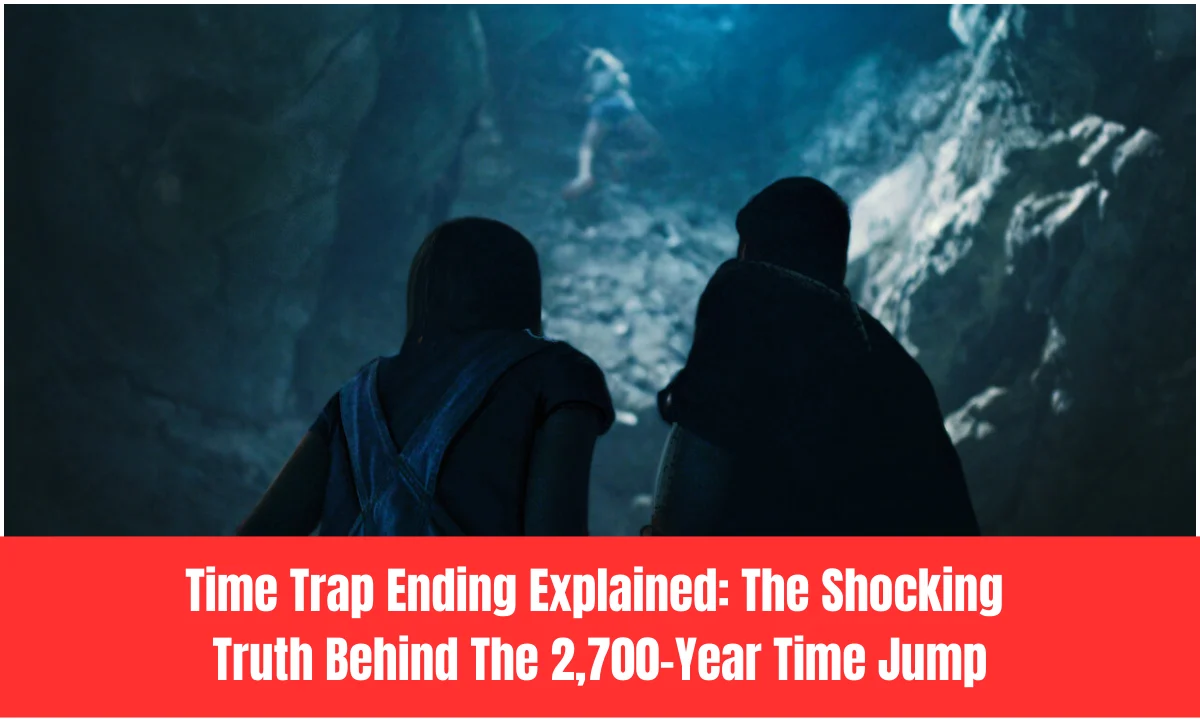
When you watch the movie Time Trap At first look the movie looks like a small-scale sci-fi thriller about students searching for their missing professor in a remote cave. But as the story proceeds & at the time of ending when credits roll the story has quietly stretched across thousands of years.
What starts as a rescue mission of professor turns into a massive time jump that changes the destiny of every character. The confusion around the ending usually comes from how casually the film reveals its biggest twist.
The group is inside the cave for only a few hours. But outside, hundreds or even thousands of years pass. That means when they finally come out, the world they knew is already gone.
When the futuristic humans rescue them and take them to the space. The story is not just about saving their lives. It shows that Earth has changed completely and humanity has moved on.
To understand the ending properly, we need to look at three things.
How time works inside the cave? What the healing Fountain really does? And what that final spaceship scene tells us about the future?
Key Takeaways
- Time inside the cave moves drastically slower than outside
- Roughly 3 hours inside equals over 2,700 years on Earth
- The Fountain of Youth is real and tied to the healing pool
- Future humans rescue the group using advanced technology
- Earth is largely abandoned and humanity has colonized space
- The cave acts as layered time zones, each slower than the last
- The ending is optimistic but leaves major unanswered questions
The Premise Of Time Trap: A Quick Recap
Time Trap that is Directed by Mark Dennis and Ben Foster, and starring Andrew Wilson as Hopper, Time Trap follows a group of college students searching for their missing archaeology professor.
Hopper was investigating legends about the Fountain of Youth linked to hippies who vanished in the 1970s. The trail leads to a remote cave in Texas. Inside that cave, things get weird very fast.
They discover:
- A cowboy frozen in near motion
- Cavemen who appear stuck in time
- Conquistadors fighting over a mysterious pool
- Light at the cave entrance flashing like a strobe
At first it looks supernatural. Later we understand it is physics. Or at least sci-fi physics.
The Cave And The Concept Of Time Dilation
Here’s where the film gets interesting.
Time inside the cave moves slower than outside. Not slightly slower. Insanely slower.
From visual clues in the movie:
- 4 seconds inside the cave equals 1 year outside
- One seasonal cycle flashes every few seconds
- The deeper you go, the slower time moves
So when Hopper briefly exits the cave early in the movie and sees his car covered in growth, decades may have passed outside. When Cara climbs out later, Earth looks post-apocalyptic.
Let’s break down the approximate time math:
| Time Inside Cave | Time Outside Earth |
|---|---|
| 4 seconds | 1 year |
| 1 minute | 15 years |
| 1 hour | 900 years |
| 3 hours | 2,700+ years |
That means the group basically skipped nearly three millennia in one afternoon. That’s wild.
The cave also appears to have layered temporal zones. Each deeper section slows time further. The Fountain chamber is even slower than the upper cave. That explains why Hopper’s sister remains a child decades later from his perspective.
The Final Moments: What Really Happens?
Now let’s decode the ending.
As chaos unfolds near the Fountain, Hopper is gravely injured and Furby dies. It feels hopeless. Then suddenly, futuristic humans in advanced suits descend into the cave using high-tech cables and a ladder system.
These future humans:
- Retrieve the survivors
- Extract preserved bodies from deeper layers
- Bring them aboard a spaceship orbiting Earth
Here’s the emotional twist.
The healing water from the Fountain works. Furby is revived. Hopper recovers. Hopper’s parents and sister, preserved in deeper time layers, are reunited with him.
When the group wakes up on the spacecraft, Earth is no longer the same planet. Humanity has largely moved off-world. Colonization of Mars or other space settlements is implied.
The “trap” becomes a bridge to the future.
The Significance Of The Future Civilization Reveal
This is more than just a rescue scene. It shifts the entire theme of the movie.
The future humans are not aliens. They are evolved descendants of humanity. Thousands of years more advanced. Their technology allows them to:
- Navigate time distortions
- Survive altered atmospheres
- Access the cave safely
The triangular structure seen earlier in the sky is likely a massive orbital station. Humanity did not go extinct. It adapted.
There is also something subtle here. The future humans seem fascinated by the 21st-century survivors. From their perspective, these people are ancient artifacts. Living history.
The cave may have eventually been studied and harnessed as:
- A preservation chamber
- A scientific anomaly
- A potential immortality tool
The Fountain of Youth legend turns out to be partially true. Not magic. Just extreme time distortion combined with regenerative water.
Theories And Interpretations: Unpacking Hidden Meanings
Now let’s talk deeper interpretations.
1. The Cave As A Time Vault
One popular theory suggests the cave became a natural time vault. Future civilizations may have studied it for centuries before figuring out how to enter safely.
Some fans speculate the rescue was triggered by signals from the group’s equipment, possibly the satellite phone.
2. Why Did Future Humans Intervene Then?
The movie never clearly explains why the rescue happens at that exact moment.
Possible explanations:
- They finally mastered access technology
- The cave was about to destabilize
- They detected movement or energy spikes
The ambiguity adds mystery but also leaves loose ends.
3. The Emotional Gap
One criticism many viewers point out is how quickly the group accepts their fate.
Think about it. In a few hours they lose:
- Their era
- Their friends outside
- Their planet as they knew it
- Their entire civilization
Yet they adjust surprisingly fast.
You could argue shock. Or survival instinct. Or the emotional relief of being alive. Still, realistically, it should hit harder.
4. Why Not Save Everyone?
Another debated question.
Why did future humans rescue the main group but seemingly ignore:
- Cavemen
- The cowboy
- Conquistadors
Some viewers believe they did rescue others off-screen. The cables branching through tunnels suggest broader extraction efforts. The film just focuses on our main characters.
Public Opinion: What Viewers Are Saying
Looking at online discussions, audience reactions are split but passionate.
Many viewers say:
- The concept is brilliant
- The time mechanics are addictive to think about
- The low budget surprisingly works
Others criticize:
- The acting quality
- Plot holes about oxygen and physics
- The emotional realism
But one thing is clear. People keep thinking about this movie long after it ends. That alone gives it strong rewatch value.
An Open-Ended Finale: Is There Room For A Sequel?
Technically yes. Unanswered questions include:
- What caused the cave anomaly? Natural or alien origin?
- How exactly did Earth collapse environmentally?
- How advanced are future humans biologically?
- Is the Fountain water now mass-produced?
A sequel could explore:
- Life on Mars colonies
- Ethical use of the cave
- Time tourism
- The long-term psychological effects on the rescued group
As of now, there is no confirmed sequel. But the ending clearly leaves space for continuation.
Conclusion: Why Understanding The Time Trap Ending Matters For Sci-Fi Fans
The ending of Time Trap transforms the movie from a survival thriller into a cosmic sci-fi story about evolution and rebirth.
In just a few hours of screen time, the characters leap over 2,700 years of human history. They lose everything. Yet they gain a second chance in a future civilization that survived against the odds. The cave was never just a trap. It was a gateway.
That mix of melancholy and hope is what makes the ending stick. Sure, the film has rough edges. But the time dilation mechanics, layered temporal zones, and futuristic rescue twist give it surprising depth.
If you love decoding movie endings and unpacking sci-fi concepts, this one is worth a rewatch. You notice more each time.