A Dark Rom-Com That Defies Expectations
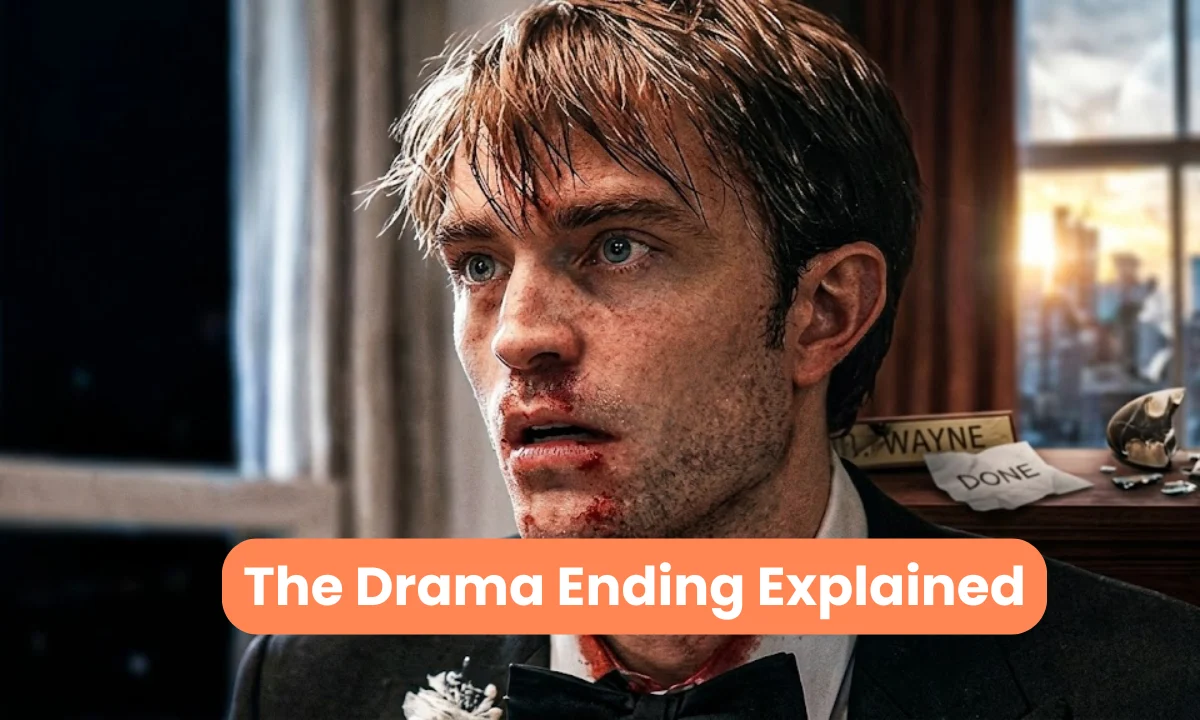
The Drama is a dark romantic comedy released in 2026 and directed by Kristoffer Borgli. It stars Zendaya as Emma and Robert Pattinson as Charlie. The story shows a couple planning their wedding, but everything changes when Emma shares a shocking secret from her teenage years.
The film has become popular because of its bold story and unexpected ending. Many viewers are talking about what the ending really means. Some people like it, while others feel confused or uncomfortable.
Movie deals with serious topics in a simple but strong way. It does not give clear answers or a happy ending. Instead, it makes people think about love, forgiveness, and how much we can accept from someone we care about.
Director Kristoffer Borgli said that every viewer can understand the ending in their own way. There is no single correct meaning, and that is why the movie feels different to everyone.
Table of Contents
The Drama Ending Explained: What Is the Big Twist
The central twist of The Drama occurs approximately 15 to 20 minutes into the film. During a dinner with friends, Emma confesses that when she was 15 years old, she planned a school shooting. This revelation comes during a game where everyone shares the worst thing they have ever done.
Emma’s confession is detailed and disturbing. She explains that she was a lonely, awkward teenager with no friends who was being bullied at school. She planned to use her father’s gun to carry out the attack. She even practiced shooting in the woods, which caused her to lose hearing in one ear from a ruptured eardrum. She had created a manifesto and was prepared to go through with her plan.
The reason she did not carry out the shooting was not due to a moral awakening. Instead, another mass shooting occurred at a local mall the same week, killing a classmate. In the aftermath, Emma was drawn into a gun control advocacy group at her school, made friends, and abandoned her plan. She describes this pivot as waking up from a bad dream.
This twist is significant because it happens so early in the film. Rather than being a traditional third-act revelation, Emma’s confession serves as the catalyst for everything that follows. The movie is not about the secret itself but about how Charlie processes this information and whether their relationship can survive it.
The confession creates immediate tension among the group. Rachel, whose cousin was paralyzed in a mass shooting, reacts with anger and cuts Emma out of her life. Mike attempts to be conciliatory. Charlie is stunned and begins to question everything he knows about his fiancée.
The coincidental timing of another shooting created a situation where Emma could redirect her anger and isolation into activism. She became a leader in the gun control group, which gave her the social connection and purpose she had been lacking. This transformation was pragmatic rather than moral.
Emma insists that she is a changed person. She has built a life as an activist and has not shown any violent tendencies since her teenage years. However, the film suggests that her past cannot simply be erased. The person she was at 15 still exists within her, and Charlie must decide whether he can accept this.
The film uses flashbacks to show young Emma, played by Jordyn Curet, plotting the shooting. These scenes are disturbing and effective, making Charlie’s dilemma more visceral for the audience. We see the depth of Emma’s isolation and anger, which helps explain but does not excuse her actions.
Charlie’s Reaction and Moral Failure
Charlie’s reaction to Emma’s confession forms the emotional core of the film’s middle section. Initially, he attempts to be understanding and supportive. He asks questions and tries to process the information rationally. However, as the wedding approaches, he becomes increasingly unstable.
Charlie’s primary struggle is determining whether he truly knows Emma. He begins to see her everyday behaviors in a new, suspicious light. He wonders if she is actually capable of violence. This doubt consumes him and leads him to make his own moral mistakes.
The film intentionally parallels Emma and Charlie’s flaws. While Emma’s past involves contemplated violence, Charlie’s present involves actual betrayal. In a moment of panic and confusion, he kisses his coworker Misha after asking her a hypothetical question about what she would do if she learned her partner had planned a school shooting.
This kiss is significant because it shows Charlie’s moral weakness. He judges Emma for her past while simultaneously betraying her in the present. The film does not let Charlie off the hook for his actions. Instead, it presents both characters as deeply flawed individuals who must decide whether they can accept each other’s imperfections.
Charlie’s behavior becomes increasingly erratic as the wedding approaches. He indirectly shares Emma’s secret, behaves impulsively, and fails to take responsibility for his own actions. By the time of the wedding, he is emotionally unraveling, which sets the stage for the chaos that follows.
The Wedding Day Chaos
The wedding day represents the complete collapse of Emma and Charlie’s relationship. The ceremony itself proceeds, but the reception becomes a disaster. Several key moments contribute to the chaos.
Rachel delivers a passive-aggressive maid of honor speech that sarcastically praises Charlie’s open-mindedness. This speech highlights the tension that has been building and publicly shames both Emma and Charlie. Emma feels isolated and judged by her friend.
Charlie forgets his wedding speech and instead accidentally reveals that he cheated on Emma with Misha. This confession comes out in a flustered, awkward manner that makes the situation worse. Misha’s boyfriend Blake learns of the kiss and physically attacks Charlie, headbutting him during the reception.
The physical altercation symbolizes the complete breakdown of trust and communication between all parties. Emma leaves the venue in her wedding dress, overwhelmed and hurt. The wedding, which was supposed to be a celebration of their love, has become a public spectacle of their failures.
This chaos is the culmination of everything that has been building since Emma’s confession. The secrets, lies, and moral compromises have destroyed the foundation of their relationship. The film presents this not as a tragedy but as an inevitable consequence of their inability to honestly confront their problems.
Why Charlie Is Also At Fault
The film makes a deliberate point about Charlie’s culpability in the relationship’s failure. While Emma’s past is disturbing, Charlie’s present actions are equally damaging to their partnership.
Charlie betrays Emma’s trust by discussing her secret with Misha. This violation of privacy is significant because it shows Charlie’s inability to handle the situation maturely. Instead of communicating directly with Emma, he seeks outside validation and ends up making things worse.
Charlie also acts impulsively and makes choices that hurt Emma emotionally. His kiss with Misha is a betrayal that occurs while he is judging Emma for her past. This hypocrisy is intentional and central to the film’s message about moral complexity.
The film presents both characters as flawed individuals who have made serious mistakes. It does not place all the blame on Emma for her teenage plans or on Charlie for his adult betrayal. Instead, it shows how relationships can break down when both partners fail to handle difficult situations with honesty and empathy.
This balanced portrayal is what makes The Drama more than a simple story about a dark secret. It becomes a meditation on how people judge others while ignoring their own failings, and how love requires accepting imperfection.
The Final Diner Scene Meaning
The final scene of The Drama takes place in a diner that holds special meaning for Emma and Charlie. After the wedding chaos, Charlie goes to this diner alone, injured and emotionally exhausted. Emma eventually arrives, and they share a quiet moment that serves as the film’s resolution.
The diner scene is deceptively simple. Emma pretends that they are meeting for the first time, introducing herself to Charlie as if they are strangers. Charlie plays along with this roleplay. They flirt, smile, and hold hands as the screen cuts to black.
This scene has generated significant debate among viewers and critics. On the surface, it appears to be a hopeful moment where the couple chooses to start fresh. However, the film’s handling of this resolution has been criticized as being too pat and simplistic.
Director Kristoffer Borgli has stated that he sees the ending as hopeful. In an interview with the Popcorn Podcast, he said, “Deep down, I’m a romantic. I’m hopeful. I feel good about their future, but who knows.” This suggests that Borgli intends for the audience to believe Emma and Charlie stay together and attempt to rebuild their relationship.
However, the ending is ambiguous enough to support darker interpretations. Some viewers see the diner scene as a fantasy or a moment of denial rather than genuine reconciliation. The film does not show them addressing their problems directly. Instead, they pretend that their history does not exist.
The diner represents a reset button for their relationship. By pretending to meet for the first time, they are choosing to ignore the wreckage of their wedding and the revelations about Emma’s past. This is not a traditional happy ending but rather an acknowledgment that love sometimes requires starting over from a damaged place.
Are Emma and Charlie Still Together
The question of whether Emma and Charlie remain together is deliberately left open by the film. The diner scene suggests they are attempting to continue their relationship, but it does not guarantee a successful future.
The film implies that they do stay together, at least initially. They have gone through with the wedding ceremony, and the diner scene shows them choosing to be with each other despite everything that has happened. However, the ending does not promise a happily ever after.
What the film suggests is that Emma and Charlie are willing to try again. They are not ignoring their problems but are choosing to move forward despite them. This is a more realistic approach to relationships than traditional romantic comedies offer.
The ending acknowledges that both characters have made serious mistakes. Emma planned a horrific act as a teenager, and Charlie betrayed her trust as an adult. Their relationship is built on a foundation of secrets, lies, and moral compromises. The diner scene does not fix these issues but shows them choosing to face an uncertain future together.
Director Borgli’s comments indicate that he believes in their future, but the film itself leaves room for doubt. The audience is left to decide whether this couple can truly overcome their past or whether they are doomed to repeat their mistakes.
Themes and Real Meaning
The Drama explores several complex themes through its ending. The film is not simply about a shocking twist or a wedding gone wrong. It uses these elements to examine deeper questions about human nature and relationships.
Forgiveness and Unconditional Love
The central question of the film is whether unconditional love is possible. Can Charlie love Emma knowing the worst thing about her past? Can Emma forgive Charlie for his betrayal? The ending suggests that forgiveness is difficult but necessary for moving forward.
Intent Versus Impact
Emma’s past raises questions about whether intention matters more than action. She had terrible intentions as a teenager but did not act on them. Meanwhile, Charlie’s actual betrayal causes real harm. The film contrasts these situations without providing clear answers.
Judgment and Hypocrisy
Other characters judge Emma harshly while ignoring their own moral failings. Rachel in particular reacts with anger despite her own questionable past actions. This highlights how people often apply different standards to themselves and others.
Imperfect Love
The film suggests that real love is messy and complicated. Emma and Charlie’s relationship is not ideal, but the film presents this as more realistic than traditional romantic comedy perfection. Love requires accepting flaws and choosing to stay despite them.
Why the Ending Is Divisive
The ending of The Drama has generated significant debate among viewers and critics. This divisiveness is intentional and reflects the film’s challenging subject matter.
Some viewers find the ending emotional and realistic. They appreciate the film’s honesty about relationships and its refusal to provide easy answers. The diner scene resonates as a genuine moment of connection between two damaged people.
Other viewers find the ending unsatisfying or even offensive. They argue that the film trivializes school shootings by using them as a plot device. The comparison between Emma’s contemplated violence and Charlie’s infidelity strikes some as false equivalence.
Director Borgli has acknowledged these reactions and stated that “however you react is valid.” He has not attempted to defend the film’s choices or explain away its controversies. This openness to interpretation is part of what makes The Drama a topic of ongoing discussion.
The film’s marketing has also been controversial. Organizations like March For Our Lives have spoken out against how the movie was promoted. This real-world controversy adds another layer to discussions about the film’s ending and overall message.
Director’s Vision & Intent
Understanding Kristoffer Borgli’s intentions helps clarify the ending. The Norwegian director has described The Drama as a “very personal story” that explores individual limits rather than societal judgments.
Borgli told the Popcorn Podcast that the movie is “exploring more your personal limit and more the limits of how honest and how flawed you can be in your most private life.” He is not attempting to make a statement about cancel culture or gun violence. Instead, he is interested in how people navigate difficult emotional territory.
The director sees the film as ultimately hopeful about love. His comments about being a romantic and feeling good about Emma and Charlie’s future suggest that he intends for the ending to be read positively. However, he also acknowledges the uncertainty by adding “but who knows.”
This ambiguity is central to Borgli’s approach. He wants audiences to engage with the material and draw their own conclusions. The Drama ending explained is not a puzzle with a single correct answer but rather a starting point for discussion about love, forgiveness, and moral complexity.