India has achieved what nuclear superpowers like the United States and France could not. On April 6, 2026, the Prototype Fast Breeder Reactor (PFBR) at Kalpakkam attained criticality. This milestone places India in an exclusive club. Only Russia currently operates commercial fast breeder reactors. Once fully operational, India becomes the second country worldwide to run this advanced technology at commercial scale.
This is not merely a technical achievement. It represents the activation of a 70-year strategic vision. India holds approximately 25 percent of global thorium reserves but only 1 to 2 percent of uranium deposits. The PFBR bridges this gap. It converts India’s limited uranium resources into a self-sustaining fuel cycle that eventually unlocks thorium reserves capable of powering the nation for centuries.
Prime Minister Narendra Modi called this a defining step in India’s civil nuclear journey. The International Energy Agency congratulated India on this important technological achievement after many years of development. This article explains what happened at Kalpakkam, how fast breeder reactors work, why thorium matters, and what comes next for India’s nuclear energy program.
Table of Contents
What Happened at Kalpakkam on April 6, 2026?
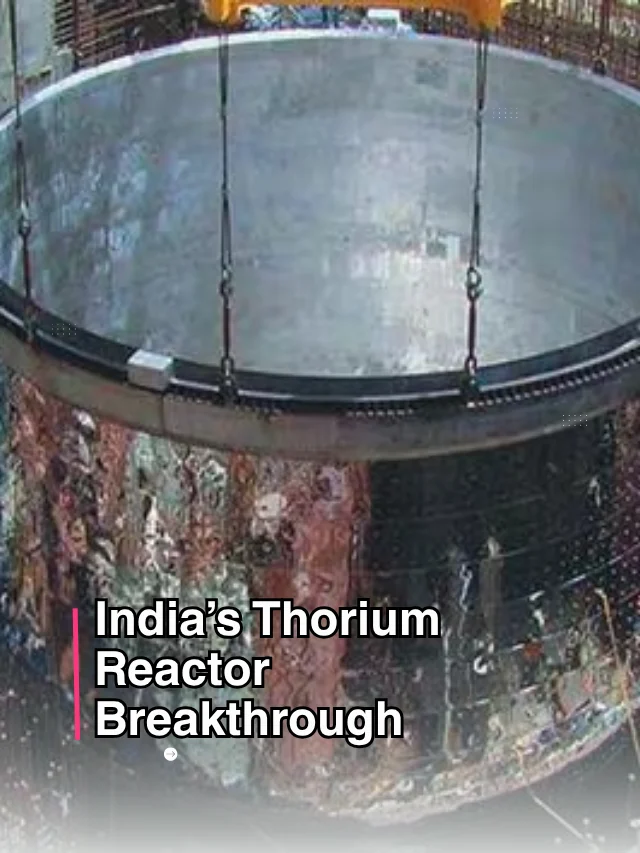
The PFBR attained first criticality at 8:25 PM on April 6, 2026. This means the reactor core began a controlled and self-sustaining fission chain reaction. The 500 MWe reactor uses mixed oxide fuel and liquid sodium as coolant. It will now undergo low-power testing before connecting to the electrical grid later this year.
This achievement marks India’s official entry into Stage 2 of its three-stage nuclear program. The program was first conceived by Dr. Homi Jehangir Bhabha in the 1950s. The PFBR was designed by the Indira Gandhi Centre for Atomic Research (IGCAR) and built by Bharatiya Nabhikiya Vidyut Nigam Limited (BHAVINI). Over 200 Indian industries contributed to this indigenous project.
Construction began in 2004. The project faced multiple delays and cost overruns. Initial estimates placed costs at Rs 3,492 crore. Final costs exceeded double that amount. Despite these challenges, the reactor now operates as designed. This persistence demonstrates India’s commitment to long-term energy independence.
Understanding Criticality in Nuclear Reactors
Criticality represents the precise state where a nuclear chain reaction becomes self-sustaining. This concept requires clear understanding because popular culture often misrepresents it.
What Criticality Actually Means
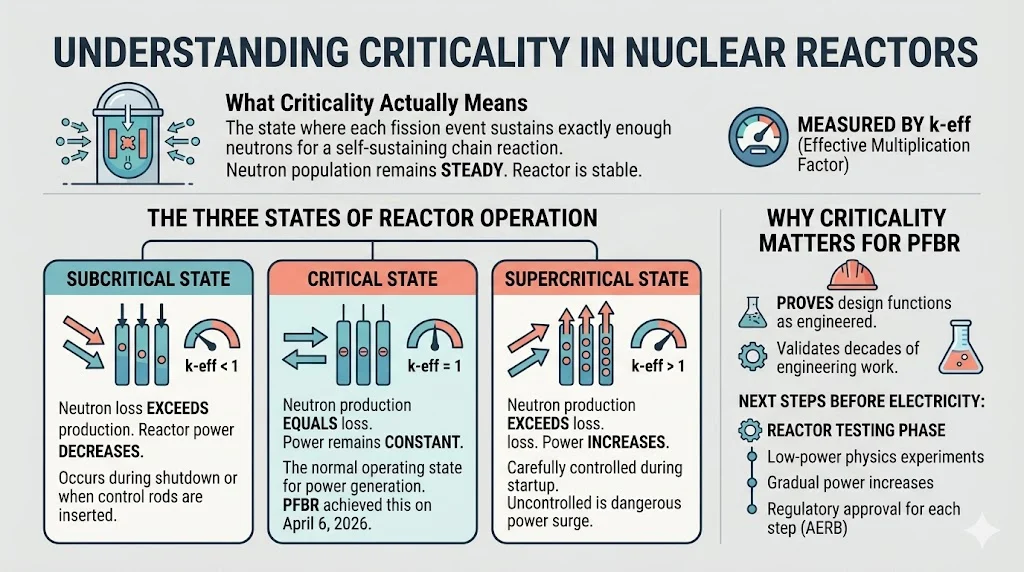
In nuclear engineering, criticality is the goal. It describes the condition where each fission event releases exactly enough neutrons to sustain an ongoing series of reactions. The neutron population remains steady. The reaction neither grows out of control nor fades away.
Scientists measure this using the effective multiplication factor (k-eff). When k-eff equals exactly one, the reactor is critical. This balance ensures neutron production equals neutron loss through absorption and leakage. The reactor produces consistent thermal energy output.
The Three States of Reactor Operation
Nuclear reactors operate in three distinct states:
- Subcritical State: Neutron loss exceeds production. Each generation produces fewer neutrons than the previous one. Reactor power decreases. This state occurs during shutdown or when control rods absorb too many neutrons.
- Critical State: Neutron production equals loss. Power remains constant. This is the normal operating state for power generation. The PFBR achieved this state on April 6, 2026.
- Supercritical State: Neutron production exceeds loss. Power increases. Operators carefully control this state during reactor startup. Uncontrolled supercriticality leads to dangerous power surges.
Why Criticality Matters for PFBR
Attaining criticality proves the reactor functions as designed. It validates decades of engineering work. However, criticality does not mean immediate electricity generation. The reactor now enters a testing phase.
Engineers will conduct low-power physics experiments to assess reactor behavior. Power levels will increase gradually. Each increase requires regulatory approval from the Atomic Energy Regulatory Board. This careful approach ensures safety before grid connection.
How Fast Breeder Reactors Work?
Fast breeder reactors operate on fundamentally different principles than conventional nuclear plants. Understanding these differences explains why this technology offers unique advantages.
Basic Working Principle
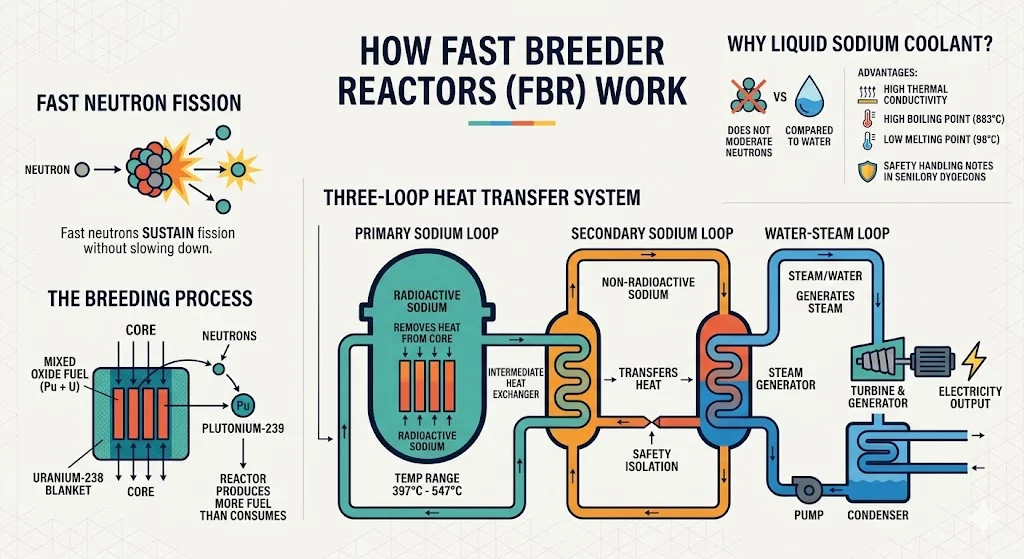
Fast breeder reactors use high-energy neutrons to sustain nuclear fission. These fast neutrons move at approximately 20,000 kilometers per second. This contrasts with thermal reactors that slow neutrons down using moderators like water or heavy water.
The core contains mixed oxide fuel made from plutonium and uranium. Surrounding the core is a blanket of uranium-238. This is the fertile material that enables breeding.
When fast neutrons strike the core fuel, fission occurs. This releases energy and additional neutrons. Some neutrons continue the chain reaction in the core. Others strike the uranium-238 blanket. These neutrons convert uranium-238 into plutonium-239 through a process called neutron capture.
The reactor produces more plutonium than it consumes. This is the breeding process. Operators periodically remove the blanket material and reprocess it to extract new fuel.
The Role of Liquid Sodium Coolant
Fast breeder reactors use liquid sodium as coolant instead of water. This choice is essential for the breeding process.
Water slows down neutrons. This moderation is desirable in conventional reactors but counterproductive in breeder reactors. Fast neutrons are required for efficient breeding. Sodium does not moderate neutrons significantly.
Liquid sodium offers additional advantages:
- High Thermal Conductivity: Sodium transfers heat efficiently from the reactor core
- High Boiling Point: Sodium boils at 883 degrees Celsius, allowing high-temperature operation at atmospheric pressure
- Low Melting Point: Sodium melts at 98 degrees Celsius, remaining liquid at operational temperatures
The PFBR uses a pool-type design with two sodium loops. The primary loop carries radioactive sodium through the reactor core. Heat transfers to a secondary non-radioactive sodium loop through intermediate heat exchangers. This isolation prevents radioactive contamination from reaching the steam generation system.
Sodium requires careful handling. Contact with water produces violent chemical reactions. Contact with air causes fires. The PFBR incorporates multiple safety systems to prevent such incidents.
The Three-Loop Heat Transfer System
The PFBR employs a sophisticated three-loop heat transfer configuration:
Primary Sodium Loop: Radioactive sodium circulates through the reactor core, absorbing heat from nuclear fission. This loop operates at temperatures between 397 degrees Celsius (inlet) and 547 degrees Celsius (outlet).
Secondary Sodium Loop: Non-radioactive sodium receives heat from the primary loop through intermediate heat exchangers. This loop isolates the radioactive primary sodium from the water-steam system.
Water-Steam Loop: Heat from the secondary loop generates steam that drives turbines for electricity production.
This design ensures that any leak in the steam generator does not expose radioactive material to the environment. The intermediate loop provides crucial safety isolation.
Countries with Fast Breeder Reactors in 2026
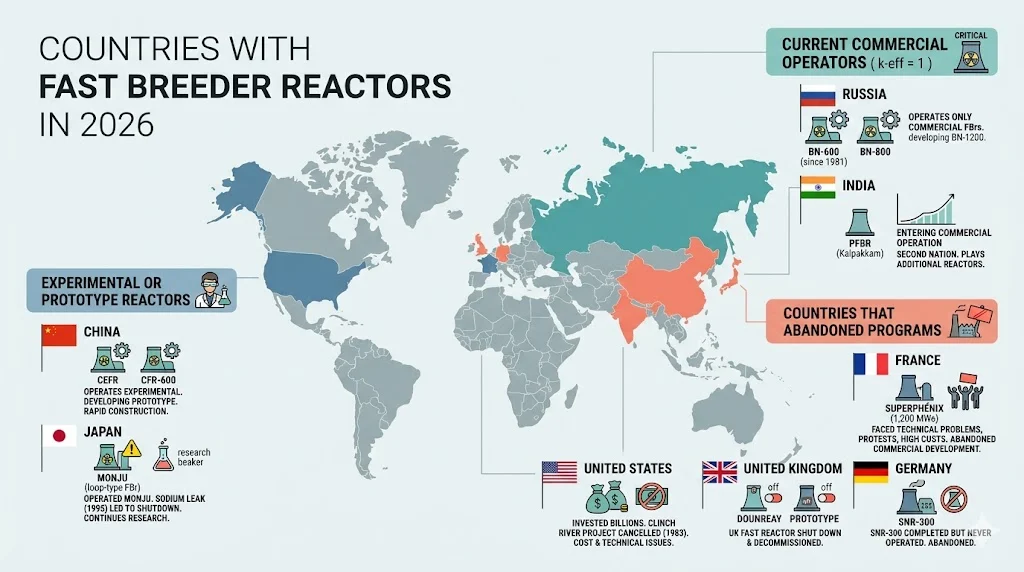
Fast breeder reactor technology has a complex global history. Many nations attempted development. Few succeeded.
Current Commercial Operators
Russia: Russia operates the only commercial fast breeder reactors worldwide. The BN-600 at Beloyarsk has supplied electricity since 1981. It has operated more successfully than any other reactor in Russia. The newer BN-800 also operates commercially. Russia is developing the BN-1200 for future deployment.
India: India joins Russia as the second nation with commercial fast breeder reactor capability. The PFBR at Kalpakkam will enter commercial operation following testing. India plans additional fast breeder reactors after successful PFBR operation.
Countries with Experimental or Prototype Reactors
China: China operates the China Experimental Fast Reactor (CEFR) and is developing the CFR-600 prototype. China built its fast breeder reactor in approximately six years, demonstrating rapid construction capability. However, these remain experimental or prototype scale rather than fully commercial.
Japan: Japan operated the MONJU reactor, a 280 MWe loop-type sodium-cooled fast breeder. A sodium leak incident in 1995 led to extended shutdown. Japan continues research but has not achieved sustained commercial operation.
Countries That Abandoned Programs
United States: The U.S. invested billions in fast breeder reactor development, including the Clinch River Breeder Reactor project. The program was cancelled in 1983 due to cost overruns, technical challenges, and changing energy economics.
France: France developed the Superphénix reactor, a 1,200 MWe fast breeder. The reactor faced technical problems, protests, and high costs. France suspended operation and eventually abandoned commercial fast breeder development despite significant investment.
United Kingdom: The UK operated the Dounreay Fast Reactor and Prototype Fast Reactor. Both were shut down and decommissioned.
Germany: Germany operated the SNR-300 at Kalkar but never started commercial operation. The reactor was completed but then abandoned.
Why India Succeeded Where Others Failed?
India’s success stems from strategic necessity and persistent execution. Other countries had alternatives. They possessed adequate uranium reserves or could import fuel economically. India lacked these options.
The three-stage program provided a clear roadmap. Each stage feeds into the next. This closed fuel cycle approach maximizes resource utilization. India could not afford to abandon the program because energy independence was strategically essential.
Additionally, India developed indigenous capabilities through institutions like IGCAR and BARC. This reduced dependence on foreign technology that could be disrupted.
Fast Breeder Reactor Advantages & Disadvantages
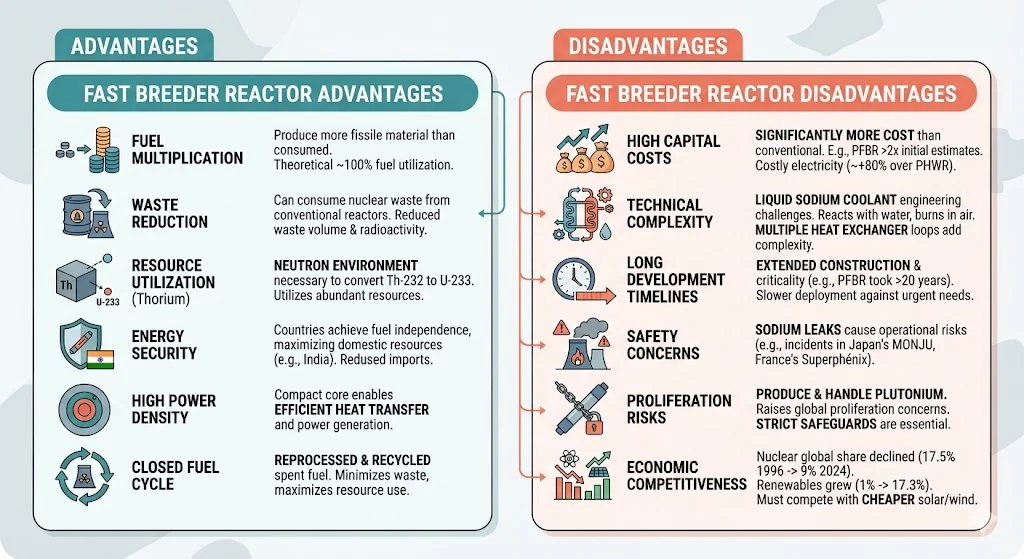
Like any technology, fast breeder reactors offer distinct benefits and face significant challenges. Understanding both sides provides balanced perspective.
Advantages of Fast Breeder Reactors
- Fuel Multiplication: The primary advantage is fuel breeding. Fast breeder reactors produce more fissile material than they consume. This extends fuel resources dramatically. Conventional reactors use approximately 0.7 percent of natural uranium. Fast breeders can theoretically utilize nearly 100 percent through plutonium conversion.
- Waste Reduction: Fast breeders can consume nuclear waste from conventional reactors. The plutonium in spent fuel becomes fuel for fast breeders. This reduces the volume and radioactivity of waste requiring long-term disposal.
- Resource Utilization for Thorium: Fast breeders provide the neutron environment necessary to convert thorium-232 into uranium-233. This enables India to use its abundant thorium reserves. No other reactor type efficiently performs this conversion.
- Energy Security: Countries with limited uranium reserves achieve fuel independence. India imports most uranium. Fast breeders reduce this dependence by maximizing domestic resources.
- High Power Density: Fast reactor cores are compact. The BN-600 core measures only 0.88 meters in active height and 0.75 meters in diameter. This compact design enables efficient heat transfer and power generation.
- Closed Fuel Cycle: Fast breeders enable a closed nuclear fuel cycle. Spent fuel is reprocessed and recycled. This minimizes waste and maximizes resource use.
Disadvantages of Fast Breeder Reactors
- High Capital Costs: Fast breeder reactors cost significantly more than conventional reactors. The PFBR cost more than double initial estimates. Electricity from fast breeders costs approximately 80 percent more than power from pressurized heavy water reactors.
- Technical Complexity: Liquid sodium coolant presents engineering challenges. Sodium reacts violently with water and burns in air. Multiple heat exchanger loops add complexity. These systems require sophisticated monitoring and maintenance.
- Long Development Timelines: The PFBR took over 20 years from construction start to criticality. Other countries experienced similar delays. This slow development conflicts with urgent energy needs.
- Safety Concerns: Sodium leaks have caused problems in multiple reactors. The MONJU reactor in Japan shut down after a sodium leak. The Superphénix in France experienced sodium fires. These incidents demonstrate operational risks.
- Proliferation Risks: Fast breeders produce and handle plutonium. This raises nuclear proliferation concerns. Strict safeguards are essential.
- Economic Competitiveness: Nuclear energy’s global share declined from 17.5 percent in 1996 to 9 percent in 2024. Renewables grew from 1 percent to 17.3 percent in the same period. Fast breeders must compete with increasingly cheap solar and wind power.
Comparative Analysis
The following table summarizes how fast breeder reactors compare to conventional pressurized heavy water reactors:
| Feature | Conventional PHWR | Fast Breeder Reactor (PFBR) |
|---|---|---|
| Fuel Type | Natural Uranium | Uranium-Plutonium Mixed Oxide (MOX) |
| Coolant | Heavy Water | Liquid Sodium |
| Neutron Speed | Slow (thermal) | Fast |
| Fuel Efficiency | Low (0.7% of uranium used) | High (up to 100% potential) |
| Fuel Production | No | Yes (breeds more fuel than consumes) |
| Waste Generation | Higher (spent fuel stored) | Lower (reprocesses waste) |
| Thorium Utilization | Not possible | Enables thorium conversion |
| Construction Cost | Lower | Higher (more than double) |
| Electricity Cost | Lower | Higher (80% more than PHWR) |
| Commercial Operation | Widespread | Only Russia and soon India |
| Construction Time | 5-7 years | 20+ years (PFBR example) |
This comparison reveals trade-offs. Fast breeders offer superior resource utilization and fuel breeding but at higher cost and complexity. For India, the strategic value of thorium utilization and fuel independence justifies these trade-offs.
Kalpakkam Nuclear Reactor: Technical Specifications and Significance
The PFBR at Kalpakkam represents decades of indigenous research and engineering. Understanding its technical details clarifies why this achievement matters.
Location and Operator
The PFBR sits at the Kalpakkam Nuclear Complex in Tamil Nadu, approximately 80 kilometers south of Chennai. This location hosts multiple nuclear facilities including the Madras Atomic Power Station. The reactor is built and operated by Bharatiya Nabhikiya Vidyut Nigam Limited (BHAVINI), a public sector enterprise under the Department of Atomic Energy.
Technical Specifications
The PFBR features the following key specifications:
- Electrical Capacity: 500 MWe (megawatts electric)
- Reactor Type: Pool-type sodium-cooled fast breeder reactor
- Coolant: Liquid sodium
- Fuel: Uranium-Plutonium Mixed Oxide (MOX)
- Core Design: Cylindrical core surrounded by uranium-238 blanket
- Primary Sodium Temperature: 397 degrees Celsius (inlet) to 547 degrees Celsius (outlet)
- Construction Start: 2004
- First Criticality: April 6, 2026
Design Features
The PFBR uses a pool-type design. The reactor core, primary pumps, and intermediate heat exchangers sit in a single large sodium pool within the reactor vessel. This design enhances safety by eliminating primary loop piping.
The reactor core contains 217 fuel subassemblies. The radial blanket surrounding the core contains 120 blanket subassemblies. These blanket assemblies contain depleted uranium that converts to plutonium during operation.
Two primary sodium pumps circulate coolant through the core. Heat transfers to two intermediate loops, each with its own secondary sodium pump and steam generator. This redundancy enhances reliability.
Safety Systems
The PFBR incorporates multiple safety features:
- Control and Safety Rods: Boron carbide rods absorb neutrons to control reaction rate and shut down the reactor
- Decay Heat Removal Systems: Passive systems remove residual heat even without power
- Leak Detection Systems: Multiple sensors detect sodium leaks immediately
- Containment Structure: Robust containment prevents radioactive release
The Atomic Energy Regulatory Board conducted multi-tier safety reviews before granting criticality permission. Regular inspections by resident site observers ensured compliance with safety standards.
Historical Context
The PFBR journey began in 2003 when the project received approval. Construction started in 2004 with initial completion targeted for 2010. Technical challenges, regulatory reviews, and design refinements caused repeated delays.
Prime Minister Modi visited Kalpakkam on March 4, 2024, to witness core loading commencement. This process involved inserting fuel assemblies into the reactor. Regulatory clearances followed in stages. The Atomic Energy Regulatory Board granted First Approach to Criticality permission after extensive safety evaluations.
The April 6, 2026 criticality achievement validates this prolonged development effort. It demonstrates India’s capability to develop complex nuclear technology indigenously.
Thorium Reserves in India and World: The Strategic Energy Advantage
Thorium availability defines India’s nuclear strategy. Understanding global and Indian thorium reserves explains why the PFBR is strategically essential.
Global Thorium Reserves Distribution
Worldwide thorium reserves total approximately 14.6 million tons. Distribution is highly uneven. Some nations hold massive deposits. Others have minimal resources.
The following table presents major thorium reserve holders globally:
| Country | Thorium Reserves (tons) | Primary Deposit Type | Key Locations |
|---|---|---|---|
| India | 846,500 | Monazite sands | Kerala, Tamil Nadu, Odisha, Andhra Pradesh coasts |
| Brazil | 632,000 | Monazite sands | Espirito Santo, Rio de Janeiro |
| United States | 595,000 | Vein deposits, monazite | Idaho, Montana, Carolinas |
| Egypt | 380,000 | Beach placers | Nile delta region |
| Turkey | 374,000 | Anatolian plateau deposits | Central Turkey |
| Australia | 300,000+ | Various | Multiple locations |
| Venezuela | 300,000 | Monazite sands | Coastal deposits |
| Canada | 100,000+ | Uranium-thorium veins | Ontario, Quebec |
| Russia | 100,000+ | Various | Siberia, other regions |
| South Africa | 35,000 | By-product of mining | Associated with heavy minerals |
India holds approximately 25 percent of global thorium reserves. This concentration in a single nation is unique. India’s reserves primarily occur in monazite sands along coastal regions.
India’s Thorium Reserves Detail
India possesses an estimated 13.15 million tonnes of in-situ monazite deposits. Monazite contains approximately 9 to 10 percent thorium oxide. This translates to roughly 846,500 tons of thorium.
Distribution across Indian states:
- Kerala: The coastal belt contains significant monazite deposits. Some estimates suggest Kerala holds approximately 32 percent of global monazite sand deposits.
- Tamil Nadu: The Manavalakurichi region and other coastal areas contain substantial reserves.
- Odisha: Beach placer deposits along the Odisha coast contribute significantly to national reserves.
- Andhra Pradesh: Coastal regions contain additional monazite deposits.
These deposits occur in beach sands and inland placer deposits. The thorium is co-located with rare earth elements. Extraction requires specialized processing.
Thorium vs Uranium: India’s Resource Position
India’s nuclear fuel resource position shows stark contrast:
| Resource | India’s Global Share | Availability | Import Dependence |
|---|---|---|---|
| Uranium | 1-2% | Limited domestic reserves | High (most uranium imported) |
| Thorium | ~25% | Abundant domestic reserves | None (fully domestic) |
This disparity drives India’s three-stage program. Conventional uranium-fueled reactors would perpetuate import dependence. Thorium utilization enables complete energy independence.
Thorium’s Energy Potential
Thorium offers exceptional energy density. According to Department of Energy projections, one ton of thorium generates energy equivalent to approximately:
- 200 tons of uranium
- 3.5 million tons of coal
India’s thorium reserves could theoretically generate 500 GW of electricity for four centuries. For context, India’s current total nuclear capacity is only 8.18 GW. The potential scale-up is enormous.
However, thorium-232 is fertile, not fissile. It cannot sustain a chain reaction directly. It must first convert to uranium-233 through neutron absorption. Fast breeder reactors like the PFBR provide this conversion capability.
Global Thorium Developments
Other nations are recognizing thorium potential:
China: Recently launched the world’s first operational molten salt reactor running on thorium fuel. China identified substantial thorium reserves at Bayan Obo, Inner Mongolia. Chinese estimates suggest these deposits could provide energy for 60,000 years at current consumption rates.
International Interest: Turkey, Brazil, and other reserve holders are exploring thorium utilization. However, India remains the only nation with a comprehensive three-stage program specifically designed for thorium deployment.
India’s Three-Stage Nuclear Program: The Roadmap to Thorium
The PFBR criticality activates Stage 2 of India’s nuclear program. Understanding all three stages clarifies the complete vision.
Stage 1: Pressurized Heavy Water Reactors (PHWRs)
Stage 1 uses natural uranium fuel in pressurized heavy water reactors. These reactors generate electricity and produce plutonium as a by-product.
India currently operates 22 PHWRs. These reactors have an installed capacity of approximately 6.7 GW. They form the backbone of India’s current nuclear fleet.
The spent fuel from PHWRs contains plutonium. Reprocessing this fuel extracts plutonium for Stage 2. Stage 1 thus feeds Stage 2 with necessary fuel.
Stage 2: Fast Breeder Reactors (Current Stage)
The PFBR marks India’s entry into Stage 2. This stage uses plutonium from Stage 1 as fuel in fast breeder reactors.
Stage 2 serves dual purposes:
- Electricity Generation: Fast breeders generate commercial power
- Fuel Breeding: They produce more plutonium and convert thorium to uranium-233
The PFBR initially uses uranium-plutonium MOX fuel. Eventually, it will use thorium blankets to breed uranium-233. This uranium-233 becomes the fuel for Stage 3.
India plans additional fast breeder reactors at Kalpakkam following successful PFBR operation. The Department of Atomic Energy proposes construction of more FBRs beyond 2030.
Stage 3: Thorium-Based Reactors
Stage 3 represents the endgame of India’s nuclear vision. These reactors will use thorium-232 and uranium-233 fuel.
The Advanced Heavy Water Reactor (AHWR) is under development for Stage 3. This reactor will derive approximately 75 percent of its power from thorium. It requires initial plutonium and uranium-233 to sustain the reaction. Once operational, Stage 3 reactors can sustain themselves using India’s abundant thorium.
Stage 3 offers several advantages:
- Sustainable Energy: Thorium reserves provide centuries of fuel supply
- Reduced Waste: Thorium reactors produce less long-lived radioactive waste
- Inherent Safety: Thorium fuel cycles offer improved safety characteristics
- Energy Independence: Complete elimination of fuel imports
Timeline and Targets
India has established ambitious nuclear capacity targets:
- Current Capacity (2024-25): 8.78 GW
- Target for 2031-32: 22.38 GW
- Nuclear Energy Mission Target for 2047: 100 GW
The Nuclear Energy Mission, announced in the Union Budget 2025-26, allocates Rs 20,000 crore for Small Modular Reactor development. At least five indigenous SMRs are targeted for operation by 2033.
The SHANTI Act, 2025 (Sustainable Harnessing and Advancement of Nuclear Energy for Transforming India) modernizes India’s nuclear legal framework. It enables limited private sector participation under regulatory oversight.
What Happens Next: From Criticality to Commercial Operation
Criticality is a milestone, not the destination. Several steps remain before the PFBR delivers commercial electricity.
Immediate Next Steps
Low-Power Physics Experiments: Engineers will conduct experiments at low power levels to study reactor behavior. These tests validate computer models and operational procedures.
Power Ascension: Power levels will increase gradually in stages. Each increase requires regulatory review and approval. This cautious approach ensures safety.
System Integration Testing: All support systems including cooling, control, and electrical systems undergo integrated testing.
Commercial Operation Timeline
The PFBR is expected to connect to the grid later in 2026 following successful testing. Full commercial operation will follow initial grid connection. The exact timeline depends on test results and regulatory approvals.
Future Expansion
The Department of Atomic Energy plans additional fast breeder reactors:
- Kalpakkam Expansion: More FBRs proposed at the Kalpakkam site after one year of successful PFBR operation
- Post-2030 Program: Further reactors planned beyond 2030
- SMR Development: 200 MWe Bharat Small Modular Reactor (BSMR-200) and 55 MWe SMR-55 under development at BARC
Thorium Utilization Timeline
Full-scale thorium utilization requires successful completion of Stage 2 breeding. The PFBR and subsequent FBRs must breed sufficient uranium-233 from thorium. This process takes years.
Stage 3 thorium reactors will deploy once adequate uranium-233 inventory exists. Realistic timelines suggest significant thorium-based generation by the 2040s.
Global Context & India’s Position
India’s achievement occurs within a shifting global energy landscape. Understanding this context clarifies strategic implications.
Nuclear Energy Global Trends
Nuclear energy’s global electricity share declined from 17.5 percent in 1996 to 9 percent in 2024. Meanwhile, modern renewables (excluding large hydro) grew from approximately 1 percent to 17.3 percent.
Several factors drive this shift:
- Cost Competition: Solar and wind costs declined dramatically
- Safety Concerns: Fukushima and other incidents affected public perception
- Construction Challenges: Nuclear projects face delays and cost overruns globally
Why India Persists with Nuclear
Despite global trends, India maintains strong nuclear commitment because:
- Baseload Power: Nuclear provides reliable 24/7 electricity unlike intermittent renewables
- Energy Security: Domestic thorium eliminates fuel import vulnerability
- Decarbonization: Nuclear supports net-zero 2070 goals with low-carbon baseload power
- Industrial Development: Nuclear program develops high-technology capabilities
Comparison with China’s Program
China recently built a fast breeder reactor in approximately six years. This faster construction demonstrates China’s industrial capacity. However, China’s reactor remains at prototype scale.
India’s 20-year PFBR development reflects different priorities. India emphasized indigenous technology development and safety verification over speed. Both approaches have merit. India must accelerate future deployments to meet energy targets.