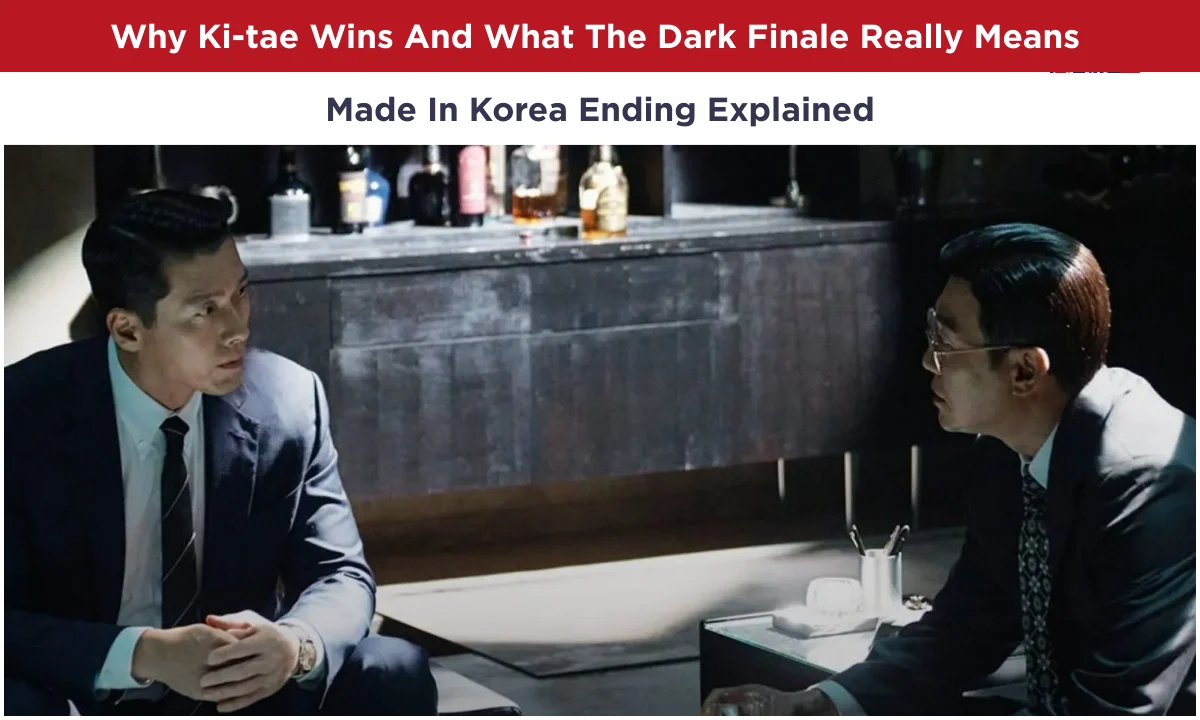
If you just finished watching the Disney plus Korean thriller Made In Korea then their are high chances that ending left you shocked. The final episode completly flips unlike other K Drama.
Instead of the hero winning, the villain walks away with power. That twist is exactly why so many viewers are searching for “Made In Korea ending explained”. Movie is Set in the chaotic political climate of 1970s South Korea, the show follows Baek Ki-tae who is a ruthless KCIA agent building a secret drug empire. On the other hand is prosecutor Jang Geon-young who tries to expose corruption at the highest levels of power.
Their rivalry drives the entire series. But the finale takes a dark turn that reveals how power, politics, & corruption actually work.
In this blog post you will get all the explanation of Made In Korea with ending explained in simple langauge so keep reading…
Table of Contents
Key Takeaways
- Baek Ki-tae successfully manipulates the political system and becomes Director General of the KCIA
- Prosecutor Jang Geon-young is framed and arrested despite trying to expose the truth
- Kang Dae-il becomes the scapegoat after dying in custody
- Powerful political figures protect Ki-tae and his international drug operation
- The ending shows a realistic message that power often defeats justice
- Many fans praised Hyun Bin’s performance and the bold dark ending
- The finale leaves the door open for a potential Season 2 storyline
What Happens In The Made In Korea Finale
The last episode focuses on the final confrontation between Baek Ki-tae and prosecutor Jang Geon-young. Throughout the series Geon-young tries to prove that Ki-tae is secretly running a drug empire connected with international crime networks.
At the beginning of the finale, it looks like Geon-young has been killed. His bicycle and shoes are found on the street. This scene makes viewers think the investigation is over.
Later the truth is revealed. Geon-young was kidnapped by Ki-tae. He is beaten and held captive. Ki-tae also threatens his younger sister Hye-eun. Fake evidence is created to accuse her of receiving communist funds from North Korea.
In the political atmosphere of the 1970s, that accusation is extremely dangerous. It could destroy someone’s life instantly. Ki-tae uses this pressure to break Geon-young and force him to stop the investigation. However Geon-young refuses to give up. Even after being released, he continues trying to bring Ki-tae down.
The Rise Of Baek Ki-tae’s Drug Empire
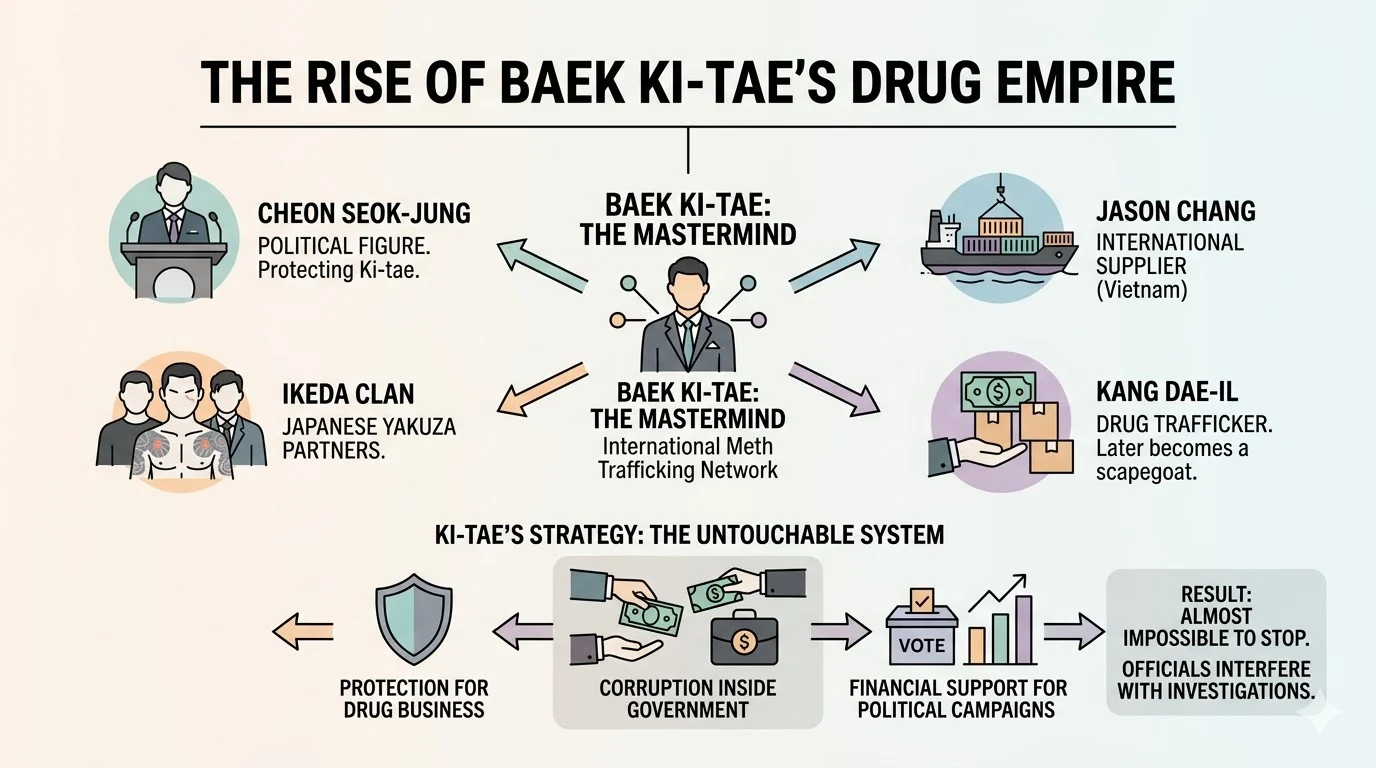
One of the most important storylines in the series is Ki-tae’s international drug operation. While working inside the Korean intelligence system, he secretly builds a massive meth trafficking network.
The operation connects several powerful groups.
| Network Member | Role In The Story |
|---|---|
| Ki-tae | Mastermind behind the drug empire |
| Cheon Seok-jung | Political figure protecting Ki-tae |
| Ikeda Clan | Japanese Yakuza partners |
| Jason Chang | International supplier from Vietnam |
| Kang Dae-il | Drug trafficker who later becomes a scapegoat |
Ki-tae’s strategy is simple. He uses corruption inside the government to protect his illegal business. In return he provides massive financial support for political campaigns.
This arrangement makes him almost impossible to stop. Even when investigators get close, powerful officials interfere and protect him.
Why Kang Dae-il’s Death Is So Important?
Another tragic moment in the finale is the death of Kang Dae-il. Dae-il starts the series as a criminal involved in drug distribution. Later he becomes emotionally connected with Ki-tae’s sister. That relationship changes his motivations.
When he is arrested, Dae-il realizes he will never escape the system alive. Instead of exposing Ki-tae, he sacrifices himself. He injects a lethal dose of drugs and dies in custody.
His death becomes the perfect opportunity for powerful officials. The authorities blame the entire drug operation on him. This allows the real masterminds to walk away untouched. Dae-il essentially becomes the fall guy for a much larger conspiracy.
Why Jang Geon-young Loses In The End
The biggest shock of the finale is the downfall of prosecutor Jang Geon-young. Throughout the show he represents justice and patriotism. His mission is personal because his family suffered due to drug addiction.
He believes exposing Ki-tae will protect the country. But the system he trusts ultimately betrays him.
Instead of arresting Ki-tae, the investigation is reversed. Evidence is manipulated and false accusations appear against Geon-young himself. Several factors contribute to his downfall.
Reasons For Geon-young’s Failure
- Political leaders protect Ki-tae
- Evidence is manipulated by intelligence agents
- Dae-il’s confession shifts blame toward Geon-young
- His family background is used to discredit him
- Government institutions prioritize power over truth
By the end of the episode Geon-young is arrested and removed from his position as prosecutor. In the final scene he is taken away in handcuffs, questioning what his patriotism truly meant. It is a brutal conclusion for the character.
Ki-tae’s Final Victory And KCIA Promotion
While Geon-young loses everything, Ki-tae achieves his ultimate goal. The series reveals that he has been planning this rise to power from the beginning. Every alliance and betrayal was part of a larger strategy.
By delivering money and influence to political leaders, he earns their protection. This allows him to climb to the highest position in the intelligence agency.
The final moments show Ki-tae becoming the new Director General of the KCIA. The position previously belonged to Director Hwang, who Ki-tae secretly eliminated earlier in the story. The closing scene is symbolic. Ki-tae calmly smokes a cigar while pledging loyalty to the president and the nation. But viewers know the truth. His loyalty is only to power.
Public Opinion About The Ending
The finale triggered a lot of discussions online. Many viewers shared their reactions after the final episode aired in January 2026. Some fans loved the bold storytelling. Others felt frustrated because the villain wins.
Common viewer reactions included:
- Praise for Hyun Bin’s intense acting performance
- Comments that the ending felt realistic rather than heroic
- Some viewers felt chills watching the final scene
- Others said the ending was frustrating but powerful
- Many fans started discussing a possible Season 2
A lot of discussions also focused on the visual style of the final scene. Ki-tae smoking a cigar became one of the most talked-about moments because it symbolized his total control.
Will There Be Made In Korea Season 2
The ending leaves several storylines open. That is why many viewers believe the story is far from finished. Important unresolved questions include:
- Will Geon-young attempt revenge or redemption
- Can Ki-tae maintain control over the intelligence agency
- What happens to the growing international drug empire
- Could political alliances collapse in the future
Reports suggest that another season could continue exploring power struggles within the Korean government. Even though Ki-tae wins for now, his rise may create new enemies.
The Meaning Behind The Dark Ending
personally for me the ending of Made In Korea feels less like a typical TV finale & more like a quiet warning about how power really works.
This isn’t a story where the hero saves the day and everything falls neatly into place. Instead, the show reminds us that systems often protect themselves first, even when the truth is right in front of them.
Ki-tae believes that power is the only real protection in the world, and by the end of the series, it’s hard to argue with him. He bends every rule, manipulates everyone around him, and still ends up on top. Meanwhile, Geon-young does everything the “right” way, follows the law, and still loses everything.
That contrast is what makes the ending stick with you long after the credits roll.
Personally, I think the show is asking viewers to reflect on something deeper. It’s not just about who wins or loses, but about the kind of world we live in and the choices people make when power is involved. Sometimes the truth doesn’t win immediately, and sometimes justice takes longer than we’d like.
So if the ending feels frustrating or even unfair, that’s probably the point. Made In Korea leaves us with a reminder that power can shape reality but it also quietly challenges us to think about what kind of people we choose to be in a world like that.