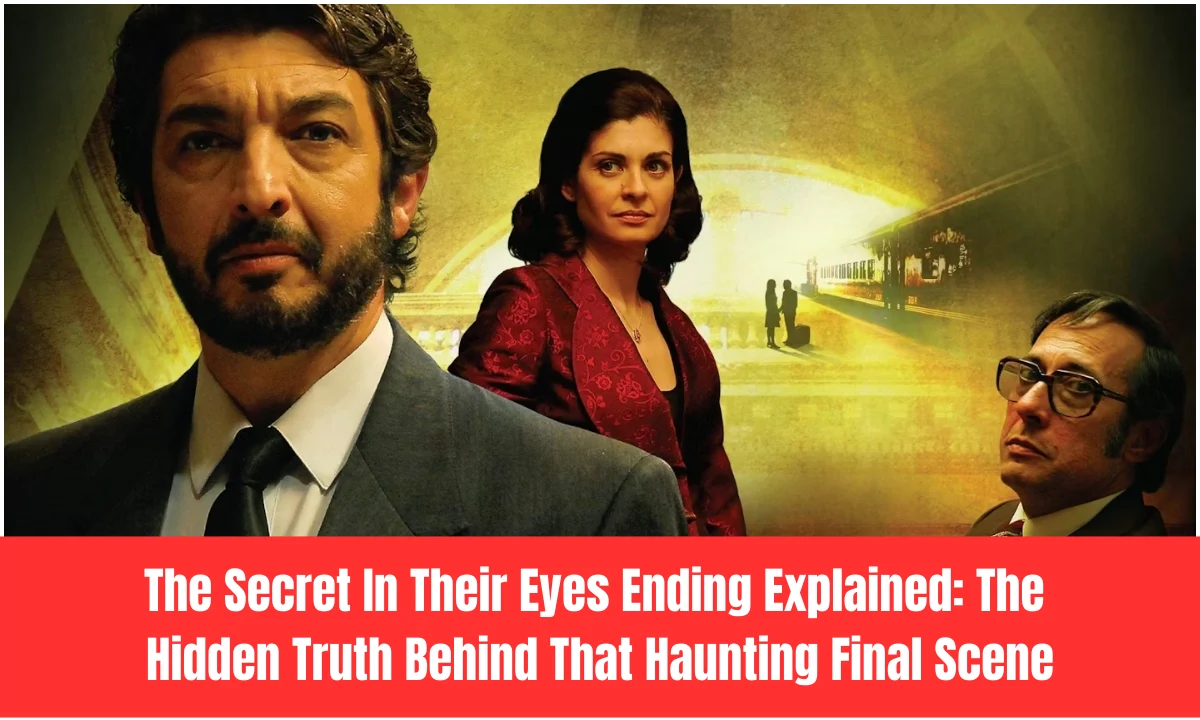
If you just finished watching movie The Secret in Their Eyes and are now sitting in silence thinking what you just saw. If you feel the same then you are not alone. secret in their eyes is Argentine film from 2009 directed by Juan José Campanella is famous because of the most chilling and emotionally devastating endings in modern cinema.
At first look It looks like a crime drama about a cold case on the outside. But as the story proceeds the movie becomes something much deeper. Story is about love that was never spoken, wounds that won’t heal, obsession, and justice. The last twist does not make a lot of noise but It silently ruins you.
In this blog post we i will explain ending of the secret in their eyes in simple language. You can read the summery of whole blog post in following key takeaways section:
Key Takeaways
- The film follows retired investigator Benjamín Espósito revisiting a 1974 rape and murder case.
- The suspect Isidoro Gómez was released due to corruption during Argentina’s political turmoil.
- The victim’s husband Ricardo Morales secretly imprisoned Gómez for 25 years instead of killing him.
- The ending explores justice vs revenge and moral ambiguity.
- The phrase “The Secret in Their Eyes” reflects hidden emotions, guilt, rage, and love.
- The political backdrop of 1970s Argentina shapes the film’s message about failed institutions.
- The ending resonates because it is restrained, poetic, and morally complex.
Setting The Stage: A Brief Overview Of The Film
The story revolves around Benjamin Esposito character played by the played by Ricardo Darin who is a retired judicial investigator. Decades after a brutal 1974 rape and murder of a young woman named Liliana Colotto. He decides to write a novel about that case.
Through flashbacks in the movie we can see how Esposito and his superior Irene Menendez Hastings, played by Soledad Villamil, investigated the crime. Their main suspect was Isidoro Gomez. The evidence pointed toward him. His obsession was visible in photographs. His eyes gave him away.
But the system failed.
Due to political corruption during Argentina’s unstable pre dictatorship era, Gomez was released. Justice slipped through the cracks. Esposito was forced into exile. The victim’s husband, Ricardo Morales, was left shattered.
Main Themes In The Film
- Justice vs Revenge
- Corruption in legal systems
- Obsession and passion
- Memory and trauma
- Unspoken love
The movie blends crime thriller with romance and political commentary. That mix is what makes the ending hit so hard.
The Build Up: Key Events Leading To The Climax
To understand the ending, you need to track the emotional tension building across timelines.
The narrative jumps between the 1970s investigation and the late 1990s. Esposito is not just solving a crime. He is confronting his own unfinished life. His love for Irene was never expressed properly. His fear stopped him.
Meanwhile, Morales repeatedly says something important. He does not want Gomez dead. He wants him to suffer life imprisonment. He wants “cadena perpetua”. That line becomes crucial later.
There is also a powerful stadium chase sequence at Racing Club’s stadium in Buenos Aires. It shows the film’s technical brilliance and pushes the investigation forward. But even after arrest and confession, corruption wins.
Esposito’s partner Sandoval is murdered. The system protects criminals. Politics overrides morality.
By the time we reach the present timeline, everything feels unresolved. That tension is intentional.
The Shocking Revelation: Breaking Down The Final Twist
Now comes the part that stays with you. Years later, Esposito visits Morales. Morales claims he killed Gomez long ago. Case closed. Simple answer. But something feels off.
Esposito remembers Morales insisting on life imprisonment, not death. He becomes suspicious and secretly returns to Morales’ remote property.
There, in a small isolated shed, he discovers the truth. Gomez is alive. For 25 years. Locked inside a tiny cell. No conversation. No human connection. No hope. He is physically alive but socially dead.
When Gomez sees Esposito, he begs him to speak. “Talk to me, please.” That moment is heartbreaking. Not because we feel sympathy for Gomez, but because we see what absolute isolation does to a human being.
Morales’ version of justice was not quick revenge. It was endless solitude.
Esposito looks at Morales. Morales reminds him, you promised life imprisonment. Esposito nods. And he leaves. That nod is the real twist. He chooses silence. He becomes complicit.
Justice Vs Revenge: What The Ending Really Says
The film does not give easy answers. It forces you to ask uncomfortable questions. Here is a simple comparison to understand Morales’ decision:
| Legal Justice | Morales’ Justice |
|---|---|
| Court trial | Secret imprisonment |
| Prison system | Private cell |
| Defined sentence | Endless isolation |
| Institutional punishment | Personal retribution |
The state failed. So Morales created his own system. Is it morally right. No. Is it understandable. Maybe. That ambiguity is why the ending works. It does not celebrate revenge. It shows its cost.
Morales sacrificed his entire life to keep Gomez alive. He also imprisoned himself emotionally. He stopped living the moment his wife died.
Symbolism And Visual Cues In The Ending
The title itself carries weight.
“The Secret in Their Eyes” refers to what remains unspoken but visible.
- Gomez’s obsession seen in photographs
- Morales’ hidden rage
- Esposito and Irene’s suppressed love
- Guilt and trauma that never disappear
Another powerful symbol is the word trick with the typewriter. The word “temo” meaning I fear becomes “te amo” meaning I love. Esposito literally adds a letter to transform fear into love. That small detail mirrors his emotional journey.
Eyes are constantly framed in close up shots. The gaze becomes a metaphor for truth. Photographs reveal what memory hides.
The film quietly suggests that eyes do not lie. Systems do.
Moral Dilemmas And Character Decisions Explored
Esposito’s final choice is crucial. He could have reported Morales. He did not. Why? Because he understood that the legal system already failed. He saw the pain. He chose emotional truth over procedural law.
But that decision also shows how corruption spreads. When institutions collapse, individuals start bending rules.
The political context matters here. The story is set during Argentina’s unstable 1970s era. Corruption, authoritarian influence, and abuse of power were real issues. The film subtly mirrors that historical tension without turning into a documentary.
Personal morality and law enforcement duty clash directly in that final scene.
Public Opinion: Why Viewers Still Talk About That Ending
Recent discussions online show how deeply the ending continues to affect viewers. Many call it one of the greatest twist endings of this century. Some compare it to classics like The Sixth Sense and Fight Club, not because of shock value but because of emotional impact.
Common reactions include:
- It broke me
- That ending still lingers after rewatch
- Mind blowing but quiet
- Devastating yet poetic
Interestingly, many viewers also compare it to the 2015 American remake starring Julia Roberts, which changed the structure and tone of the ending. Most fans believe the original Argentine version handled the twist with more restraint and depth. The original feels raw. It does not over explain. It trusts the audience.
The Film’s Impact And Why The Ending Resonates
The ending resonates because it connects personal trauma with societal failure. It tells us that when justice systems collapse, people carry their own prisons inside them. Morales built a physical prison. Esposito built an emotional one. Irene waited in silence.
Yet the final moments offer a tiny bit of hope. After confronting the truth, Esposito finally approaches Irene honestly. For the first time, he stops running from his feelings.
The film ends not with triumph but with possibility. Pain remains. Scars remain. But silence begins to break.
Conclusion: What Does The Secret In Their Eyes Ending Truly Mean
The ending is not about revenge winning. It is about the cost of obsession and the weight of unresolved trauma.
Morales got his version of justice. But at what price. Esposito chose silence. But that silence allowed him to finally move forward emotionally. Irene represents the life that was paused for decades.
The real secret was never just about the murderer. It was about what each character carried inside their eyes. If you rewatch the film, notice the glances. Notice the pauses. Notice what is not spoken.
That is where the truth hides. And maybe that is why this ending stays with you long after the screen goes black.