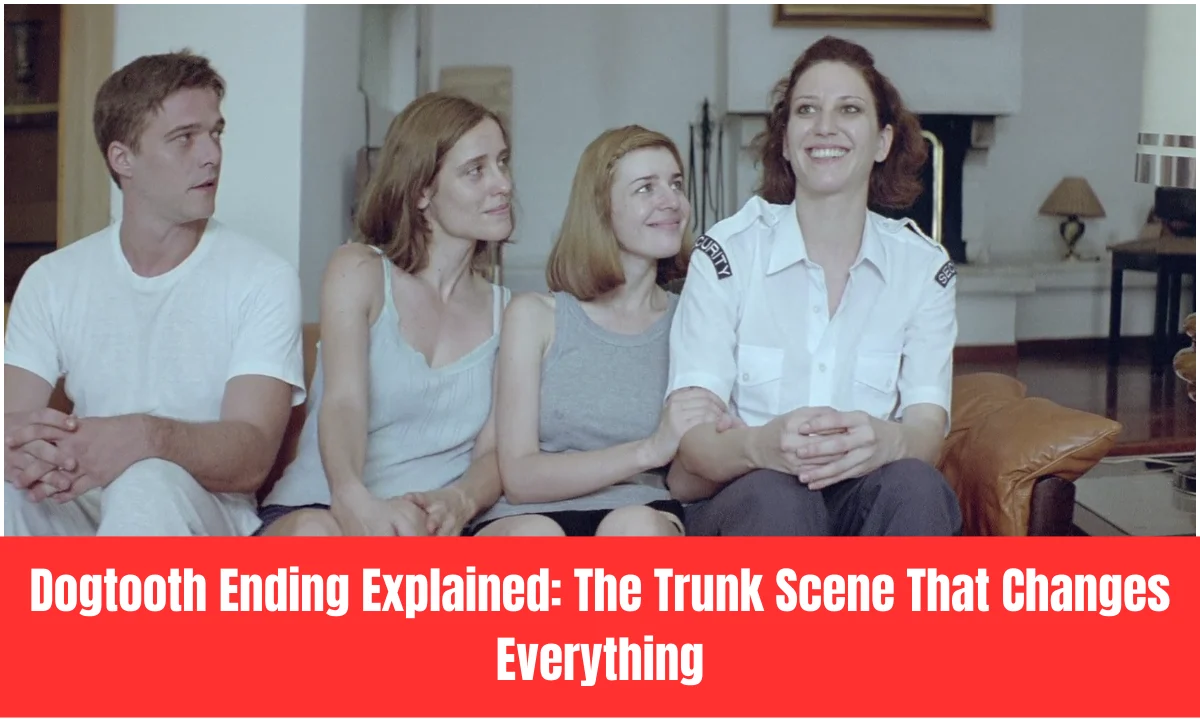
You finish watching movie Dogtooth and for a few seconds you just sit there. No background music. No clear answer. Just silence. That last shot stays in your head.
Dogtooth film which is directed by Yorgos Lanthimos. The story in this movie is about family that lives completely cut off from the outside world. The parents control everything. Language. Information. Even basic reality. Their three adult children grow up believing lies about the world beyond the fence.
In the final minutes of Dogtooth the eldest daughter makes a shocking decision. She breaks her own tooth because her parents told her that she can only leave the house when her tooth falls out. After that she quietly hides inside the trunk of her father’s car. Now She believes this is her only chance to escape and finally see the outside world.
After this moment The film ends without showing what happened after that. No confirmation. No rescue. No tragedy shown clearly. Just a closed trunk. And that is what makes the ending so powerful…
Key Takeaways
- The eldest daughter knocks out her dogtooth to “earn” freedom under her parents’ twisted rule.
- She hides inside the trunk of her father’s car to escape the fenced compound.
- The ending is ambiguous. We never see if she survives or escapes.
- The final incestuous kiss between the siblings suggests the cycle of dysfunction continues.
- The film critiques authoritarian control, indoctrination, and psychological manipulation.
- Many viewers on X describe the ending as bleak, jaw dropping, and unforgettable.
Now let’s properly unpack what really happens and what it means.
The Enigmatic World Of Dogtooth
At the surface the move Dogtooth looks simple. A family lives inside a fenced house. Parents raise their three adult children in total isolation. They invent fake meanings for words. They create imaginary dangers like flesh eating cats. They claim the children can only leave once their dogtooth falls out.
But this is not just a weird family drama. It is a psychological experiment. The parents control language. They control sex. They control information. This is not parenting. This is brainwashing..
The children believe airplanes that fly overhead are tiny toys. They think “telephone” means salt. They believe their brother was killed by a cat outside the fence. Every lie builds a fake reality. And then something cracks.
The Symbolism Behind The Dogtooth Rule
The canine tooth becomes the symbol of “maturity” in the house. The parents tell the children they can leave only when it falls out naturally. That moment equals readiness.
But here’s the catch. Adult canine teeth do not fall out. So the rule is a trap. The dogtooth represents false hope. It gives the children something to wait for. Something that will never happen.
When the eldest daughter smashes her tooth out with a dumbbell, she is not just hurting herself. She is breaking the illusion. She uses their own rule against them. It is painful. It is desperate. But it is her first real act of independent thinking.
The Final Scene Explained Step By Step
Let’s break down what actually happens in the ending:
- The eldest daughter watches smuggled VHS tapes like Flashdance.
- She realizes parts of her world are lies.
- She knocks out her dogtooth.
- She hides in the trunk of her father’s car.
- The father drives to work.
- The camera lingers on the trunk. Cut to black.
We never see her come out. This ambiguity is intentional. Yorgos Lanthimos does not give answers. He leaves you stuck with the discomfort.
Does She Escape Or Is It A Doomed Attempt?
This is the big question. There are three major interpretations:
1. She Escapes Successfully
She waits until the car stops. She gets out. She enters the real world. Freedom at last.
But here’s the problem. She has zero social knowledge. She does not understand language properly. She does not know how the world works. Freedom might destroy her.
2. She Suffocates In The Trunk
The car trunk is closed. It is hot. It is airtight. The camera lingers long enough to make you anxious. Some viewers believe she dies before ever reaching freedom. That makes the ending even darker.
3. Psychological Escape, Not Physical
Maybe the point is not whether she survives. The point is that mentally she broke free. She rejected the control. Even if her body fails, her mind woke up. This is why the ending hits so hard.
The Incestuous Kiss And The Cycle Of Control
While the father searches for the daughter, the remaining siblings kiss in bed. This scene is disturbing. But it tells us something important. The system continues.
The remaining children are still trapped mentally. The parents’ regime survives. The rebellion removed one piece, not the structure. It shows how abuse and indoctrination create cycles. If one escapes, the system still functions for others.
Allegory For Authoritarian Control
Many critics connect Dogtooth to political themes. The film was released in 2009, during Greece’s financial crisis era. Some interpret the house as a metaphor for a closed society.
The manipulation of language feels similar to dystopian fiction like 1984 by George Orwell. Control the words. Control reality.
The children are like prisoners in The Republic where Plato describes the Allegory of the Cave. Prisoners mistake shadows for truth. When one escapes, the real world blinds them. The eldest daughter is that prisoner.
Public Opinion On X About The Ending
Recent discussions on X show that the ending still lives rent free in people’s minds.
Many users describe it as:
- Jaw dropping
- Bleak
- Disturbing but genius
- A perfect capstone to Lanthimos’ absurd style
Some even compare it to later films like The Lobster and The Killing of a Sacred Deer, saying Dogtooth remains his most politically sharp and unfiltered work.
A lot of viewers mention that the trunk scene gave them anxiety. Others say the dogtooth moment is one of the most shocking self harm scenes in modern cinema. It is not a feel good ending. But it sticks.
What The Ending Symbolizes
| Element | Surface Meaning | Deeper Meaning |
|---|---|---|
| Dogtooth | Physical maturity | False promise of freedom |
| Trunk of car | Escape method | Claustrophobic uncertainty |
| Incest kiss | Shock value | Cycle of dysfunction |
| Smuggled VHS tapes | Outside influence | Awakening and curiosity |
| Cat myth | Fear of outside world | Tool of psychological control |
Why The Ending Still Resonates Today
Even after more than a decade, Dogtooth feels relevant. In a world of misinformation, controlled narratives, and isolated echo chambers, the film feels uncomfortable close to reality. When information is filtered, people lose the ability to question.
That is what makes the ending powerful. It does not give resolution. It forces you to sit with uncertainty. And maybe that is the scariest part. Because real life rarely gives neat endings.
Final Verdict On The Dogtooth Ending
The ending of Dogtooth is not about whether she survives. It is about whether awakening is worth the pain. The eldest daughter chooses truth over comfort. Even if it destroys her.
That trunk scene is not just suspense. It is a question. Would you risk everything for freedom if you barely understood the world outside? That is why people still talk about it. That is why it has cult status. And that is why it remains one of the most unsettling endings in psychological cinema.