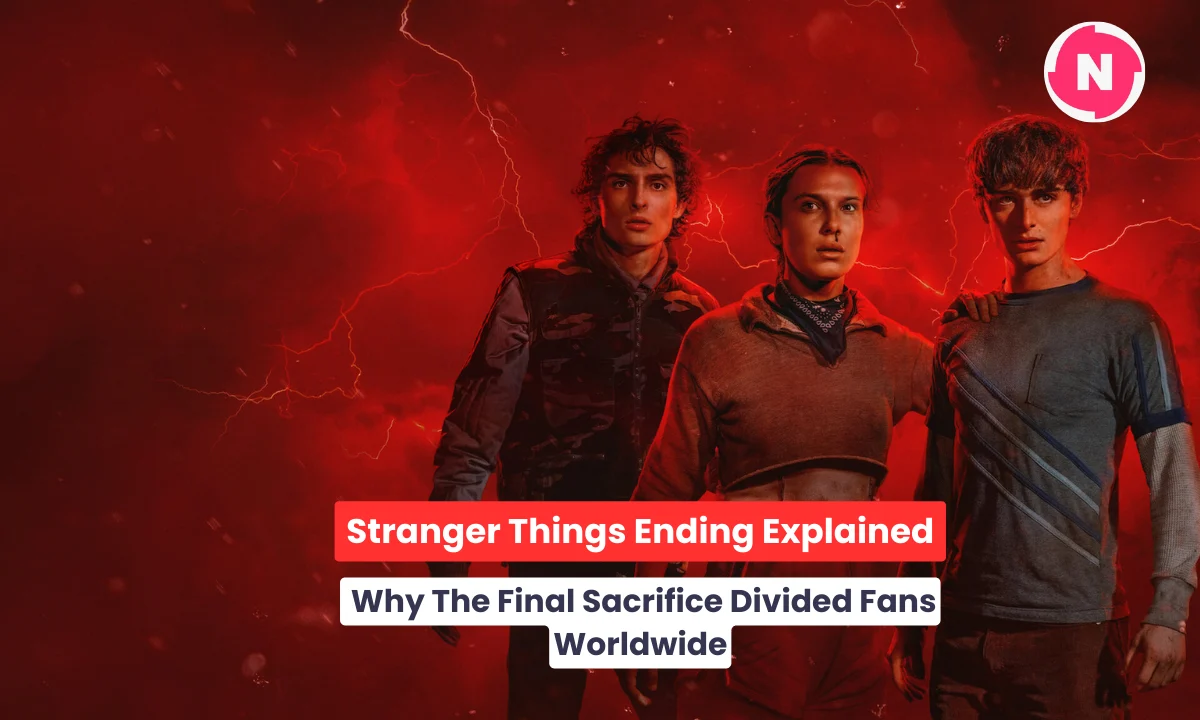
Stranger Things ending explained is one of the most searched topics since the series concluded with Season 5 in late 2025. After nearly a decade of buildup, Hawkins, the Upside Down, Vecna, and Eleven all reached their final chapter. The finale promised closure, emotional payoff, and answers. What viewers received instead was a bold and polarizing ending that sparked debates across social media and fan communities.
The final episode focuses less on spectacle alone and more on consequences. It closes the supernatural war but leaves emotional questions open. The most debated moment is Eleven’s fate and whether her sacrifice was permanent or symbolic. The Duffers clearly chose meaning over comfort, which explains why reactions are still intense months later.
Key Takeaways
- The final battle ends the Mind Flayer and Vecna for good.
- Joyce delivers the final blow, completing a long emotional arc.
- Eleven chooses to stay behind to seal the Upside Down forever.
- The finale leaves Eleven’s fate intentionally unclear.
- Fans are deeply divided, with criticism louder than praise.
- The story ends where it began, with Dungeons and Dragons and friendship.
The Final Battle That Ends The Upside Down
The Stranger Things finale centers on a massive confrontation inside the Abyss, a core dimension of the Upside Down. Unlike earlier seasons that relied on mystery and slow dread, the final fight is direct and relentless. Every major character plays a role, reinforcing the long-running idea that no one survives alone.
Vecna, also known as Henry Creel, faces Eleven and Will in a psychological and physical struggle. At the same time, the Mind Flayer reveals its final form as a massive creature rather than a hidden manipulator. This creative choice disappointed some fans who expected a more cerebral villain. Others saw it as a necessary step to make the threat tangible and final.
The group defeats the Mind Flayer through coordinated attacks using fire, explosives, and weapons. The victory is not elegant or clever. It is chaotic, exhausting, and costly. That tone matters because it frames what happens next.
Why Joyce Killing Vecna Matters
Joyce Byers delivering the killing blow to Vecna surprised many viewers. Throughout the series, Joyce is driven by belief rather than power. She trusted Will was alive when no one else did. She followed instincts instead of logic. Giving her the final act of violence brings the story full circle.
Joyce represents ordinary courage. She is not powered by experiments or supernatural abilities. Her choice to end Henry Creel with an axe is not heroic in a flashy way. It is raw and deeply personal. Vecna targeted her family first, so her action feels earned rather than symbolic.
This moment also reinforces a core message of Stranger Things. Evil is not defeated by destiny alone. It is defeated by people who refuse to stop fighting for those they love.
Eleven’s Choice And The Meaning Behind It
The most controversial moment of the Stranger Things ending is Eleven staying behind as the Upside Down collapses. After the Mind Flayer and Vecna are defeated, the group prepares to escape before a bomb destroys the interdimensional rift. Eleven does not leave.
Her decision is not framed as impulsive. Earlier conversations suggest she understands the consequences. If she escapes, the government could use her blood to reopen portals and restart experiments. By staying, she ends the cycle permanently.
The show never confirms her death. There is no body. No final image of destruction. Instead, the gate closes while she remains inside. Music choices and callbacks to earlier seasons hint at survival but never confirm it.
This ambiguity is deliberate. The Duffers wanted viewers to sit with uncertainty rather than relief.
Is Eleven Alive Or Gone Forever
The finale offers two interpretations, and both are supported by the story.
One interpretation is that Eleven dies. Her arc begins with suffering caused by experiments and ends with her choosing to protect others at the cost of herself. From this view, her sacrifice is final and meaningful. It forces the remaining characters to grow up and move forward without her.
The second interpretation is survival. The final Dungeons and Dragons game includes a story about a powerful mage escaping and living quietly far away. Some see this as hope. Others see it as denial.
The show never resolves this because resolution is not the point. The focus is how the characters cope, not whether fans feel comforted.
The Epilogue And Growing Up Theme
Set 18 months later, the epilogue shows life continuing in Hawkins and beyond. Characters graduate, move cities, and choose careers. The world is safe, but it is not untouched. Emotional scars remain.
The final scene mirrors the very first episode with a Dungeons and Dragons game. Younger kids take over the basement while the original group steps away. This moment quietly confirms the show’s real ending. Childhood is over. Stories continue, but players change.
This choice fits the long-running theme of Stranger Things. The real horror was never just monsters. It was time moving forward whether people were ready or not.
Public Opinion And Fan Backlash Explained
Public reaction on X and other platforms has been overwhelmingly divided. Criticism dominates in volume and intensity.
Common Criticisms From Viewers
- The Mind Flayer felt reduced to a basic monster.
- Some characters felt underused in the final season.
- The epilogue felt too long and emotionally forced.
- The ending lacked a clear answer about Eleven.
- Years of hype led to expectations the finale did not meet.
Praise From Supporters
- The ending stayed emotionally honest rather than safe.
- Friendship remained the central power, not spectacle.
- The ambiguity encouraged discussion rather than closure.
- Performances carried the emotional weight of the finale.
The backlash became so loud that the ending is now compared to other divisive finales in television history. Yet even critics admit the show succeeded in one way. It made people care enough to argue.
Why The Ending Feels Unsatisfying To Many
Stranger Things built its reputation on mystery, clever reveals, and emotional payoffs. The finale focuses more on consequence than surprise. That shift alone explains much of the frustration.
Viewers waited years for answers. Instead, they received reflection. For a show rooted in nostalgia and adventure, that felt like a mismatch to some fans. For others, it felt honest.
The ending does not aim to please everyone. It aims to close a story about growing up, loss, and letting go.
What Stranger Things Ultimately Says In Its Final Moments
Stranger Things ends with a simple idea. Evil can be defeated, but nothing returns to how it was. Friendship saves the world, but it does not freeze time. Childhood ends whether people are ready or not.
Eleven’s story represents sacrifice. Mike’s final narration represents grief. Hopper’s acceptance represents survival. Together, they form the real ending of the show.
Whether viewers love or hate the finale, it accomplished something rare. It became unforgettable.
Tags: Stranger Things Ending Explained, Stranger Things Season 5 Finale, Eleven Stranger Things Fate, Vecna Ending Explained, Upside Down Explained, Stranger Things Final Episode, Netflix Series Finale