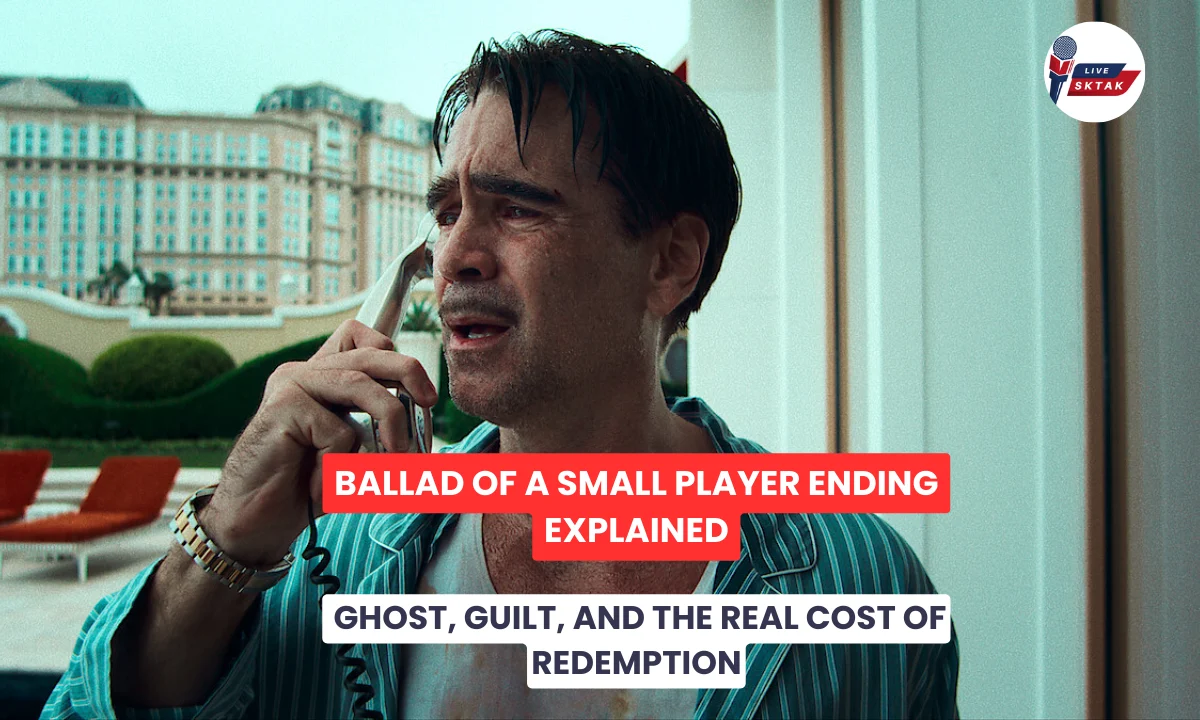
The ending of Ballad of a Small Player has left many viewers quietly unsettled. Not because it is confusing in a technical sense, but because it refuses to hand over a clean emotional answer. This Netflix film follows a man who survives on borrowed luck, borrowed money, and borrowed identities. By the final scene, the story asks a simple question that feels heavy once it lands. Was Lord Doyle saved, or was he simply released?
In this article, the Ballad of a Small Player ending explained discussion focuses on what actually happens, what might be imagined, and why the final act of burning money matters more than any winning streak. The film sits between a gambling drama and a ghost story, using Macau’s Hungry Ghost Festival as more than a backdrop. It becomes the moral engine of the story.
KEY TAKEAWAYS
- The ending is intentionally ambiguous, blending supernatural and psychological readings
- Dao Ming may be a ghost, a hallucination, or a moral guide shaped by guilt
- Burning the money symbolizes breaking the addiction cycle, not wasting wealth
- The Hungry Ghost Festival frames the story as spiritual rather than literal
- Public opinion remains split between poetic redemption and narrative frustration
WHAT THE ENDING SHOWS IN SIMPLE TERMS
By the final stretch, Doyle has done what he has chased the entire film. He wins. He clears his hotel debts. He pays off Cynthia. He walks away from the baccarat table after defeating Lippett. On paper, this is the dream ending for a gambling addict.
Then the film pulls the floor out.
Doyle learns that Dao Ming drowned herself during the Hungry Ghost Festival. The woman who guided him, calmed him, and led him to hidden money is no longer alive. The peaceful days on Lamma Island are recontextualized. They may have never happened in the way Doyle experienced them.
Instead of keeping his winnings or escaping Macau rich, Doyle walks into a temple and burns every note of cash as an offering. Fireworks fill the sky. The city glows. Doyle disappears into the night.
The film cuts before we see what comes next.
IS DAO MING A GHOST OR A DELUSION
This is the question that dominates discussions around the ending.
One reading is supernatural. Dao Ming is a ghost bound to the Hungry Ghost Festival. She appears after death to guide Doyle toward redemption. The casino staff even suggest he has a ghost attached to him. This explanation fits the film’s spiritual tone and cultural framing.
Another reading is psychological. Dao Ming represents Doyle’s conscience breaking through addiction. His binge drinking, collapse, and withdrawal symptoms suggest hallucination. The island scenes could be his mind forcing rest and clarity before another spiral.
The film never confirms either interpretation. That choice feels deliberate. Whether Dao Ming is real matters less than what she does. She interrupts Doyle’s momentum. She slows him down. She forces reflection.
In that sense, Dao Ming functions as a guide rather than a plot device. Ghost or not, she pushes Doyle to face the truth he avoids.
WHY THE HUNGRY GHOST FESTIVAL MATTERS
The Hungry Ghost Festival is not decorative.
In folklore, hungry ghosts are spirits cursed by greed and desire. They are never satisfied. They consume endlessly without relief. Dao Ming directly compares gamblers to hungry ghosts earlier in the film.
Doyle embodies this idea. No amount of money, food, or luxury calms him. Even when he wins, he feels hollow. The more he consumes, the emptier he becomes.
Burning offerings during the festival is meant to give peace to the dead. When Doyle burns his winnings, he mirrors that ritual. But the offering is also for himself. He is feeding the part of him that cannot be satisfied.
The act turns wealth into ash. Desire into silence.
WHY DOYLE BURNS THE MONEY
This is the most divisive moment of the film.
Some viewers see it as wasteful. After everything Doyle suffers, why destroy the money that could buy freedom. Others see it as the only honest ending.
Throughout the film, money is poison. Every win leads to another loss. Every debt pulls him deeper. The winnings he burns are tied to theft, lies, and addiction.
By destroying them, Doyle breaks the cycle. He chooses absence over excess. Loss over illusion.
Importantly, the film does not claim this act cures him. It does not promise recovery. It shows a decision. One clean moment of refusal.
DOES DOYLE FIND REDEMPTION
The ending does not show Doyle sober, healed, or transformed into a better man. That would be dishonest.
Instead, it shows him letting go.
Redemption here is quiet. It is not victory. It is restraint. Doyle walks away from the table. He resists Grandma’s offer. He gives away what he once would have protected at any cost.
Whether he stays free is unknown. The film ends before certainty arrives.
That uncertainty is the point.
PUBLIC OPINION ON THE ENDING
Public reaction on X reflects how personal this ending feels.
Many viewers praised the emotional weight and haunting tone. They describe the ending as poetic, spiritual, and unexpectedly gentle for a gambling film. Colin Farrell’s performance is often called raw and vulnerable, especially in the final moments.
Others reacted with frustration. Burning the money felt pointless to them. Some felt the ghost reveal was predictable or underdeveloped. A few viewers questioned the logic of Dao Ming’s guidance if she was truly supernatural.
The split opinion mirrors the film’s theme. People want clarity. The story offers ambiguity.
That tension keeps the ending alive long after the credits roll.
SYMBOLS THAT TIE THE ENDING TOGETHER
To understand the ending, it helps to look at repeating symbols rather than plot points.
Gambling Tables
They represent control disguised as chance. Doyle believes skill will save him. It never does.
Food And Excess
Doyle eats without hunger. He drinks without joy. Consumption becomes punishment.
The Number On His Hand
A test rather than a gift. He fails it when he steals the money. He passes it when he burns it.
Fireworks
Celebration and destruction at once. Beauty that disappears instantly.
ENDING INTERPRETATIONS AT A GLANCE
| Interpretation | What It Suggests |
|---|---|
| Supernatural | Dao Ming is a guiding spirit offering redemption |
| Psychological | Dao Ming is Doyle’s fractured conscience |
| Symbolic | The story is about breaking addiction, not ghosts |
| Cultural | Buddhist themes reshape the gambling narrative |
Each interpretation leads to the same emotional destination. Letting go is harder than winning.
HOW THE ENDING REFRAMES THE WHOLE FILM
Once the ending lands, earlier scenes change meaning.
Doyle’s confidence feels fragile. His charm feels rehearsed. His accent shifts feel like survival tactics, not clever tricks.
Dao Ming’s calm stands out against casino noise. Silence becomes the rarest luxury in the film.
The ending does not resolve the story. It reframes it. This was never about money. It was about hunger.
FINAL THOUGHT ON THE ENDING
The Ballad of a Small Player ending explained conversation continues because the film trusts the audience to sit with discomfort. It refuses easy redemption. It refuses punishment.
Doyle does not walk away rich. He does not collapse in tragedy. He steps into uncertainty.
That choice makes the ending linger.
Some viewers see peace. Others see loss. The film allows both. And that may be its quiet success.
Tags: Ballad of a Small Player ending explained, Colin Farrell gambling movie, Dao Ming ghost theory, Hungry Ghost Festival meaning, Netflix movie ending analysis, psychological vs supernatural films, gambling addiction movies