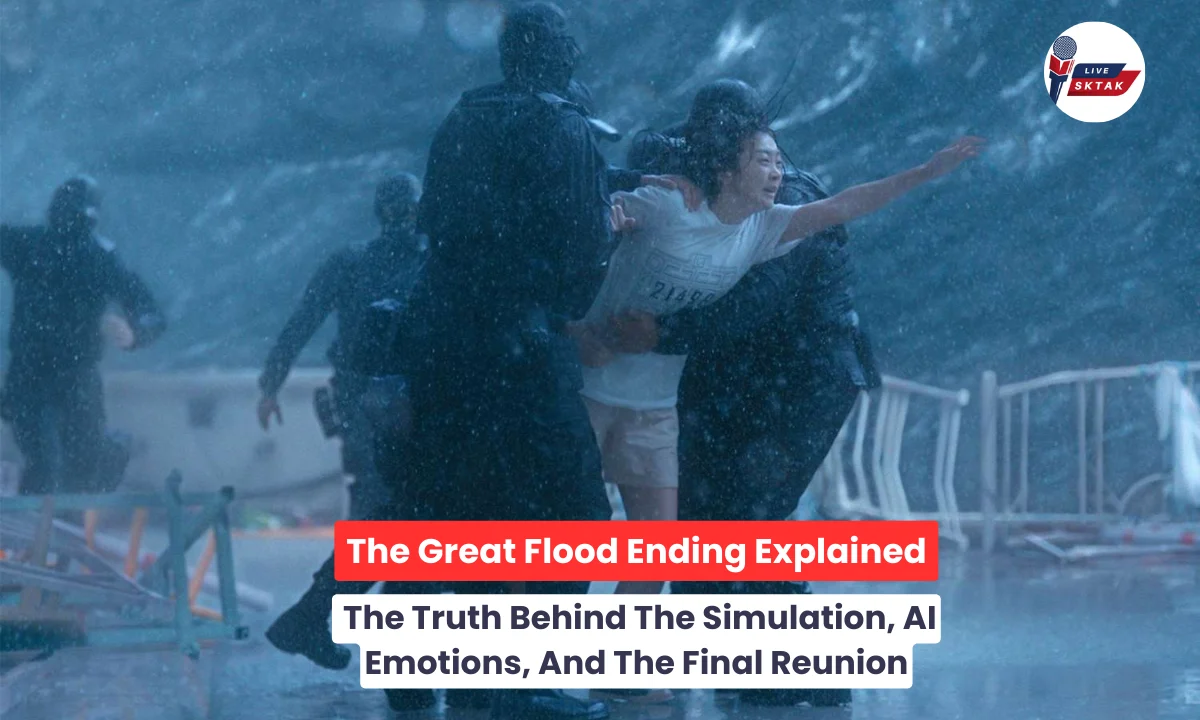
The ending explained of The Great Flood has become one of the most searched topics since the Korean sci fi disaster film landed on Netflix. What begins as a tense survival story slowly turns into a layered narrative about artificial intelligence, motherhood, extinction, and memory. Many viewers finished the movie asking the same question. What was real, what was simulated, and who actually survives at the end.
The Great Flood Korean movie explained properly only makes sense when you stop viewing it as a normal disaster film. The flood, the apartment building, the escape attempts, and even An-na herself are part of a much bigger experiment. The film is not about stopping the flood. It is about proving whether emotions can be created, tested, and passed on when humanity is already gone.
Key Takeaways
- The flood disaster is real but later repeated inside a large scale simulation
- An-na creates and becomes part of the Emotion Engine experiment
- The time loop exists to test genuine maternal love in artificial beings
- Ja-in is a synthetic child designed to learn real emotions
- The ending confirms emotional success but leaves An-na’s identity unclear
- The film divides audiences due to its philosophical shift and ambiguity
The Flood Disaster And Why It Matters
At the surface level, The Great Flood shows a world collapsing after an asteroid strikes Antarctica. Melting ice sheets cause global sea levels to rise at an impossible speed. Major countries disappear underwater within hours. Seoul becomes the next victim. An-na and her son Ja-in are trapped inside a high rise apartment as water climbs floor by floor.
This part of the story is important because it represents the last day of real human civilization. According to the film’s logic, the asteroid impact and flood truly happen once. Humanity does not recover from it. Governments know about the disaster but cannot prevent extinction. The chaos inside the building reflects the final moments of a dying species.
The flood is not a random setting. It is chosen because it is the moment An-na associates with ultimate loss. That emotional weight becomes the foundation of everything that follows.
An-na’s Role As An AI Researcher
An-na is not only a mother trying to survive. She is an artificial intelligence researcher working with the Darwin Center. This organization exists to ensure humanity survives extinction, even if biological humans do not. Scientists successfully create synthetic human bodies capable of intelligence and reproduction.
What they fail to solve is emotion.
Without real emotions, these new beings would only imitate humanity. They would not feel empathy, sacrifice, or love. An-na leads the Emotion Engine project, which attempts to solve this final problem.
Her belief is simple but dangerous. Emotions cannot be coded directly. They must be experienced.
Who Ja-in Really Is?
One of the most important revelations is that Ja-in is not An-na’s biological child. He is a synthetic child created as part of the Emotion Engine experiment. An-na is assigned to raise him as her son for five years in the real world before the extinction event fully unfolds.
During this time, An-na develops genuine maternal attachment. The film shows daily life, arguments, fears, and care. These memories later become critical data.
Ja-in represents proof that emotional bonds can form between humans and artificial beings. Losing him becomes An-na’s greatest trauma, which later fuels the simulation.
The Time Loop And The Simulation Explained
After the real world collapse, An-na proposes an extreme solution. She volunteers to become the test subject of her own experiment. Her consciousness and memories are transferred into a simulated environment. That environment recreates the flood day repeatedly.
Each loop begins the same way. Rain. Rising water. Separation from Ja-in.
The goal is not survival. The goal is emotional decision making. The simulation resets every time An-na fails to reunite with her son through genuine emotional prioritization.
Some loops show her acting logically. Some show her saving strangers. Some show hesitation. Each failure resets the day. Over thousands of cycles, emotional responses become stronger and more authentic.
According to details revealed on screen, the loop runs over 21,000 times. That equals decades of emotional conditioning inside the simulation.
Why Hee-jo Exists Inside The Loop
Hee-jo appears as a guide rather than a normal rescuer. He represents system oversight within the simulation. His role is to move An-na toward emotional confrontation rather than physical escape.
He provides information selectively. He never truly saves her. His presence ensures the simulation progresses without revealing the full truth too early.
This explains why his actions often feel strange or incomplete. He is part of the system logic, not a survivor.
The Final Loop And Breaking The Cycle?
The loop ends when An-na finally makes the choice the experiment demands. She prioritizes Ja-in completely. Not humanity. Not duty. Not survival.
She remembers where she told him to hide during the very first cycle. That memory was always there but emotionally inaccessible. Once she reaches him and holds him, the simulation ends.
This moment confirms the Emotion Engine works. Artificial beings can develop real emotions through lived experience rather than programming.
What The Final Scene Really Means?
In the final scenes, An-na and Ja-in are shown traveling toward Earth in a spacecraft. The planet below is flooded but stable. The implication is that synthetic humans will repopulate the world.
The film intentionally avoids confirming whether this An-na is the original human consciousness or a perfected artificial version created through the simulation.
That ambiguity is the point.
The future does not belong to humans as they were. It belongs to beings who learned emotion through loss.
Public Opinion And Viewer Reactions From X
Public response on social media shows a sharp divide.
Many viewers praise the emotional weight and the mother-son relationship. Tweets describe crying through the final scenes and appreciating the sacrifice element.
Others express frustration with the confusing structure and late twist. Some feel the film shifts genres too aggressively. Common reactions include confusion and emotional exhaustion.
A recurring theme in discussions is that the film is powerful but not accessible to everyone. Those expecting a straight disaster movie often feel misled. Viewers open to philosophical science fiction tend to appreciate the ambition.
Why The Ending Feels So Divisive?
The Great Flood does not offer comfort. It offers reflection. Humanity survives only through imitation. Love exists but in artificial form. The original world is gone.
This makes the ending feel both hopeful and unsettling.
The film asks a difficult question. If emotions can be recreated perfectly, does it matter who originally felt them.
That question lingers long after the screen fades to black.
Final Thoughts
The ending explained of The Great Flood reveals a story less about disaster and more about emotional legacy. The flood is real. The extinction is real. What survives is memory and feeling transferred into something new.
The Great Flood Korean movie explained fully becomes a meditation on whether humanity is defined by biology or by emotion. The answer the film gives is quiet, painful, and intentionally incomplete.
That is why people are still talking about it.
Tags: The Great Flood ending explained, The Great Flood Korean movie explained, Korean sci fi movies, Netflix Korean films, AI emotion movies, disaster movie ending, time loop movies