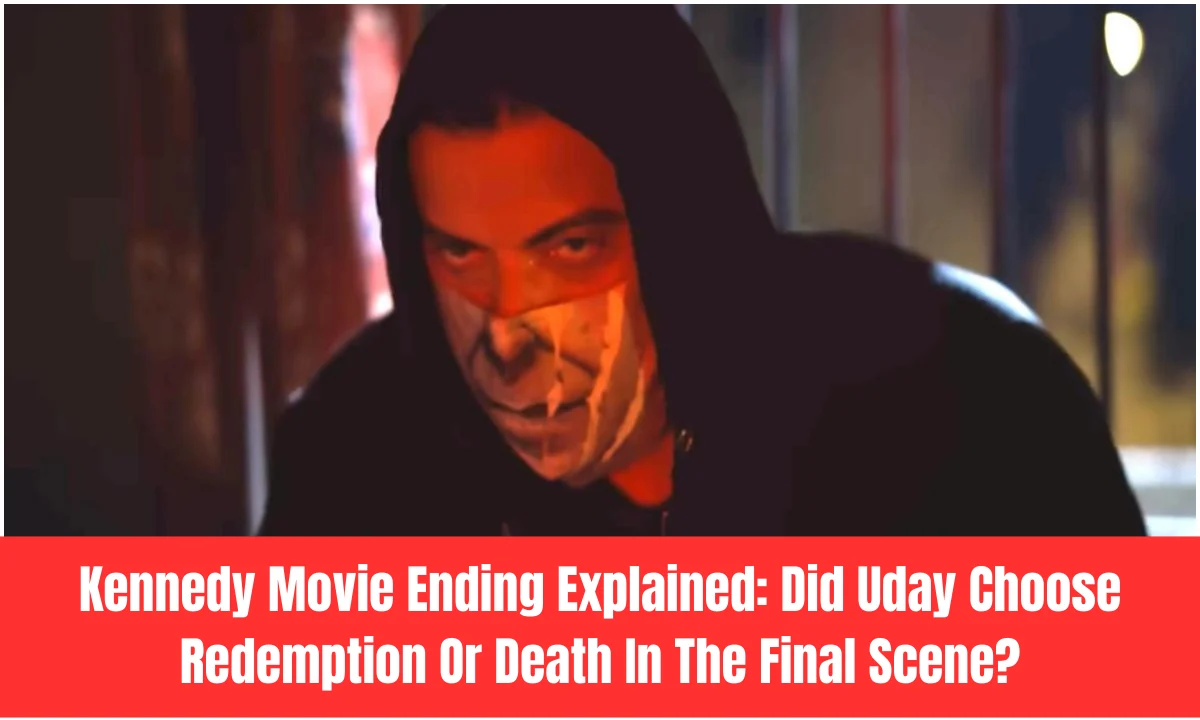
If you just finished watching Kennedy and sat there staring at the screen during that last phone call, you are not alone. The ending of Kennedy does not spoon feed anything. It leaves you with a ringing phone, a broken man, and a question that hits straight in the chest.
Directed by Anurag Kashyap and powered by a haunting performance from Rahul Bhat, this neo noir crime thriller is not just about violence. It is about guilt. It is about systemic corruption. It is about a man officially declared dead who cannot escape his own conscience. So let us break down the Kennedy movie ending explained in simple and clear words.
Key Takeaways
- Uday Shetty, aka Kennedy, was declared dead and turned into a shadow hitman.
- His real motive throughout the film was revenge against Saleem for his son Adi’s death.
- He kills Saleem and later eliminates Commissioner Rasheed Khan.
- He uploads evidence exposing the corrupt system before disappearing.
- His daughter Aditi calls him in the final scene.
- The film cuts to black before we know whether he answers or pulls the trigger.
- The ending is intentionally ambiguous and focuses on guilt, not action.
The Past That Broke Uday Forever
Before he became Kennedy, Uday Shetty was a police officer. Not a clean hero. Not a textbook cop. He crossed lines. In one reckless operation, he suffocates Chandan, the brother of gangster Saleem’s partner. That mistake triggers a chain reaction.
Saleem retaliates by planting a car bomb that kills Uday’s young son Adi. That single act destroys Uday’s family. His wife cuts ties. His daughter Aditi grows up believing her father is gone.
To save the department from scandal, Rasheed Khan declares Uday officially dead. Instead of punishment, he gets repurposed. Hidden. Rebranded. Used.
That is where Kennedy is born.
Living As A Ghost In A Corrupt System
Set during the COVID 19 pandemic in a decaying Mumbai, the film shows a city where power, police and criminals are all mixed up. Rasheed Khan, now Police Commissioner, runs dirty operations. Kennedy becomes his silent weapon.
On paper he is a luxury chauffeur. In reality he is a contract killer cleaning up political messes.
The film carefully shows how Kennedy does not sleep. His insomnia is not random. It is guilt. He sees ghosts of people he killed. He barely talks. He moves like a man already buried.
Many viewers on X have pointed out that Kennedy feels like a spiritual cousin to Kashyap’s darker films. The comparison with Ugly and Raman Raghav 2.0 keeps coming up. That slow burn character study vibe is very clear here too.
What Kennedy Really Wanted All Along
For most of the film, it feels like Kennedy is just surviving. Taking orders. Killing without emotion. But halfway through, we realise something important. He has a plan.
He deliberately kills Akbar, who is Saleem’s nephew. That is not random. It is a message. He wants Saleem to know he is alive. He wants him to come out. Revenge is his fuel.
At the same time, he also wants Rasheed gone. The same man who protected him is also the one who trapped him inside a corrupt machine. This is not just about one gangster. It is about cleaning the entire rot.
The Charlie Angle And Emotional Undercurrent
Charlie, played by Sunny Leone, brings a different energy into the film. She is trapped by Rasheed. Her boyfriend Kabir is killed by Kennedy in the opening sequence without knowing the full picture.
Later she realises who he is.
Strangely, she still turns to him for help. Maybe she sees pain in him. Maybe she senses he is not fully evil. Through Charlie, we see a small glimpse of the man Uday once was. She represents a life he can never return to.
The Final Confrontation Explained
The climax is brutal and personal. Rasheed sides with Saleem once Kennedy becomes uncontrollable. They try to trap him through Charlie. But Kennedy outsmarts them.
He kills Saleem after a violent struggle. He never gets a full emotional closure about his son’s death. Saleem taunts him till the end.
Then comes the big moment. Kennedy eliminates Rasheed Khan. The corrupt commissioner who used him like a disposable weapon.
With Saleem and Rasheed dead, his revenge arc is technically complete. But is he free?
The Confession And The Daughter’s Call
Here is where the ending becomes powerful.
Kennedy uploads evidence exposing the entire police underworld nexus. He sends a message to his daughter Aditi. He first types I love you. Then changes it to I am sorry.
That detail hurts.
Aditi realises her father is alive. She calls him. Again and again. He holds a gun inside his mouth. The phone keeps ringing. Cut to black. No gunshot. No hello.
Did Uday Kill Himself Or Answer The Call?
This is the core of the Kennedy movie ending explained.
There are three strong interpretations.
1. He Pulls The Trigger
The guilt is too heavy. His son is gone. His wife moved on. His daughter grew up without him. He exposed the system. His job is done. Suicide becomes his final punishment to himself.
The film shows him putting the gun in his mouth. That image is not casual.
2. He Answers The Call
The constant ringing may symbolise a second chance. Aditi calling him is redemption knocking at his door. If he answers, he chooses to live with consequences instead of escaping.
This would make the ending tragic but hopeful.
3. The Film Does Not Want You To Know
This is the most likely answer.
Kashyap avoids closure deliberately. The focus is not whether he lives or dies. The focus is that he finally faces himself. For the first time, he is not killing for someone else. He is making a personal choice.
That is why the film cuts before resolution.
Public Opinion On X And Audience Reactions
Since its India streaming release on Zee5 in February 2026, reactions have been strong.
Many users praised Rahul Bhat’s restrained performance. Words like haunting, controlled, internal acting are common in discussions. People felt the ending gave an emotional gut punch.
Some viewers found the third act slightly convoluted. Flashbacks and side politics confused a few people. But almost everyone agrees the final scene lands hard.
A lot of posts describe the daughter’s unanswered call as the most heartbreaking moment of the film. It symbolises lost time. Lost fatherhood. Lost redemption.
The non glamorous violence and raw portrayal of police corruption during the pandemic also received appreciation. No heroic slow motion. No dramatic speeches. Just decay.
Themes That Define The Ending
Here is a quick breakdown of what the ending represents:
| Theme | How It Connects To The Ending |
|---|---|
| Guilt | His insomnia and final hesitation reflect inner torment |
| Revenge | Saleem’s death completes his mission |
| Corruption | Killing Rasheed and uploading evidence exposes the system |
| Isolation | He stands alone in the final scene |
| Redemption | The phone call represents a possible second chance |
Why The Ending Works So Well
There is no dramatic background score telling you what to feel. No heroic sacrifice moment. Just silence and a ringing phone. That is bold.
In typical commercial thrillers, you would get a clear answer. Here, you are forced to sit with discomfort. That discomfort is the point.
Kennedy was already declared dead years ago. The final scene asks whether he wants to live again emotionally. Not physically. And that question stays with you.
Final Verdict
Kennedy is not a mass entertainer. It is slow. It is moody. It is heavy. But the ending elevates everything that came before it.
Whether Uday answers Aditi’s call or ends his life does not matter as much as this. For the first time, he is not acting under orders. He is confronting himself.
That is why the final black screen hits harder than any gunshot could. If you were confused, now you know. The Kennedy movie ending explained is not about plot clarity. It is about emotional truth.