India’s steel sector is quietly entering a powerful growth phase. If you’ve been searching for top steel stocks in India for long term investment, then you’re already thinking in the right direction. From massive infrastructure projects to green steel adoption, this sector is getting strong support from both demand and government policies.
But here’s the thing. Most articles just list companies and move on. They don’t tell you what actually matters in 2026 and beyond. In this article, we go deeper. We combine real market data, public sentiment, and long-term trends so you get a complete picture before making any decision.
Table of Contents
Key Takeaways
- Steel demand in India is expected to grow steadily till 2030 and beyond
- Government policies like PLI scheme and infra spending are major catalysts
- Integrated players like Tata Steel and JSW Steel are long-term favorites
- Mid and small-cap stocks in tubes and infra are gaining attention
- Public sentiment in 2026 is strongly bullish but risks still exist
- Long-term investors are focusing on capacity expansion and low-cost production
Why Steel Stocks Are Gaining Momentum In 2026
The steel sector is not just another cyclical play right now. It is turning into a structural growth story. India is pushing heavy investments into infrastructure. Roads, railways, airports, housing, and even shipbuilding are expanding fast. This directly increases steel demand. According to recent trends, the market could nearly double in size by 2033.
On top of that, government support is strong. Policies like the PLI scheme for specialty steel and plans to increase capacity to 300 million tonnes by 2030 are creating long-term visibility. Another important trend is green steel. Companies investing in low-carbon production are getting more attention from global investors. This is something many competitor articles completely miss.
Top 10 Best Steel Stocks In India For Long Term Investment
Here’s a carefully selected list based on market size, growth potential, and future outlook:
1. Tata Steel
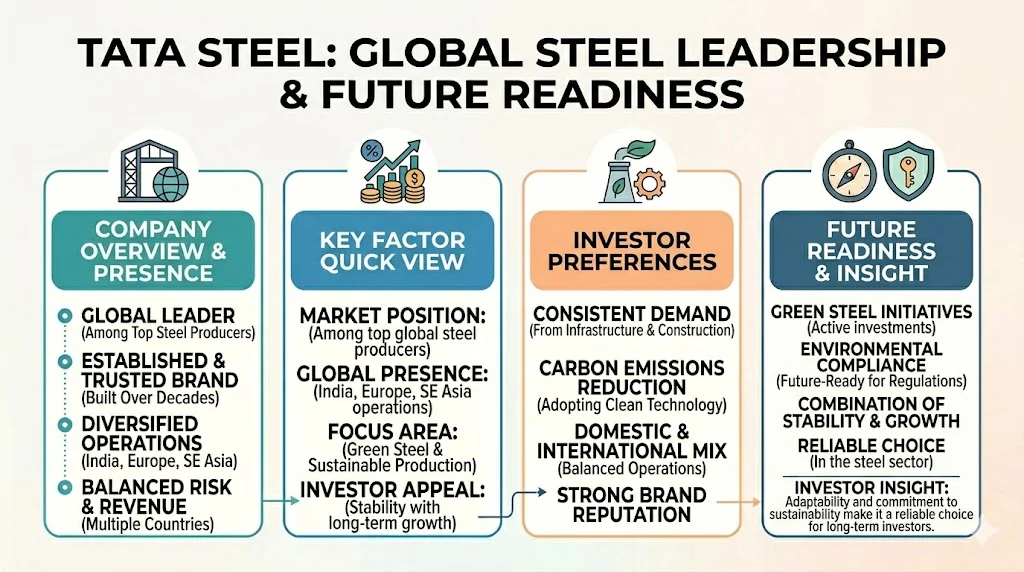
Tata Steel is one of the most trusted and established steel companies in India, known for its strong global presence and consistent performance. The company operates in multiple countries, including India, Europe, and Southeast Asia, which helps it diversify risk and maintain steady revenue streams. It is also actively investing in green steel initiatives, making it future-ready as environmental regulations become stricter.
Here’s a quick overview of Tata Steel’s strengths:
| Key Factor | Details |
|---|---|
| Market Position | Among top steel producers globally |
| Global Presence | India, Europe, Southeast Asia |
| Focus Area | Green steel and sustainable production |
| Investor Appeal | Stability with long-term growth potential |
Why investors prefer Tata Steel:
- Strong brand reputation built over decades
- Consistent demand from infrastructure and construction sectors
- Focus on reducing carbon emissions and adopting clean technology
- Balanced mix of domestic and international operations
For long-term investors, Tata Steel offers a combination of stability and growth. Its ability to adapt to changing market trends, along with its commitment to sustainability, makes it a reliable choice in the steel sector.
2. JSW Steel
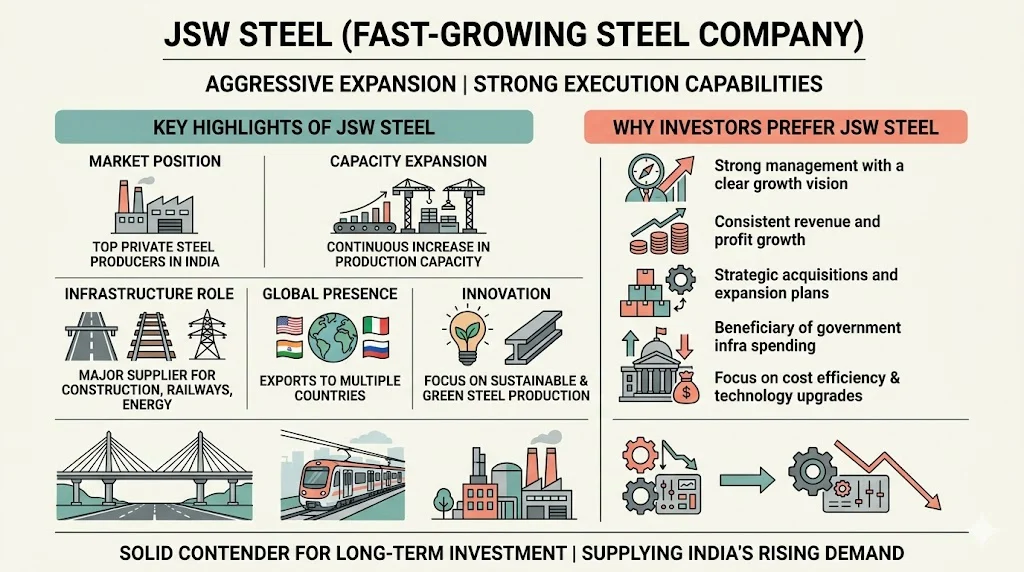
JSW Steel is one of India’s fastest-growing steel companies, known for its aggressive expansion strategy and strong execution capabilities. The company has consistently increased its production capacity and improved operational efficiency, making it a key player in meeting India’s rising infrastructure demand.
Key Highlights of JSW Steel
| Factor | Details |
|---|---|
| Market Position | Among top private steel producers in India |
| Capacity Expansion | Continuous increase in production capacity |
| Infrastructure Role | Major supplier for construction, railways, and energy projects |
| Global Presence | Exports to multiple countries |
| Innovation | Focus on sustainable and green steel production |
Why Investors Prefer JSW Steel
- Strong management with a clear growth vision
- Consistent revenue and profit growth over the years
- Strategic acquisitions and expansion plans
- Beneficiary of government infrastructure spending
- Focus on cost efficiency and technology upgrades
JSW Steel plays a crucial role in supplying steel for large-scale infrastructure projects such as highways, metro systems, and industrial developments. Its ability to scale operations quickly and adapt to market demand makes it a strong contender for long-term investment.
3. Steel Authority Of India (SAIL)
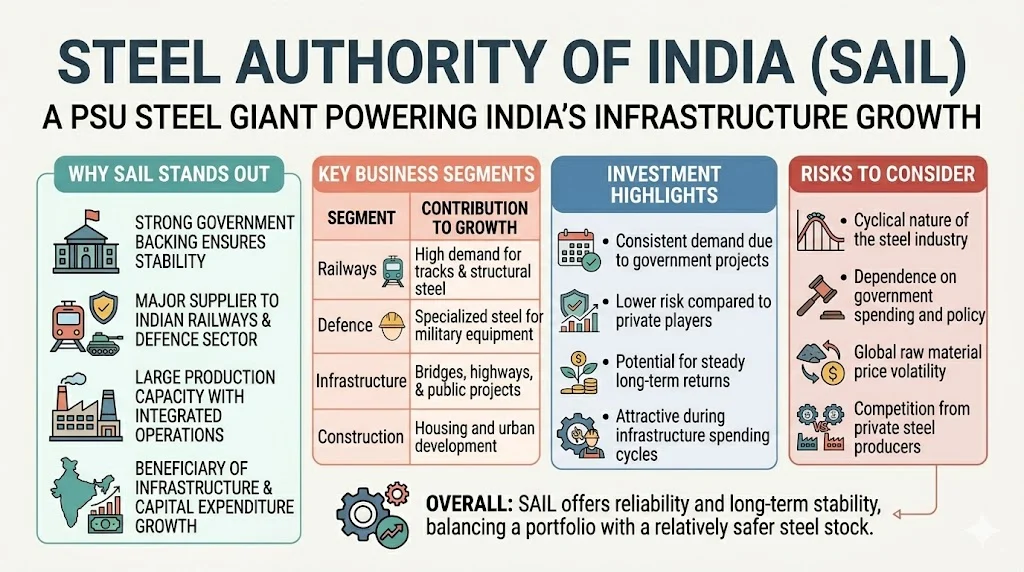
Steel Authority Of India (SAIL) is a government-backed steel giant that plays a crucial role in India’s infrastructure growth. Being a PSU, it enjoys strong policy support and consistent demand from key sectors like railways, defence, and public infrastructure projects.
Why SAIL Stands Out
- Strong government backing ensures stability
- Major supplier to Indian Railways and defence sector
- Large production capacity with integrated operations
- Beneficiary of infrastructure and capital expenditure growth
Key Business Segments
| Segment | Contribution to Growth |
|---|---|
| Railways | High demand for tracks and structural steel |
| Defence | Specialized steel for military equipment |
| Infrastructure | Bridges, highways, and public projects |
| Construction | Housing and urban development |
Investment Highlights
- Consistent demand due to government projects
- Lower risk compared to private players
- Potential for steady long-term returns
- Attractive during infrastructure spending cycles
SAIL may not always deliver explosive growth like some private companies, but it offers reliability and long-term stability. For investors looking to balance their portfolio with a relatively safer steel stock, SAIL remains a strong contender.
4. Jindal Steel And Power
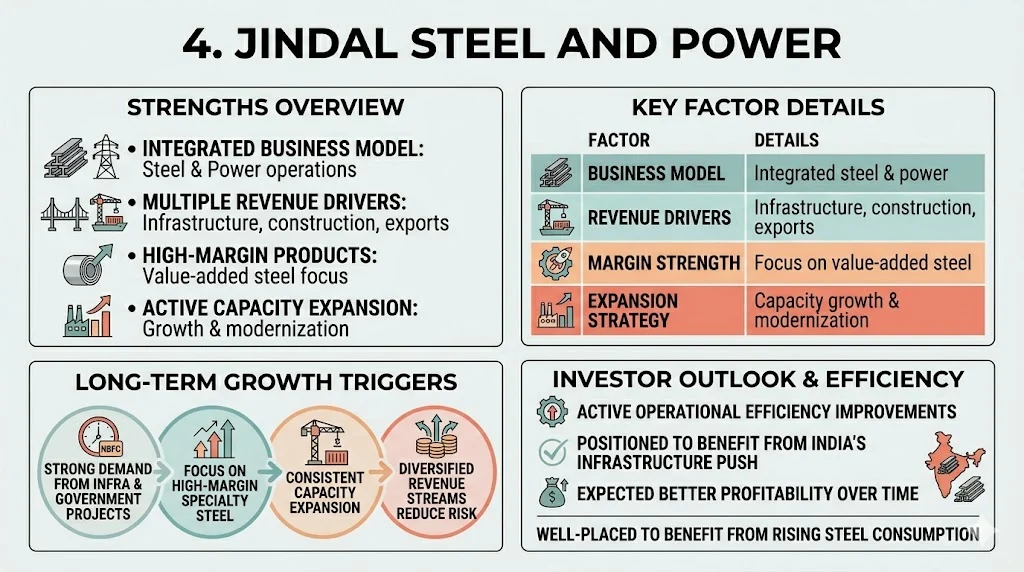
Focused on high-margin products and infrastructure projects, Jindal Steel and Power has positioned itself as a strong contender in India’s steel sector. The company benefits from its presence in both steel manufacturing and power generation, which helps maintain stable cash flows even during market fluctuations.
Here’s a quick overview of its strengths:
| Key Factor | Details |
|---|---|
| Business Model | Integrated steel and power operations |
| Revenue Drivers | Infrastructure, construction, exports |
| Margin Strength | Focus on value-added steel products |
| Expansion Strategy | Capacity growth and modernization projects |
Why investors consider it for the long term:
- Strong demand from infrastructure and government projects
- Increasing focus on high-margin specialty steel
- Consistent capacity expansion to meet future demand
- Diversified revenue streams reduce risk
The company is also actively improving operational efficiency, which can lead to better profitability over time. With India’s infrastructure push expected to continue for years, Jindal Steel and Power is well-placed to benefit from rising steel consumption.
5. Shyam Metalics
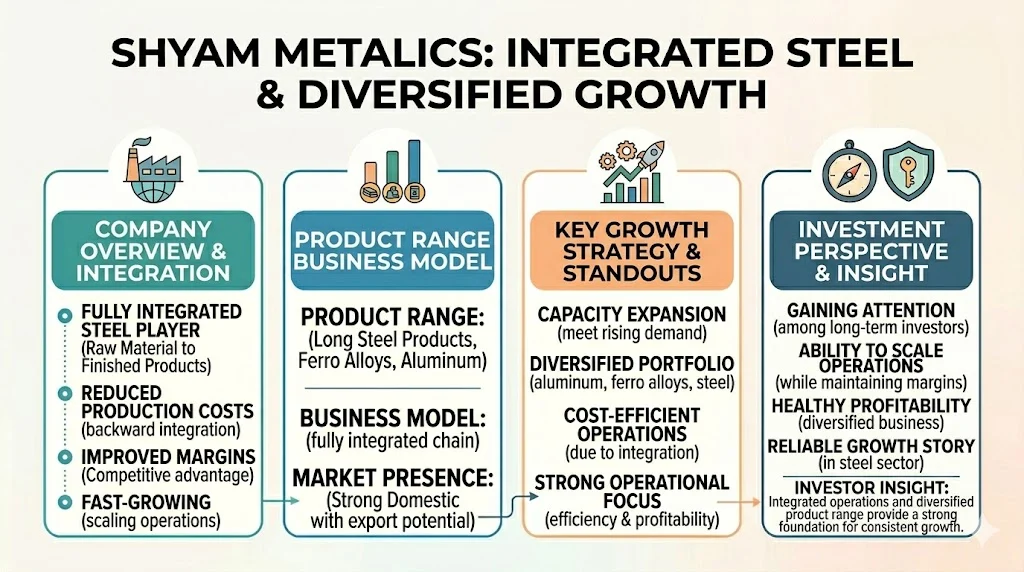
Shyam Metalics is a fast-growing integrated steel player with a strong presence across multiple segments, including long steel products, ferro alloys, and aluminum. Its integrated operations help reduce production costs and improve margins, making it a competitive player in the industry.
Key Highlights
| Factor | Details |
|---|---|
| Business Model | Fully integrated (from raw material to finished products) |
| Product Range | Steel, ferro alloys, aluminum |
| Growth Strategy | Capacity expansion and diversification |
| Market Presence | Strong domestic footprint with export potential |
Why It Stands Out
- Cost-efficient operations due to backward integration
- Diversified product portfolio reduces dependency on a single segment
- Consistent capacity expansion to meet rising demand
- Strong focus on operational efficiency and profitability
Investment Perspective
Shyam Metalics is gaining attention among long-term investors because of its ability to scale operations while maintaining healthy margins. Its diversified business model and expansion plans position it well to benefit from India’s growing infrastructure and manufacturing demand.
6. Jindal Stainless
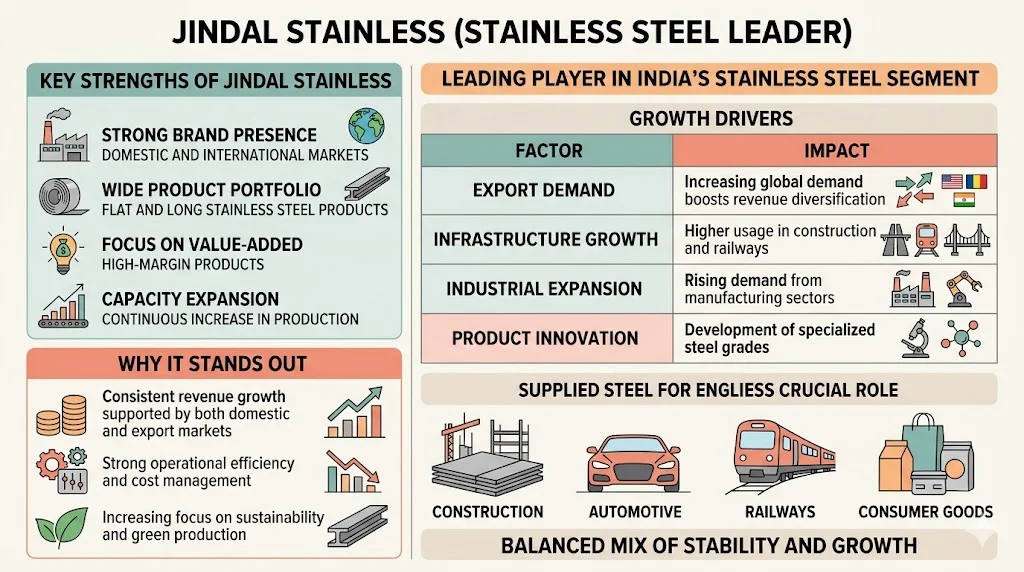
Jindal Stainless is a leading player in India’s stainless steel segment, known for its strong market position and consistent performance. The company benefits from rising demand across multiple industries such as construction, automotive, railways, and consumer goods.
Key Strengths
- Strong brand presence in domestic and international markets
- Wide product portfolio including flat and long stainless steel products
- Focus on value-added and high-margin products
- Continuous capacity expansion to meet growing demand
Growth Drivers
| Factor | Impact |
|---|---|
| Export Demand | Increasing global demand boosts revenue diversification |
| Infrastructure Growth | Higher usage in construction and railways |
| Industrial Expansion | Rising demand from manufacturing sectors |
| Product Innovation | Development of specialized steel grades |
Why It Stands Out
- Consistent revenue growth supported by both domestic and export markets
- Strong operational efficiency and cost management
- Increasing focus on sustainability and green production
Overall, Jindal Stainless offers a balanced mix of stability and growth, making it an attractive option for long-term investors looking to benefit from the expanding stainless steel market.
7. NMDC Steel
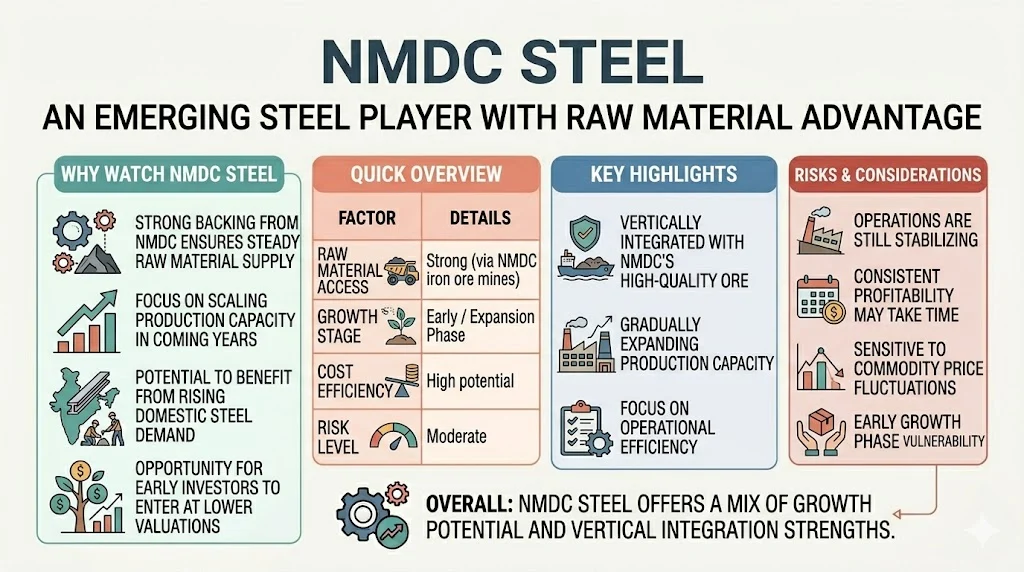
NMDC Steel is an emerging player in India’s steel sector with a strong raw material advantage, primarily due to its parent company NMDC’s access to high-quality iron ore. This vertical integration helps reduce production costs and improves long-term profitability potential. Although the company is still in its early growth phase, it is gradually expanding its production capacity and operational efficiency.
Here’s a quick overview:
| Factor | Details |
|---|---|
| Raw Material Access | Strong (via NMDC iron ore mines) |
| Growth Stage | Early / Expansion Phase |
| Cost Efficiency | High potential |
| Risk Level | Moderate |
Key reasons to watch NMDC Steel:
- Strong backing from NMDC ensures steady raw material supply
- Focus on scaling production capacity in coming years
- Potential to benefit from rising domestic steel demand
- Opportunity for early investors to enter at lower valuations
However, investors should also consider that the company is still stabilizing its operations, and consistent profitability may take time. Overall, NMDC Steel offers a mix of growth potential and moderate risk, making it suitable for long-term investors who are comfortable with emerging players.
8. Welspun Corp
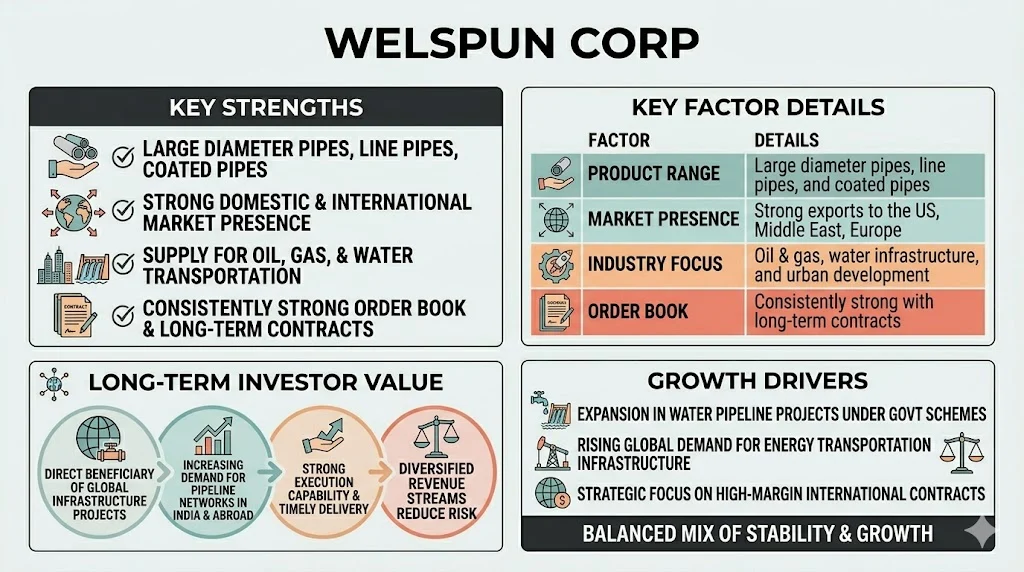
Welspun Corp stands out as a key player in the steel pipes segment, especially in infrastructure-driven projects. The company has built a strong reputation in both domestic and international markets by supplying high-quality pipes for oil, gas, and water transportation.
Key Strengths of Welspun Corp
| Factor | Details |
|---|---|
| Product Range | Large diameter pipes, line pipes, and coated pipes |
| Market Presence | Strong exports to the US, Middle East, and Europe |
| Industry Focus | Oil & gas, water infrastructure, and urban development |
| Order Book | Consistently strong with long-term contracts |
Why It Matters for Long-Term Investors
- Direct beneficiary of global energy and water infrastructure projects
- Increasing demand for pipeline networks in India and abroad
- Strong execution capability and timely project delivery
- Diversified revenue streams reduce dependency on a single sector
Growth Drivers
- Expansion in water pipeline projects under government schemes
- Rising global demand for energy transportation infrastructure
- Strategic focus on high-margin international contracts
Overall, Welspun Corp offers a balanced mix of stability and growth, making it a solid choice for investors looking to benefit from infrastructure expansion.
9. Godawari Power And Ispat
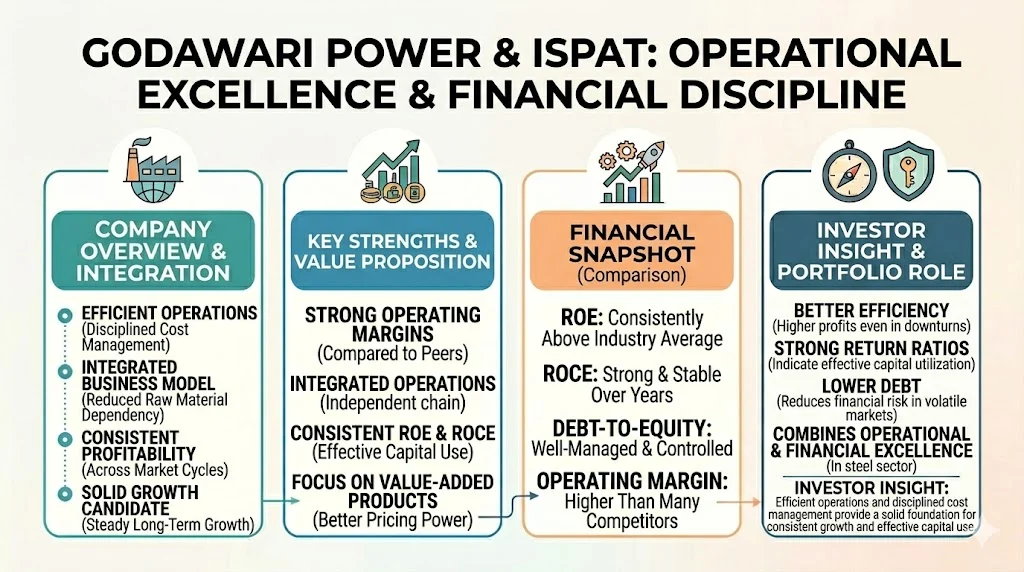
Efficient operations and strong return ratios make this company a compelling choice for long-term investors. It stands out due to its disciplined cost management, integrated business model, and consistent profitability across market cycles.
Key Strengths
- Strong operating margins compared to industry peers
- Integrated operations reducing dependency on external raw materials
- Consistent return on equity (ROE) and return on capital employed (ROCE)
- Focus on value-added products for better pricing power
Financial Snapshot
| Metric | Performance Insight |
|---|---|
| ROE | Consistently above industry average |
| ROCE | Strong and stable over years |
| Debt-to-Equity Ratio | Well-managed and controlled |
| Operating Margin | Higher than many competitors |
Why It Matters for Investors
- Better efficiency means higher profits even during downturns
- Strong return ratios indicate effective capital utilization
- Lower debt reduces financial risk in volatile markets
Overall, this company combines operational excellence with financial discipline, making it a solid candidate for investors seeking steady long-term growth in the steel sector.
10. APL Apollo Tubes
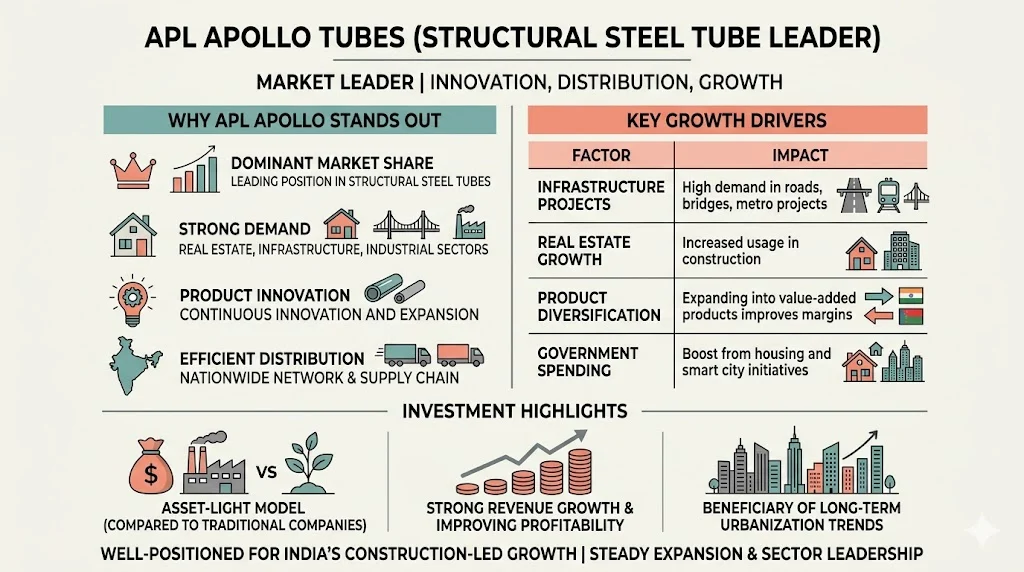
APL Apollo Tubes is a market leader in structural steel tubes and has built a strong reputation for innovation, wide distribution, and consistent growth. The company directly benefits from India’s ongoing construction and infrastructure boom, making it a strong long-term contender.
Why APL Apollo Stands Out
- Dominant market share in structural steel tubes
- Strong demand from real estate, infrastructure, and industrial sectors
- Continuous product innovation and expansion
- Efficient supply chain and nationwide distribution network
Key Growth Drivers
| Factor | Impact |
|---|---|
| Infrastructure Projects | High demand for structural steel in roads, bridges, and metro projects |
| Real Estate Growth | Increased usage in residential and commercial construction |
| Product Diversification | Expanding into value-added products improves margins |
| Government Spending | Boost from housing and smart city initiatives |
Investment Highlights
- Asset-light model compared to traditional steel companies
- Strong revenue growth and improving profitability
- Beneficiary of long-term urbanization trends
Overall, APL Apollo Tubes is well-positioned to capitalize on India’s construction-led growth story, making it an attractive option for long-term investors seeking steady expansion and sector leadership. These companies are widely discussed in industry data and competitor research , but what matters more is how they fit into future trends.
Important Factors To Consider Before Investing
Most blogs just give a list. But real investors look at deeper factors.
- Balance Sheet Strength: Steel is a capital-heavy business. Companies with high debt can struggle during downturns.
- Integration Advantage: Companies that control raw materials like iron ore have better margins.
- Capacity Expansion: Firms increasing production capacity are more likely to benefit from future demand.
- Green Steel Adoption: This is the next big theme. Companies investing here may see premium valuations.
Share Price Target Trends (What People Are Searching)
Let’s break down some popular search queries and what they actually mean:
Share Price Target Estimates (Bear vs Bull Case – 2030)
| Stock Name | Bear Case Target (2030) | Bull Case Target (2030) | Key Insight |
|---|---|---|---|
| Tata Steel | ₹180 – ₹220 | ₹350 – ₹450 | Strong global presence and green steel focus can drive long-term growth |
| Lloyd Steel | ₹60 – ₹90 | ₹180 – ₹250 | High risk due to debt, but expansion can create upside potential |
| Rama Steel Tubes | ₹40 – ₹70 | ₹120 – ₹180 | Growth linked to infrastructure and construction demand |
| Vibhor Steel | ₹150 – ₹220 | ₹400 – ₹550 | Emerging player with rising investor interest and insider activity |
| IRB Infra | ₹70 – ₹100 | ₹180 – ₹250 | Infra growth directly supports steel demand indirectly |
| Ircon International | ₹90 – ₹130 | ₹220 – ₹300 | Strong order book from railway and infra projects |
| Cochin Shipyard | ₹900 – ₹1200 | ₹2000 – ₹2800 | Shipbuilding boom and defence orders can boost growth |
| HEG Ltd | ₹1200 – ₹1600 | ₹3000 – ₹4200 | Linked to graphite demand in steel production cycle |
Public Opinion On Steel Stocks (Real Market Sentiment)
This is where things get interesting. On social platforms like X, the sentiment around steel stocks in 2026 is clearly bullish. Many investors are calling the metal sector the “next leader” of the market. Even during corrections, steel stocks are showing strength. That’s usually a sign of sector rotation.
Some key points people are talking about:
- Strong government push for infrastructure
- Attractive valuations compared to growth potential
- Re-rating opportunities in mid-cap and small-cap stocks
- Long-term compounding potential
But not everything is positive. There are also concerns:
- Rising imports can impact margins
- High debt in expansion-heavy companies
- Global steel price fluctuations
This balanced view is something missing in most competitor articles.
Advantages Of Investing In Steel Stocks
- Long-Term Demand: Infrastructure and housing demand will keep steel consumption strong.
- Inflation Hedge: Steel prices often rise with inflation, protecting investor value.
- Government Support: Policies and spending create a stable growth environment.
- Export Opportunities: Many Indian companies are expanding globally.
Risks You Should Not Ignore In The Steel Sector
- Cyclical Nature: Steel is still a cyclical industry. Prices can fluctuate.
- Raw Material Costs: Iron ore and coal prices impact margins directly.
- Overcapacity: Too much supply can reduce profitability.
- Debt Burden: Expansion requires heavy investment, which increases financial risk.
Future Outlook Of Steel Sector In India
The future looks promising but not without challenges. India is expected to become one of the largest steel producers globally. Demand from construction, railways, defence, and renewable energy will keep rising.
Green steel is another game changer. Companies investing early may dominate the next decade. Also, niche segments like steel tubes, shipbuilding, and railway infrastructure are expected to outperform traditional players in terms of growth rate.
My Final Thoughts
If you’re thinking about building wealth over the long term, steel stocks are definitely worth a closer look. This isn’t just a short-term trend anymore. It’s slowly shaping into a long-term growth story, supported by real demand and strong government backing.
That said, I’d personally suggest not getting carried away by the hype. Take your time, look at the fundamentals, understand the company’s debt levels, and see if they have a clear plan for the future. These small checks can make a big difference over time.
In my experience, a balanced approach works best. Having a mix of stable large-cap companies along with a few promising mid-cap stocks can help you grow steadily while managing risk. Investing is not about quick wins, it’s about staying patient and letting your money compound over the years.