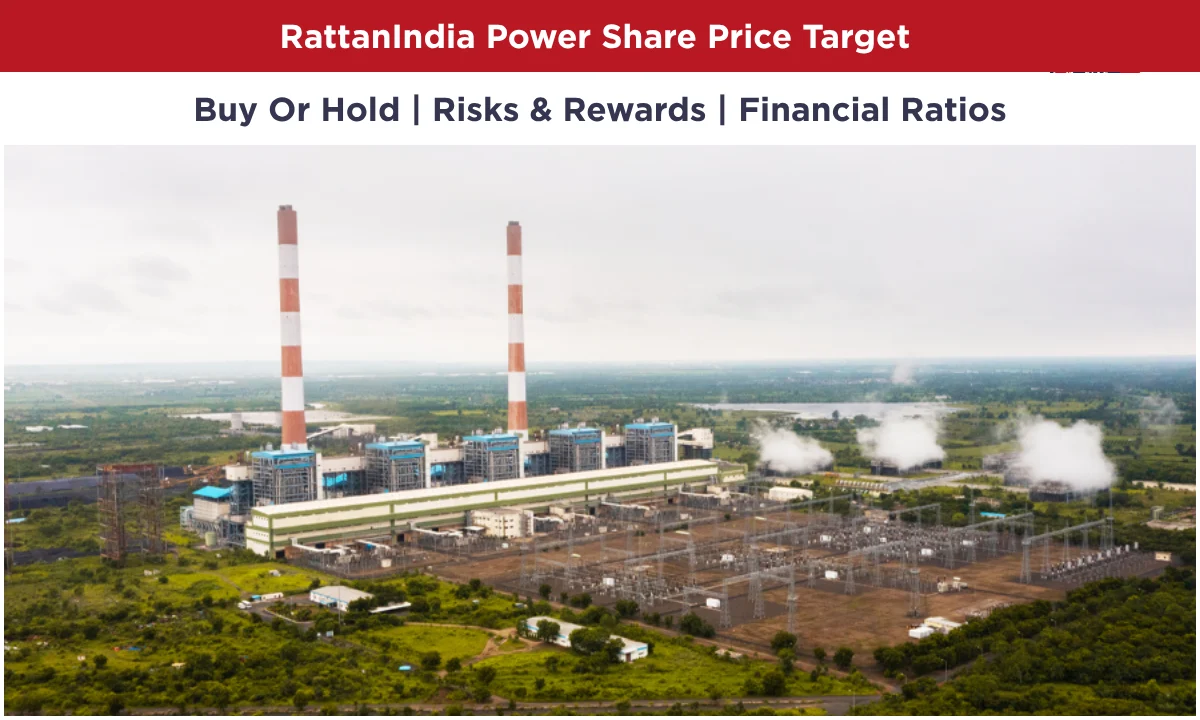
RattanIndia Power is one of the large private thermal power generation companies in India. The company operates 2,700 MW coal based power plants located at Amravati and Nashik in Maharashtra.
These plants were built with a total investment of more than ₹18,000 crore and are spread across large infrastructure networks including railway lines and water pipelines. The company generates electricity and supplies it to state utilities and discoms.
Over the last 5 years, the company has shown decent revenue growth with around 20% CAGR, but profit performance has been volatile due to high debt and interest costs.
Promoter holding remains stable at around 44%, which is a positive sign, but high promoter pledging and debt remain key concerns. Recently, the company reported a strong Q3 FY26 profit of ₹52.76 crore and improved collections from MSEDCL, which shows early signs of turnaround.
Table of Contents
RattanIndia Power share price target 2026
The company may show gradual recovery in 2026 due to improved plant availability and better coal supply. The recent profit jump and regulatory cash inflow from MSEDCL collections can support short term financial stability. However, high debt and interest burden will continue to put pressure on earnings. If the company is able to maintain stable quarterly profits, the stock can see moderate upside.
| Year | Month | Share Price Target (₹) |
|---|---|---|
| 2026 | January | 12 – 15 |
| 2026 | December | 18 – 22 |
RattanIndia Power share price target 2027
By 2027, the company may benefit from better utilization of its 2,700 MW capacity. If receivables improve and cash flow becomes stable, financial stress may reduce. Legal clarity from NCLT and resolution of past disputes are positive signals. Still, investors will closely watch debt reduction and consistent earnings before re rating the stock.
| Month | Share Price Target (₹) |
|---|---|
| Jan 2027 | 12 – 15 |
| Dec 2027 | 18 – 22 |
RattanIndia Power share price target 2028
In 2028, the company may see stable operations if it maintains plant efficiency and secures long term power purchase agreements. However, the shift towards renewable energy in India can act as a long term challenge for thermal power companies. Growth will depend on how efficiently the company manages its assets and costs.
RattanIndia Power share price target 2028
| Month | Share Price Target (₹) |
|---|---|
| Jan | 12 – 15 |
| Dec | 18 – 22 |
RattanIndia Power share price target 2029
By 2029, the company may become a stable cash flow business if debt is reduced further. Improved EBITDA and better interest coverage will be important. If the company continues to recover dues from discoms and maintains profitability, investor confidence may improve.
| Month | Share Price Target (₹) |
|---|---|
| Jan | 12 – 15 |
| Dec | 18 – 22 |
RattanIndia Power share price target 2030
India’s energy demand will continue to grow, but the share of thermal power may decline slowly. RattanIndia Power can still benefit from base load demand. If the company adapts to policy changes and improves financial strength, it can sustain its business in the long run.
RattanIndia Power share price target 2030
| Month | Share Price Target (₹) |
|---|---|
| Jan | 18 – 22 |
| Dec | 28 – 35 |
RattanIndia Power share price target 2040
In the long term, thermal power companies may face pressure due to renewable transition. RattanIndia Power may need to diversify into cleaner energy or improve efficiency of existing plants. Long term survival will depend on strategic transformation and financial discipline.
RattanIndia Power share price target 2040
| Month | Share Price Target (₹) |
|---|---|
| Jan | 18 – 22 |
| Dec | 28 – 35 |
RattanIndia Power share price target 2050
By 2050, the energy sector may be dominated by renewables and storage technologies. Thermal companies like RattanIndia Power will need to reinvent their business model. If the company adapts successfully, it can remain relevant, otherwise growth may remain limited.
| Month | Share Price Target (₹) |
|---|---|
| January 2050 | 25 – 35 |
| December 2050 | 40 – 60 |
Also Read: Top 10 Best Energy Stocks In India For Long Term [2026-2040]
Should I buy RattanIndia Power share?
The company is currently in a recovery phase. Recent profit improvement and regulatory cash inflows are positive signs. However, high debt, promoter pledging, and past inconsistent earnings are major risks. The stock may be suitable for high risk investors who are looking for turnaround opportunities. Always do your own research and understand the risks before investing.
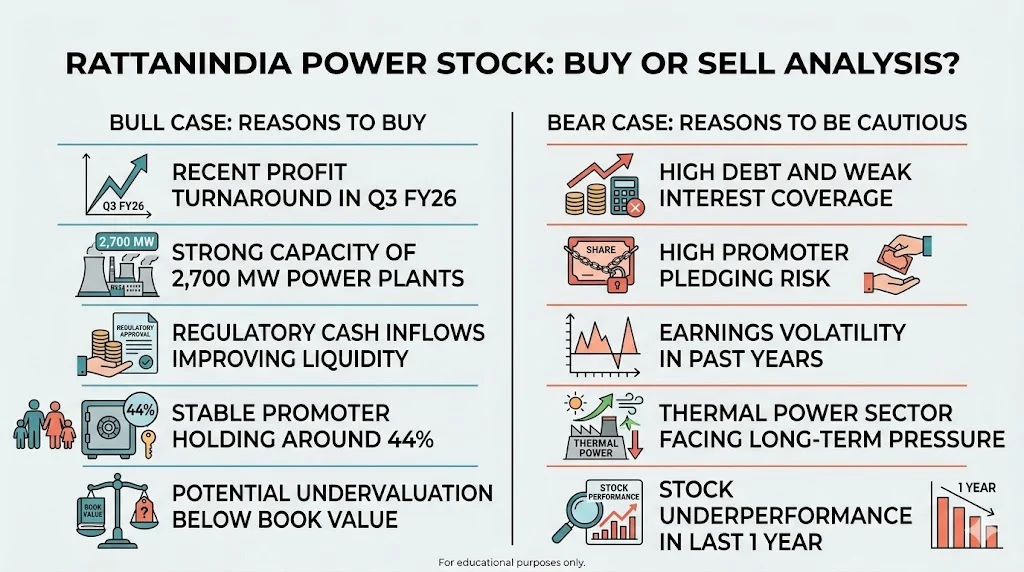
Is RattanIndia Power stock good to buy (Bull case & Bear case)
Bull Case:
- Recent profit turnaround in Q3 FY26
- Strong capacity of 2,700 MW power plants
- Regulatory cash inflows improving liquidity
- Stable promoter holding around 44%
- Potential undervaluation below book value
Bear Case:
- High debt and weak interest coverage
- High promoter pledging risk
- Earnings volatility in past years
- Thermal power sector facing long term pressure
- Stock underperformance in last 1 year
Promotors Holding Of RattanIndia Power
| Year | Promoter Holding (%) |
|---|---|
| 2021 | ~44 |
| 2022 | ~44 |
| 2023 | ~44 |
| 2024 | ~44 |
| 2025 | 44.06 |
Promoter holding is stable which is a positive sign. It shows promoters have confidence in the business. However, high pledging of shares is a major concern and increases risk.
Revenue growth Of RattanIndia Power
| Year | Revenue (₹ Cr) | Growth % |
|---|---|---|
| 2021 | 1560 | — |
| 2022 | 3260 | 108.4 |
| 2023 | 3231 | -0.9 |
| 2024 | 3364 | 4.1 |
| 2025 | 3284 | -2.4 |
Revenue growth has been reasonably strong on an overall basis, reflecting the company’s ability to scale its operations and improve topline performance over time. However, the growth trajectory has not been consistent across the years.
The company experienced a significant surge in revenue during 2022, driven by improved operational efficiency and favorable market conditions. Following this period of strong expansion, growth momentum moderated in subsequent years, indicating challenges in sustaining the same pace of increase.
This inconsistency suggests that while the company has growth potential, it may be influenced by external factors such as demand fluctuations, pricing dynamics, and operational constraints.
Profit growth (CAGR%) of RattanIndia Power
| Year | Net Profit (₹ Cr) |
|---|---|
| 2021 | 96 |
| 2022 | 210 |
| 2023 | 200 |
| 2024 | -102 |
| 2025 | 215 |
Profit trend is highly volatile, reflecting significant fluctuations in the company’s earnings over the years. The loss reported in 2024 highlights underlying operational and financial challenges, indicating a lack of consistency in profitability. Such instability raises concerns about the company’s ability to maintain sustainable earnings growth and may impact investor confidence in the long term.
EPS or ROE trends of RattanIndia Power
| Year | EPS (₹) | ROE (%) |
|---|---|---|
| 2021 | 0.19 | 1.96 |
| 2022 | 0.65 | 6.59 |
| 2023 | 0.62 | 5.93 |
| 2024 | -1.91 | -22.44 |
| 2025 | 0.40 | 4.50 |
ROE and EPS have shown significant fluctuations over the years, reflecting inconsistency in the company’s profitability and overall financial performance. This volatility suggests that the business has not been able to maintain stable earnings, which may raise concerns for investors seeking predictable returns.
Debt-to-equity ratio of RattanIndia Power
| Year | D/E Ratio |
|---|---|
| 2021 | 0.78 |
| 2022 | 0.72 |
| 2023 | 0.62 |
| 2024 | 0.69 |
| 2025 | 0.66 |
Debt levels appear moderate when viewed in isolation; however, they remain a point of concern due to the company’s relatively weak interest coverage ratio. This indicates that a significant portion of operating earnings is being used to service interest obligations, leaving limited buffer for business expansion, unforeseen expenses, or downturns in performance. Sustained improvement in earnings and cash flow will be essential to comfortably manage debt and reduce financial risk over the long term.
Net profit margins of RattanIndia Power
| Year | Net Margin (%) |
|---|---|
| 2021 | 6.19 |
| 2022 | 10.68 |
| 2023 | 10.29 |
| 2024 | -30.55 |
| 2025 | 6.57 |
Margins have shown significant volatility over the years, indicating inconsistency in the company’s operational efficiency and cost management.
The sharp decline into negative territory in 2024 is particularly concerning, as it reflects a period where expenses exceeded revenues, potentially due to higher input costs, operational challenges, or financial stress.
Such fluctuations in margins can impact investor confidence and highlight the need for the company to stabilize its cost structure and improve profitability going forward.
Market capitalization of RattanIndia Power
| Year | Market Cap (₹ Cr Approx) |
|---|---|
| 2021 | ~3600 |
| 2022 | ~6200 |
| 2023 | ~4900 |
| 2024 | ~4600 |
| 2025 | ~4450 |
Market capitalization has shown a declining trend over the period, which indicates weakening investor confidence and subdued market sentiment towards the company.
Dividend yield of RattanIndia Power
| Year | Dividend Yield (%) |
|---|---|
| 2021 | 0 |
| 2022 | 0 |
| 2023 | 0 |
| 2024 | 0 |
| 2025 | 0 |
The company currently does not distribute dividends to its shareholders, as it prioritizes the allocation of its financial resources toward debt reduction and strengthening its operational efficiency. This approach reflects a focus on improving the balance sheet and ensuring long-term sustainability rather than providing immediate returns to investors.
Overall, the company’s financial performance presents a mixed picture. While there are signs of potential improvement and growth opportunities, the business continues to face significant risks, particularly related to financial stability and earnings consistency. Investors should carefully evaluate these factors before making any investment decisions.
Conclusion
RattanIndia Power is a turnaround type stock. The company has strong assets and improving recent performance, but financial risks are still high. Debt, promoter pledging, and earnings volatility are key concerns. The power sector demand remains strong, but long term shift towards renewable energy is a challenge.
For investors, this stock can offer opportunity if the turnaround sustains. But it is not a low risk investment. It is better suited for investors who can handle volatility and are looking for recovery stories. Always invest with proper research and risk management.