You are not alone if you expect to see the ghosts, demons, or other supernatural things in the attic when you start watching The movie Visit.
This horror movie that is made by M. Night Shyamalan starts to plays tricks on your mind right from the first scene. The story shown in the move is about two siblings named Becca and Tyler Who go to see their grandparents for the first time in a long time.
Loretta who is their mother has not talked to her parents in fifteen years because of a big fight. The kids choose to film the trip for Becca’s school project. At first, the family reunion is awkward but it slowly turns into something very disturbing.
Key Takeaways
- The grandparents are not who they claim to be
- The twist is grounded in psychological horror, not the supernatural
- Hidden clues throughout the film foreshadow the identity reveal
- The climax forces both kids to confront their personal fears
- The ending highlights themes of forgiveness and unresolved family trauma
- The film marks a strong comeback for Shyamalan’s twist-driven storytelling
The Big Twist: Who Were “Nana” And “Pop Pop” Really?
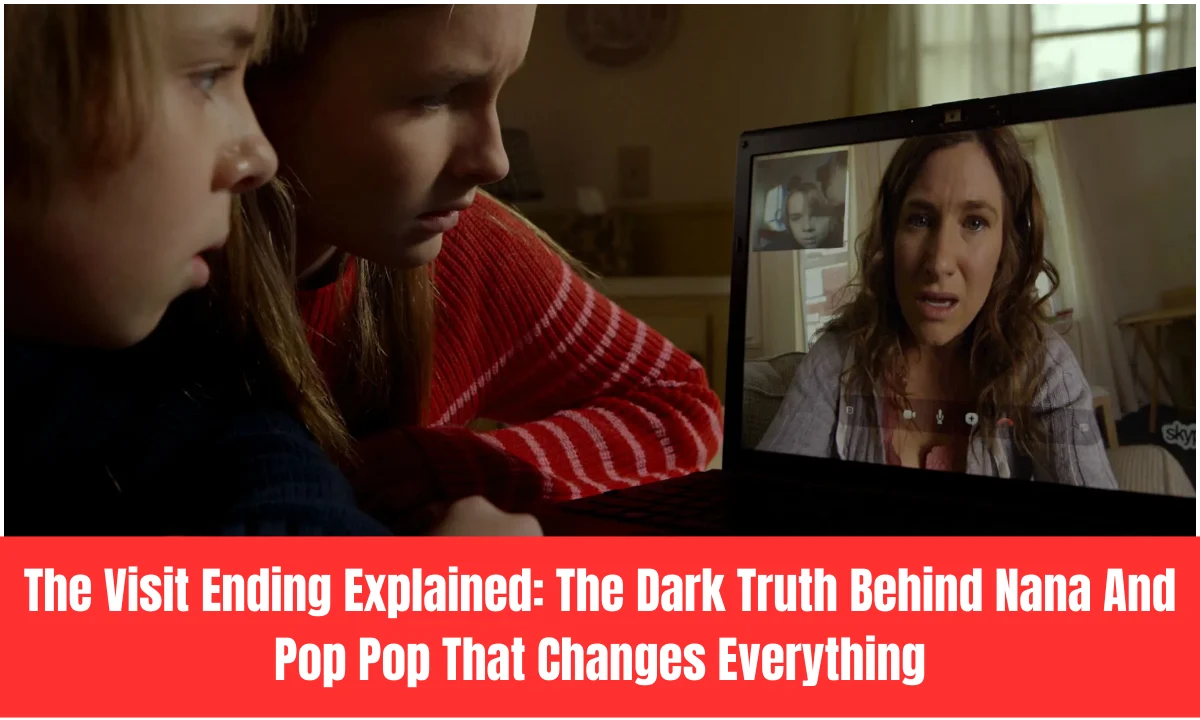
Here is the part that flips the entire film. Late in the movie, during a Skype call, Loretta sees the elderly couple clearly for the first time. Her reaction says it all. Those are not her parents.
The truth is brutal. The people posing as Nana and Pop Pop are escaped mental patients from a nearby psychiatric hospital. The real grandparents worked there as volunteers or counselors. The imposters murdered them, hid their bodies in the basement, and assumed their identities.
The twist works because the film carefully misdirects you toward supernatural explanations. Nana crawling on all fours at night. Projectile vomiting. Scratching walls. The oven scene. It all feels paranormal. But Shyamalan pulls the rug. The horror is human.
This shift from supernatural vibes to grounded psychological horror is classic Shyamalan. He builds dread through suggestion. Then he gives you something disturbingly real.
Clues You Might Have Missed Leading Up To The Shocking Ending
On a rewatch, the clues are everywhere. The film never lies. It just hides things in plain sight.
Subtle Foreshadowing Moments
- The 9:30 PM Rule
The strict bedtime feels odd but not evil. It prevents the kids from seeing too much of Nana’s nighttime episodes. - The Damaged Laptop Camera
Nana “accidentally” breaks Becca’s laptop camera. That stops Loretta from visually confirming their identity earlier. - The Shed Full Of Adult Diapers
Pop Pop hides his soiled diapers in the shed. It is disturbing but also hints at deeper instability. - The Hospital Visitors
Two people from the psychiatric facility come looking for the real grandparents. That detail becomes huge later. - The Basement Avoidance
The kids are subtly discouraged from exploring certain areas of the house.
Each of these moments builds tension without revealing the full truth. That is why the rewatch value is high. You start connecting dots that felt random before.
The Climactic Confrontation: How Did Becca And Tyler Escape?
Once Loretta reveals the truth, things escalate fast. Pop Pop realizes their cover is blown. He becomes violent. He locks Becca in a room with the unstable Nana. Meanwhile, he isolates Tyler in the kitchen.
The diaper scene is one of the most uncomfortable moments in modern horror. Pop Pop smears Tyler’s face with a soiled diaper. It is not just gross. It is psychological torture. Tyler is a germaphobe. This attack is personal.
Upstairs, Becca fights for her life. She grabs a shard from a broken mirror and stabs Nana. The mirror is symbolic. Earlier in the film, Becca avoids looking at herself. In this moment, she confronts both her fear and her attacker.
Tyler then snaps. Earlier, he talked about freezing during a football game. In the final showdown, he does not freeze. He repeatedly slams the refrigerator door on Pop Pop’s head.
Both kids survive because they overcome their internal fears. The physical battle mirrors their emotional arcs.
The Meaning Behind The Ending: Themes Of Family And Forgiveness
After the chaos, the film slows down. This is where many viewers miss the emotional core.
Loretta confesses that years ago she had a violent argument with her parents. She left home. She ignored their attempts to reconnect. Now they are dead. She carries guilt that they were isolated and vulnerable.
Becca also changes. Throughout the film, she refuses to include footage of her estranged father in her documentary. She holds resentment. By the end, she includes him.
The message is clear but not preachy. Holding onto anger can cost you chances you never get back. Forgiveness is not weakness. It is closure. The horror is not just about fake grandparents. It is about broken family bonds.
Public Opinion: What Audiences Are Saying About The Ending
Based on social media discussions and fan reactions, the ending remains divisive but memorable.
What Viewers Loved
- The grounded twist instead of a supernatural reveal
- The tension during the final 20 minutes
- The emotional mother daughter reconciliation
- The found footage style that feels immersive
Common Criticisms
- Some felt the twist arrives a bit late
- Others questioned how the impersonation lasted that long
- A few viewers disliked the mental illness trope
Even with criticism, many fans consider it one of Shyamalan’s stronger late career films. It does not rely on CGI spectacle. It relies on slow burn tension.
M. Night Shyamalan’s Signature Style: How The Visit Compares To His Other Films
Shyamalan is known for twist endings. The most famous example is The Sixth Sense. That reveal changed how audiences viewed psychological thrillers. In Unbreakable, the twist redefines the entire narrative. In The Visit, the twist is smaller in scale but just as disruptive.
What makes The Visit different is its simplicity. No grand mythology. No supernatural lore. Just human instability and identity deception. It also revived Shyamalan’s reputation after a few poorly received projects. Many critics saw it as a return to form.
Key Elements Of The Visit Ending Breakdown
| Element | Surface Meaning | Deeper Meaning |
|---|---|---|
| Fake Grandparents | Escaped patients | Fear of misplaced trust |
| Broken Mirror | Weapon in fight | Facing inner fears |
| Diaper Scene | Shock horror | Overcoming trauma |
| Basement Bodies | Plot reveal | Consequences of isolation |
| Final Interview | Emotional closure | Power of forgiveness |
Why The Visit’s Ending Still Resonates Today
The Visit works because it taps into something uncomfortable. We trust family. We trust elderly figures. The film twists that comfort.
It also plays on modern fears. Isolation. Estrangement. Communication gaps despite technology. Even with Skype and internet access, the truth stayed hidden.
At its core, the film says something simple. Do not wait too long to fix broken relationships. Life does not give unlimited chances. And that final realization hits harder than any jump scare.
Conclusion
The horror in This movie Visit was not supernatural and was caused by real people. Two children survive the nightmare by facing their fears and fighting back.
Shyamalan gives us realistic twist, emotional message, and strong tension through the found-footage style. If you wath the movie agian pay attention to the details the clues were there from the start.