The Movie Heretic is not just a psychological horror or not just an ordinary scary movie.
It includes plenty of talking, is tense, and is disturbing such that it stays with you. In this movie actor Hugh Grant as the creepy Mr. Reed. It puts two Mormon missionaries in a house that feels more like a philosophical prison than a home.
When the credits scene appears, you are not just thinking about who lived. You are questioning faith, control, illusion, and that last moment with the butterfly.
You are not the only one who is confused of whether Sister Paxton lives or dies. The end is meant to be unclear. And to be honest, that is what makes it strong.
In this post lets look at what really happened, what the butterfly means, and why the movie do not gives us a clear answer.
Key Takeaways
- Mr. Reed is a serial killer who uses religion as a tool to exert control over women.
- Sister Barnes is killed but briefly rises to fatally injure Reed before dying for real.
- Sister Paxton’s survival is intentionally ambiguous.
- The butterfly symbolizes either hope and faith or a dying hallucination.
- The film argues that the “one true religion” is control, but challenges that idea in the final moments.
- Public opinion is divided, with many praising the intelligent horror and Hugh Grant’s chilling performance.
The Setup: Faith, Debate, And A Deadly Game
Heretic follows Sister Barnes and Sister Paxton, two missionaries from The Church of Jesus Christ of Latter-day Saints, who visit Mr. Reed’s home after he requests more information about faith. At first, Reed seems like a curious intellectual. He debates theology, references history, and even compares religion to Monopoly.
Then things turn dark.
Reed reveals that the doors labeled “Belief” and “Disbelief” both lead to the same basement. That is the first major clue. The choice was never real. The house itself is a maze. Locked doors. Hidden tunnels. Timed lights. It is all engineered. Reed’s big thesis is simple. Religion is not about truth. It is about control.
And he proves it in the worst way possible.
The Fake Miracle And The Caged Women
One of the most disturbing moments is the staged resurrection. Reed poisons a captive woman with blueberry pie. She collapses. Then another woman secretly replaces her through a trapdoor. When she “comes back to life,” Reed claims it is proof of something bigger.
But Sister Paxton notices inconsistencies. She finds the trapdoor. She discovers the freezing room with previous victims locked in cages. These women are starved and broken. Reed repeats the experiment again and again. Each time he plays God.
This is not about theology anymore. It is about power.
Who Dies In The Ending
Let’s clear up the basics.
- Mr. Reed is the killer. He manipulates, imprisons, and murders women to prove his ideology.
- Sister Barnes has her throat slit earlier in the film. She appears dead.
- In the basement, when Reed prepares to kill Paxton, Barnes suddenly strikes him with a nailed plank.
- Reed dies from the blow.
- Barnes dies shortly after.
The biggest question is Sister Paxton.
She escapes through a small vent using Reed’s wooden house map. She stumbles into the snow, bleeding heavily. Then the butterfly lands on her finger.
And that is where everything becomes open to interpretation.
The Butterfly Explained
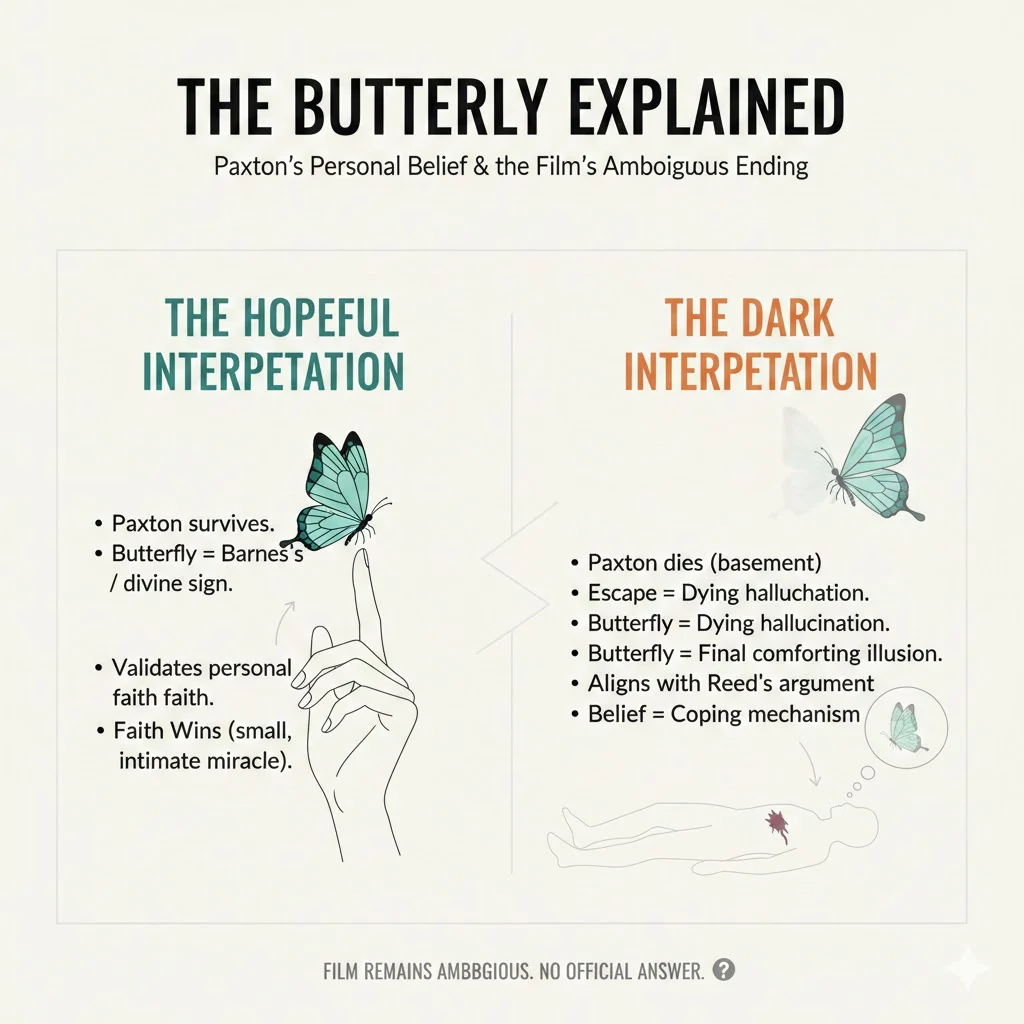
Earlier in the film, Paxton shares a personal belief. She says that after death, she would want to return as a butterfly. She would land on someone’s finger so they know she is still with them. It is not official doctrine. It is her personal hope.
In the final scene, a butterfly lands on her finger in the snow. She blinks. It disappears. There are two main interpretations:
The Hopeful Interpretation
Paxton survives. The butterfly represents Sister Barnes’ spirit or a divine sign. It validates personal faith. Reed argued that belief is illusion. But this moment suggests something beyond his control.
The butterfly becomes a symbol of rebirth and reassurance. Faith wins, not in a loud miracle, but in something small and intimate.
The Dark Interpretation
Paxton never made it out. She dies in the basement from her stab wound. The escape sequence is her dying hallucination. The butterfly is her final comforting image. A self-created illusion as she bleeds out.
This interpretation aligns with Reed’s argument. Belief is a coping mechanism. A story we tell ourselves when facing death.
The film refuses to confirm either version. Directors Scott Beck and Bryan Woods have said the ambiguity is intentional. There is no official answer.
Public Reaction On X And Why The Ending Divided Viewers
if we look at discussions on X, the debate is intense. Many viewers praised the film’s intelligent approach to horror. People appreciated that it did not rely on cheap scares. Instead, it focused on dialogue, tension, and philosophical conflict.
A lot of users admired Hugh Grant’s transformation. Seeing a former rom-com lead turn into such a chilling villain surprised audiences. His calm tone and academic confidence made Reed even scarier.
On the ending, opinions split into two camps.
Some viewers believe Paxton survives. They argue that the film subtly supports faith and compassion. Barnes’ final act of sacrifice feels meaningful. The butterfly feels earned.
Others say the ending is bleak. They believe Paxton dies. They argue that the film consistently dismantles illusions. The butterfly fits as a final delusion.
Interestingly, even people who disliked parts of the film praised the final scene for being thought provoking. That butterfly did its job.
The Core Theme: Control Is The Real Villain
Reed’s central claim is that control is the one true religion. He studies different faiths. He concludes they all evolve from earlier versions. He compares them to copies of board games. His logic is that belief systems are just structures of power.
But here is where the film gets clever.
Reed himself creates a cult of one. He builds rituals. He stages miracles. He gathers followers. He controls information. In trying to expose religion as manipulation, he becomes the very thing he criticizes.
The women resist him. They challenge him intellectually. They fight him physically. They refuse to submit completely. That resistance undercuts his thesis. If control was absolute, they would never have fought back.
Key Events Breakdown Table
| Event | What Happens | Why It Matters |
|---|---|---|
| Two Door Choice | Belief and Disbelief lead to same place | Illusion of choice |
| Fake Resurrection | Poisoned pie and body swap | Demonstrates staged miracle |
| Discovery Of Cages | Multiple imprisoned women found | Proof of serial pattern |
| Barnes’ Final Strike | Hits Reed with nailed plank | Sacrifice and resistance |
| Butterfly Scene | Lands on Paxton’s finger | Ambiguous faith symbol |
Is There A Supernatural Element
The film never shows clear supernatural proof. Every so-called miracle has a logical explanation. The resurrection is staged. The maze is engineered. The symbolism is grounded in character psychology.
The only moment without explanation is the butterfly. And that is exactly why it works.
If the film confirmed divine intervention, it would contradict its grounded tone. If it confirmed death, it would close the philosophical debate too neatly. By ending on uncertainty, Heretic forces you to decide.
Final Meaning Of Heretic
The title itself is interesting. Who is the real heretic. Is it Reed, the non-believer who commits violence in the name of truth. Or is it the missionaries, whose personal beliefs go beyond institutional doctrine.
The film suggests heresy is about deviation from control. Reed calls them heretics because they do not submit to his ideology. In that sense, resisting control becomes an act of rebellion.
And maybe that is the quiet victory of the ending. Whether Paxton lives or dies, Reed’s system collapses. His house of control falls apart. His experiment ends. The butterfly, real or imagined, represents something he could not cage.