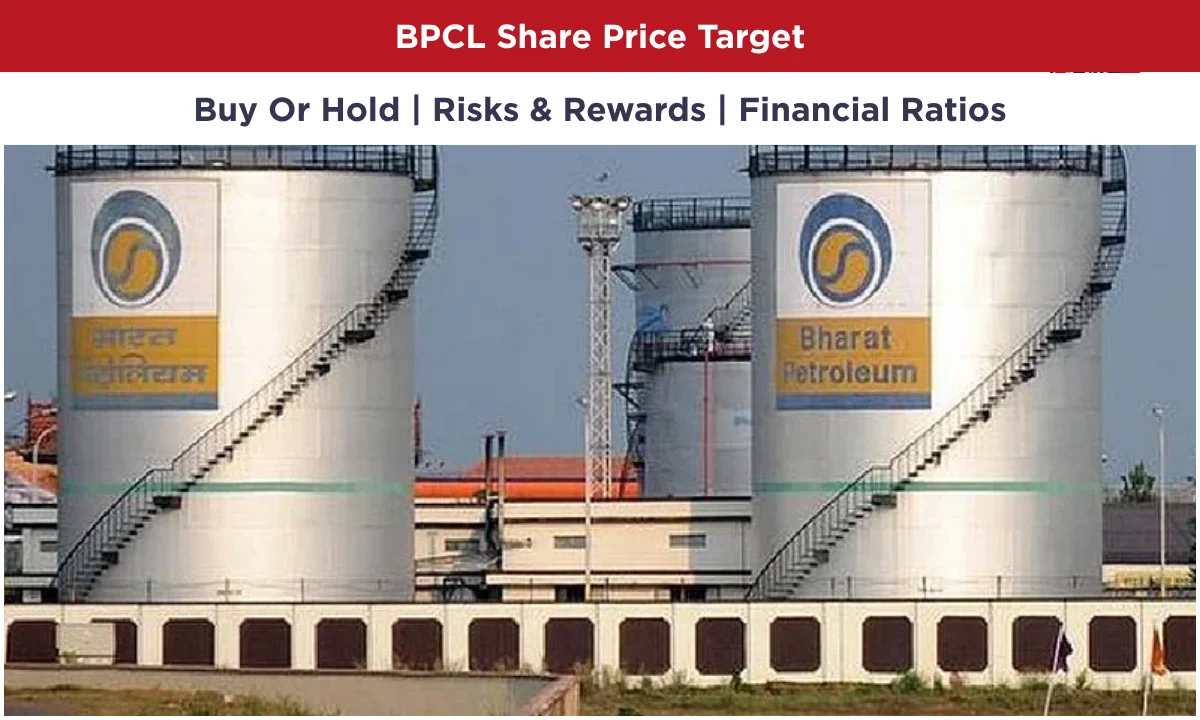
Bharat Petroleum is one of the leading oil and gas companies in India. The company is involved in crude oil refining and marketing of petroleum products like petrol, diesel, LPG, and CNG. It also deals in lubricants, gas distribution, and petrochemicals.
BPCL has a strong refinery base and a wide fuel station network across India. In the last few years, the company has shown strong revenue growth but profits have fluctuated due to crude oil price changes. Promoter holding is stable with the Government of India, which gives stability but also creates policy-related risks.
In this article we are going to see the share price target of BPCL (2026-2050) & try to guess how much returns can you expect from BPCL in upcoming years from seeing the numeric & fundamental data.
We are also going to see the dividend, market capitalization and other numeric data so that you get all pre information before you invest in BPCL..
So Keep Reading..
Table of Contents
BPCL share price target 2026
| Month | Share Price Target (₹) |
|---|---|
| Jan | 520 – 560 |
| Dec | 600 – 680 |
In 2026 Bharat Petroleum is expected to see steady growth driven by rising fuel demand and expansion in its core business segments. Increasing vehicle usage across India will continue to support petrol and diesel consumption, which remains a major revenue source for the company. At the same time, strong demand for LPG in both urban and rural areas will add to stable cash flows.
BPCL is also actively expanding its presence in gas infrastructure. The company is investing in CNG and LNG networks, which are gaining popularity due to cleaner fuel policies and lower emissions. This shift towards cleaner energy sources will help BPCL stay relevant in the long term energy transition.
Another important factor is improving refining and marketing margins. Efficient operations and better capacity utilization can support profitability. However, investors should keep an eye on crude oil price volatility and government regulations. Overall, 2026 looks stable with moderate growth potential.
BPCL share price target 2027
| Month | Share Price Target (₹) |
|---|---|
| Jan | 520 – 580 |
| Dec | 650 – 720 |
In 2027, privatization can become a major trigger for BPCL’s growth and overall market sentiment. If the government proceeds with disinvestment, it could lead to better operational efficiency, faster decision-making, and improved profitability due to reduced bureaucratic control.
Private ownership may also bring in advanced management practices, cost optimization, and strategic expansion plans. Additionally, the company is focusing on digital transformation, including automation, data analytics, and improved customer experience. Supply chain improvements, such as better logistics and inventory management, can further enhance margins and ensure smoother operations across its nationwide distribution network.
BPCL share price target 2028
| Month | Share Price Target (₹) |
|---|---|
| Jan | 650 – 720 |
| Dec | 780 – 900 |
In 2028, BPCL is projected to strengthen its strategic transition toward renewable and sustainable energy solutions, as reflected in the expected share price growth range. The company is actively investing in electric vehicle charging infrastructure, cleaner fuel technologies, and alternative energy sources to align with evolving global energy trends.
These initiatives are likely to enhance operational efficiency, diversify revenue streams, and reduce dependence on traditional fossil fuels. As indicated by the projected price targets, such forward-looking investments can support long-term value creation and position BPCL competitively in the rapidly transforming energy landscape.
BPCL share price target 2029
| Month | Share Price Target (₹) |
|---|---|
| Jan | 780 – 820 |
| Dec | 900 – 980 |
In 2029, BPCL’s growth outlook is supported by its ongoing refining capacity expansion and increasing export opportunities, as reflected in the projected share price range. The company’s strong infrastructure and established market presence enable it to efficiently meet both domestic and international demand
Stable consumption of petroleum products in India, combined with improved operational efficiency, is expected to enhance revenue generation. Additionally, strategic investments in refining and logistics will strengthen its competitive position. Overall, BPCL is well-positioned to capitalize on industry demand trends, supporting steady financial performance and long-term value creation for investors.
BPCL share price target 2030
| Month | Share Price Target (₹) |
|---|---|
| Jan | 850 – 900 |
| Dec | 1050 – 1150 |
By 2030, Bharat Petroleum is expected to operate in a transforming energy landscape. The rise of electric vehicles and renewable energy will gradually impact traditional fuel demand. However, in a country like India, fuel consumption is still expected to remain strong due to growing population, increasing vehicle ownership, and infrastructure development.
BPCL’s long-term growth will depend on how well it adapts to this transition. The company is already shifting its focus towards gas-based energy such as CNG and LNG, which are cleaner alternatives to traditional fuels. Expansion in city gas distribution and pipeline infrastructure can provide stable and growing revenue streams.
In addition, BPCL is exploring opportunities in green energy like biofuels, hydrogen, and renewable projects. These initiatives can help the company stay relevant in the future energy mix.
Operational efficiency, refining margins, and strategic investments will play a key role in profitability. While the transition brings challenges, BPCL’s strong market presence and diversification strategy can support steady long-term growth.
BPCL share price target 2040
| Month | Share Price Target (₹) |
|---|---|
| Jan | 1800 – 2000 |
| Dec | 2200 – 2500 |
By 2040, BPCL is expected to strengthen its position as a diversified energy company, driven by sustained investments in research and development and a strategic shift toward cleaner and alternative fuels. As indicated in the above table, the company’s share price targets reflect steady long-term growth supported by evolving energy demand and policy support.
BPCL’s robust refining infrastructure will continue to provide a stable revenue base, while expansion into renewable energy, green hydrogen, and advanced fuel technologies will enhance future prospects. This balanced approach between traditional operations and innovation is likely to support consistent value creation for investors.
BPCL share price target 2050
| Month | Share Price Target (₹) |
|---|---|
| Jan | 3200 – 3500 |
| Dec | 3800 – 4200 |
By 2050, Bharat Petroleum Corporation Limited is expected to operate in a completely transformed energy environment. The company’s long-term survival and growth will depend on how effectively it transitions from a traditional oil marketing company to a diversified energy player. With global focus shifting towards clean and sustainable energy, BPCL will need to reduce its dependence on fossil fuels.
Renewable energy investments will play a crucial role in this transition. The company is likely to expand into areas such as green hydrogen, biofuels, electric mobility infrastructure, and solar energy. These segments can become major revenue contributors over time if executed well.
At the same time, India may still have some demand for conventional fuels, especially in sectors where alternatives are limited. This can provide a stable base for BPCL while it expands into new energy segments.
Technology adoption, efficient capital allocation, and strategic partnerships will be key factors in determining long-term success. Overall, 2050 represents a high transformation phase where growth depends on adaptability and execution.
Also Read: Top 10 Best Energy Stocks In India For Long Term [2026-2040]
Should I buy BPCL share?
BPCL is a strong government-backed company with a large distribution network. Its core business has stable demand in India. The company is expanding into gas, petrochemicals, and renewable energy. It is also investing heavily through its large capex plans which include green hydrogen and renewable capacity expansion.
However, crude oil price volatility is a major risk. Brokerage downgrades and recent stock corrections show that margins are sensitive to global oil prices. Still, strong Q3 FY26 results and expansion plans show long-term potential. If privatization happens, it can further improve efficiency.
Long-term investors may consider BPCL for stable growth and dividend income. But always do your own research and understand the risks before investing.
Is BPCL stock good to buy (Bull case & Bear case):
Bull Case:
- Strong government-backed company
- Large distribution and refinery network
- Strong recent earnings growth
- Renewable and green hydrogen expansion
- High dividend yield
Bear Case:
- High dependence on crude oil prices
- Government control affects pricing
- Margin pressure when crude rises
- Competition in oil sector
Promotors Holding Of BPCL
| Particulars | Details |
|---|---|
| Promoter | Government of India |
| Holding | ~53% |
| Trend | Stable |
| Impact | High stability but policy risk |
A high promoter holding, particularly by the Government of India, provides strong stability and long-term confidence to investors, as it reflects sustained backing and reduced risk of abrupt ownership changes. This level of ownership often ensures financial support and strategic continuity for the company.
However, government control can also introduce certain limitations, including slower decision-making processes due to regulatory procedures and policy considerations. Such involvement may impact operational flexibility and delay the implementation of business strategies. Therefore, while promoter stability is a positive factor, investors should also consider the potential impact of administrative and policy-driven constraints on overall performance.
Revenue growth Of BPCL
| Year | Revenue (₹ Cr) | Growth % |
|---|---|---|
| 2021 | 2,38,530 | -22.5% |
| 2022 | 4,23,728 | 77.7% |
| 2023 | 5,08,844 | 20.1% |
| 2024 | 4,27,406 | -16.0% |
| 2025 | 4,47,757 | 4.8% |
Revenue performance reflects a cyclical pattern primarily influenced by fluctuations in global crude oil prices, as evident from the data presented above. The company experienced significant growth in FY2022 and FY2023, driven by favorable market conditions and higher fuel demand. However, this was followed by a decline in FY2024 due to adverse pricing dynamics and margin pressures.
A modest recovery is observed in FY2025, indicating some stabilization. Overall, while the company demonstrates the ability to generate strong revenue growth during favorable cycles, the inconsistency highlights its sensitivity to external factors, making revenue trends volatile and dependent on global energy market conditions.
Profit growth of BPCL
| Year | Profit (₹ Cr) | Growth % |
|---|---|---|
| 2021 | 2,693 | -77.2% |
| 2022 | 16,890 | 527% |
| 2023 | 26,834 | 59% |
| 2024 | 20,437 | -23.8% |
| 2025 | 24,611 | 20.4% |
Profit performance is closely linked to refining margins, which are significantly influenced by fluctuations in global crude oil prices. The data indicates considerable volatility in earnings, reflecting the company’s sensitivity to changes in input costs and market conditions.
Periods of higher margins have resulted in strong profit growth, while adverse price movements have led to noticeable declines. This cyclical pattern highlights the importance of effective cost management and pricing strategies. Overall, the company’s profitability remains vulnerable to external factors, particularly crude price trends, making it essential for investors to monitor global energy markets closely.
EPS or ROE trends of BPCL
| Year | EPS (₹) | ROE % |
|---|---|---|
| 2021 | 11.02 | 5.2 |
| 2022 | 69.07 | 26.8 |
| 2023 | 109.73 | 35.1 |
| 2024 | 83.60 | 22.4 |
| 2025 | 100.62 | 24.5 |
ROE has shown a significant improvement after 2021, indicating a notable enhancement in the company’s profitability and operational efficiency. As reflected in the table, the sharp rise in ROE from 5.2% in 2021 to over 35% in 2023 highlights the company’s ability to generate higher returns on shareholders’ equity.
Although there was a slight moderation in 2024, the ratio remained strong and stable in 2025, suggestingsustained performance. This upward trend demonstrates effective capital utilization, improved margins, and better financial management, making the company more attractive to long-term investors seeking consistent returns.
Debt-to-equity ratio of BPCL
| Year | Debt/Equity |
|---|---|
| 2021 | 1.25 |
| 2022 | 0.95 |
| 2023 | 0.82 |
| 2024 | 0.78 |
| 2025 | 0.71 |
Debt levels have shown a consistent downward trend over the observed period, indicating improved financial discipline and effective capital management by the company. A declining debt-to-equity ratio reflects reduced reliance on external borrowings and a stronger balance sheet position.
This improvement enhances the company’s ability to manage financial obligations, lowers interest burden, and increases overall financial flexibility. It also signals better risk management practices, which can positively influence investor confidence. Sustained reduction in debt strengthens long-term stability and positions the company to fund future growth initiatives more efficiently without excessive leverage.
Net profit margins of BPCL
| Year | Margin % |
|---|---|
| 2021 | 1.13% |
| 2022 | 3.98% |
| 2023 | 5.27% |
| 2024 | 4.78% |
| 2025 | 5.49% |
Margins have shown a consistent improvement over the recent years, reflecting enhanced operational efficiency and better cost management by the company. As indicated in the table, net profit margins increased from 1.13% in 2021 to 5.49% in 2025, demonstrating a strong recovery and improved profitability.
This upward trend suggests that the company has effectively optimized its refining operations, controlled expenses, and benefited from favorable market conditions. The steady rise in margins also indicates improved pricing power and operational discipline. Overall, the data highlights a positive financial trajectory, strengthening investor confidence and supporting long-term growth prospects.
Market capitalization of BPCL
| Year | Market Cap (₹ Cr) |
|---|---|
| 2021 | ~95,000 |
| 2022 | ~1,20,000 |
| 2023 | ~1,10,000 |
| 2024 | ~1,05,000 |
| 2025 | ~1,17,487 |
BPCL is a large-cap company with a strong market capitalization trend, reflecting its established position in the Indian energy sector. As shown in the table, the company has maintained a relatively stable market cap over the years, indicating consistent investor confidence despite fluctuations in the oil industry.
Its large size, government backing, and extensive infrastructure contribute to lower volatility compared to smaller companies. This stability makes BPCL an attractive option for long-term investors seeking steady returns and reduced risk exposure. Overall, its market presence and financial strength support its reputation as a reliable investment choice.
Dividend yield of BPCL
| Year | Dividend Yield % |
|---|---|
| 2021 | 7.2% |
| 2022 | 4.1% |
| 2023 | 3.5% |
| 2024 | 4.8% |
| 2025 | 3.2% |
BPCL demonstrates a consistent dividend payout track record, as reflected in the table, with yields ranging between 3.2% and 7.2% over recent years. This indicates the company’s commitment to returning value to shareholders despite fluctuations in earnings.
The relatively higher yields in certain years highlight its strong cash flow generation and stable business model. Such dividend performance enhances its appeal among income-focused investors seeking regular returns. Additionally, BPCL’s position as a large-cap, government-backed entity further strengthens confidence in its ability to sustain dividend distributions over the long term.
Conclusion
BPCL is a strong and established oil and gas company in India. It has a large network and strong demand base. Financials show good growth but also volatility due to crude oil prices. The company is investing in renewable energy, green hydrogen, and expansion projects which can drive long-term growth.
However, risks like oil price volatility, government control, and margin pressure remain. Still, for long-term investors, BPCL can be a stable option with moderate growth and dividend income. Always do proper research and manage risk before investing.