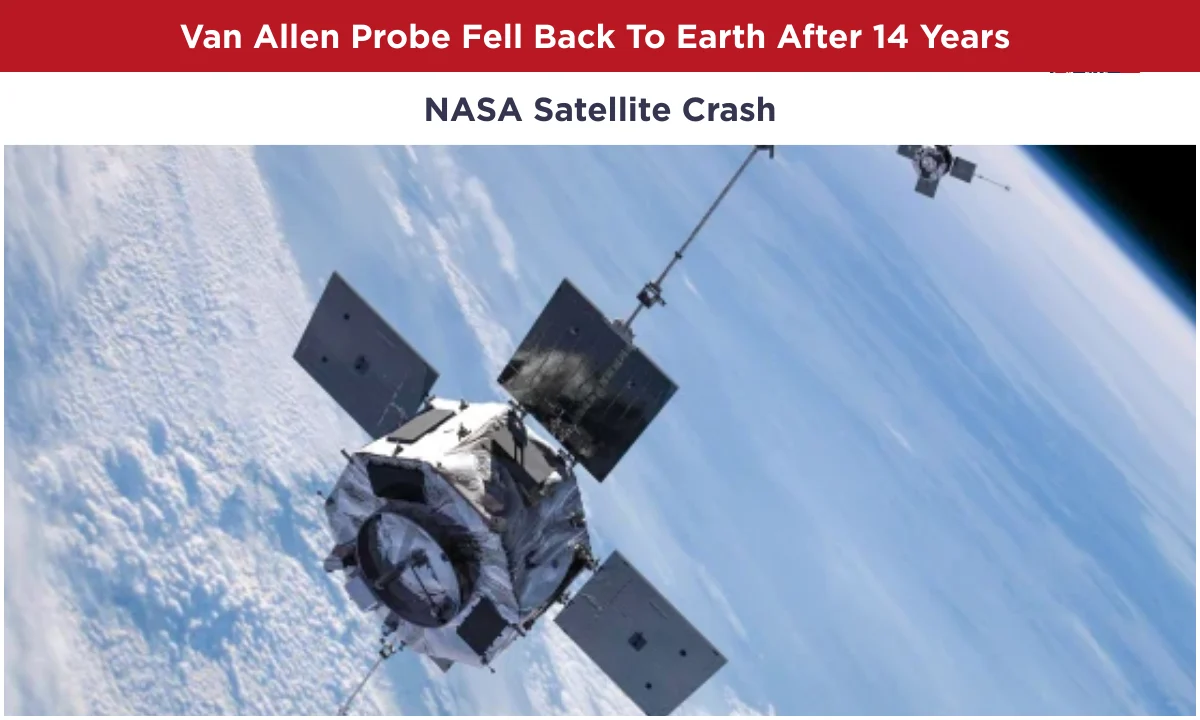
“NASA satellite crash” suddenly started trending across the internet & social media. Many people saw dramatic headlines that a 1,300-pound spacecraft falling toward Earth & naturally people got curious. Was it dangerous? Where did it fall? & why did it happen now after more than a decade in orbit?
The satellite is in trend is NASA’s Van Allen Probe A – a spacecraft launched in 2012 to study the radiation belts surrounding Earth.
After working nearly 14 years in space, the probe finally reached the end of its orbital life and re-entered Earth’s atmosphere in March 2026. While the word “crash” sounds alarming, the reality is far less dramatic.
Key Takeaways
- NASA’s Van Allen Probe A re-entered Earth’s atmosphere after about 14 years in orbit.
- The spacecraft weighed roughly 600 kg or about 1,323 pounds.
- Most of the satellite burned up during atmospheric re-entry due to intense heat.
- NASA estimated the risk of injury on Earth at about 1 in 4,200, which is extremely low.
- Increased solar activity during the solar maximum accelerated the satellite’s orbital decay.
- The twin spacecraft, Van Allen Probe B, is still orbiting Earth and may re-enter later in this decade.
In simple words the NASA satellite crash was actually a routine satellite re-entry event that happens regularly in space operations.
For scientists and space enthusiasts, this event is interesting because it shows how satellites naturally return to Earth after completing their missions. It also highlights growing conversations about space debris and satellite lifecycle management as more objects are launched into orbit every year.
Now let’s break down what actually happened, why it happened earlier than expected, and whether people on Earth had anything to worry about.
What Is The NASA Satellite That Fell Back To Earth?
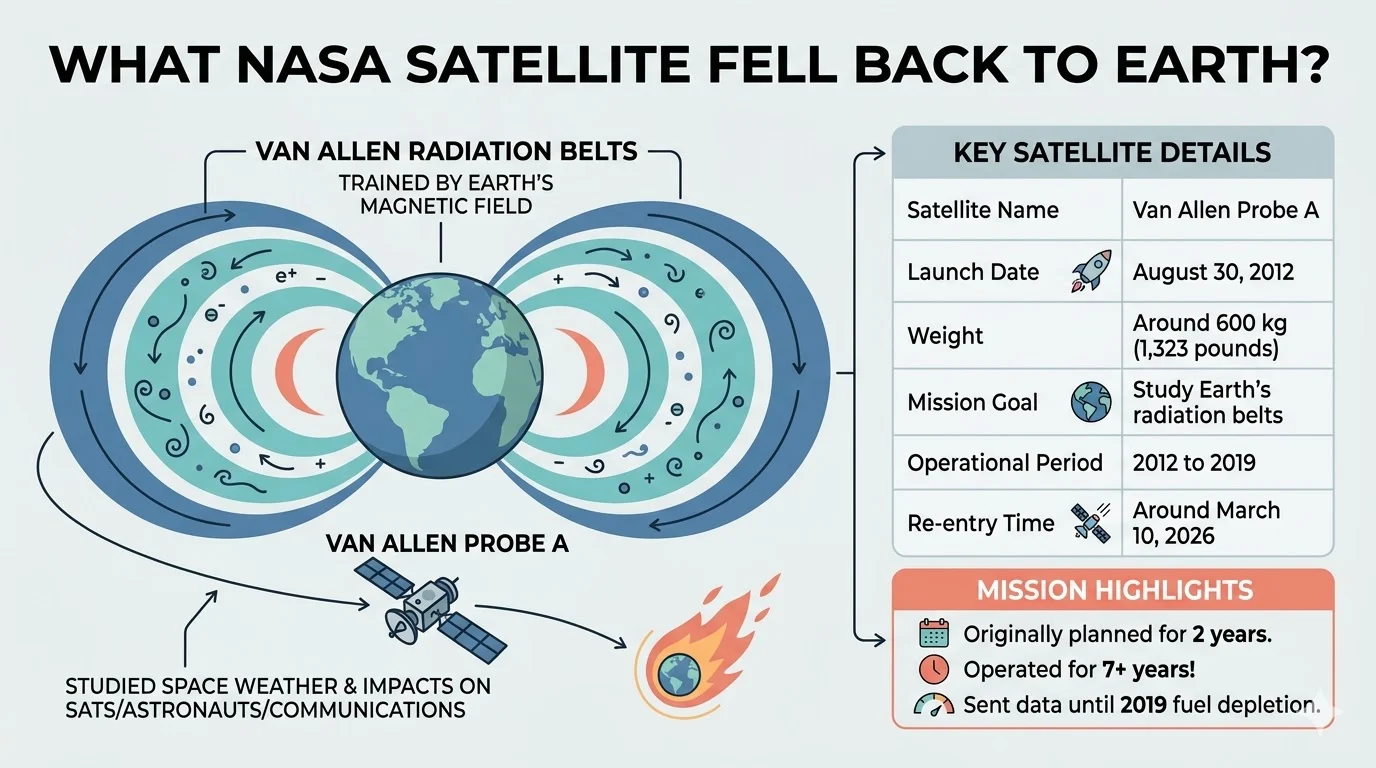
The spacecraft that triggered the “NASA satellite crash” headlines is called Van Allen Probe A. It was one of two identical satellites launched by NASA in August 2012 from Cape Canaveral.
The mission was created to study a region of space around Earth known as the Van Allen radiation belts. These belts are areas filled with high-energy charged particles trapped by Earth’s magnetic field.
Scientists study these belts because they influence space weather and can affect satellites, astronauts, and communication systems. Here are some quick details about the spacecraft.
| Feature | Details |
|---|---|
| Satellite Name | Van Allen Probe A |
| Launch Date | August 30, 2012 |
| Weight | Around 600 kg (1,323 pounds) |
| Mission Goal | Study Earth’s radiation belts |
| Operational Period | 2012 to 2019 |
| Re-entry Time | Around March 10, 2026 |
The mission was originally planned to last only two years. Surprisingly, the probe worked for about seven years and continued sending valuable data until 2019 when it ran out of fuel.
Why The NASA Satellite Reentered Earlier Than Expected?
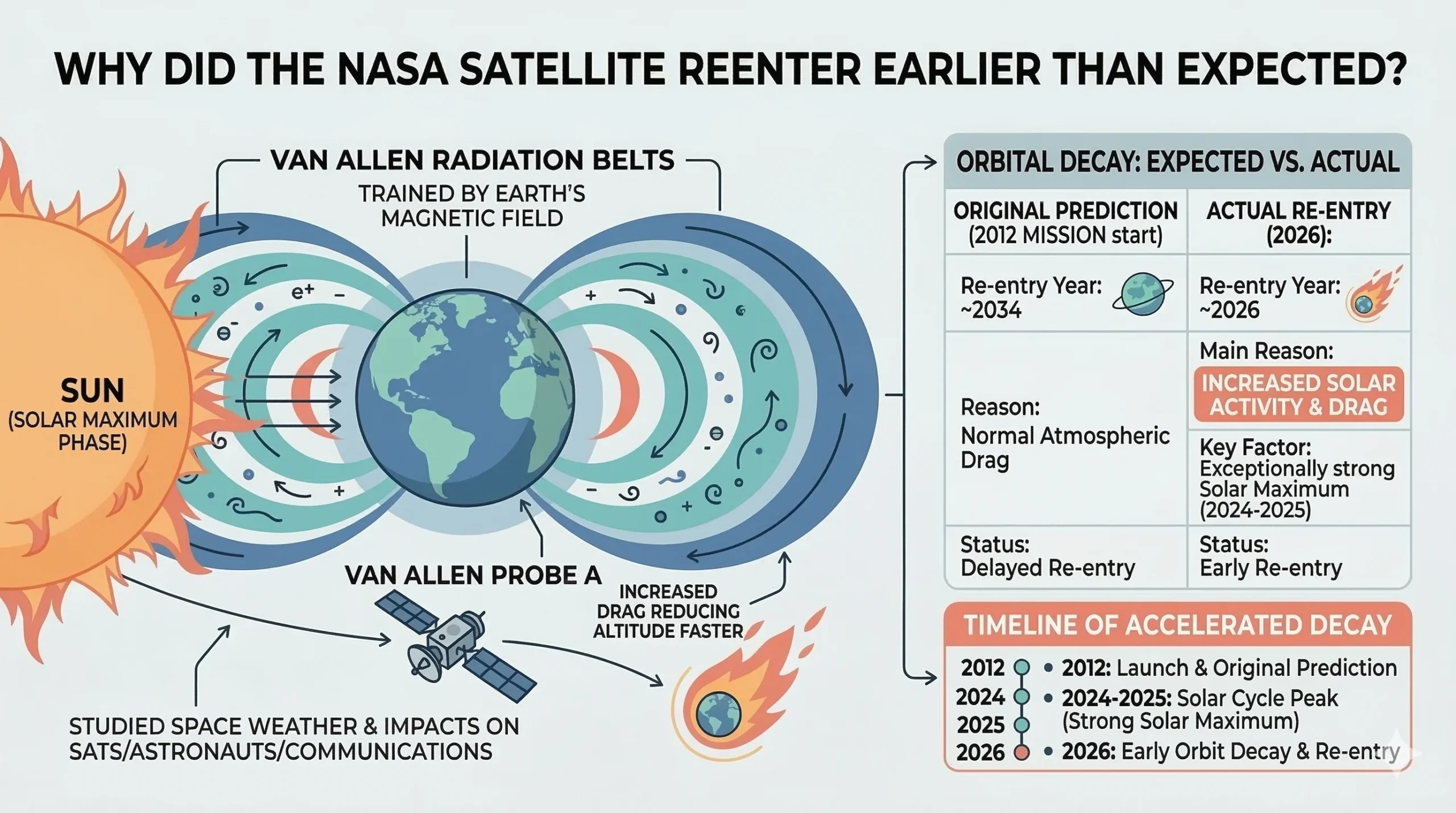
One of the biggest questions people had online was why the satellite returned to Earth sooner than predicted. Originally, scientists believed the spacecraft would stay in orbit until around 2034. But something changed in space conditions.
The main reason is increased solar activity.
Every 11 years the Sun goes through a cycle. The peak of this cycle is called the solar maximum. During this phase the Sun becomes more active and releases stronger solar radiation.
This solar activity causes Earth’s upper atmosphere to expand slightly. When the atmosphere expands, satellites in low Earth orbit experience more drag. This drag slowly reduces their altitude. Over time the orbit decays and the spacecraft eventually falls back into the atmosphere.
Because solar activity was particularly strong during 2024 and 2025, the drag increased faster than scientists expected. As a result the Van Allen Probe A descended years earlier than predicted.
What Happens When A Satellite Reenters Earth’s Atmosphere
When satellites return to Earth, they do not simply crash like airplanes. Instead, they go through a process called atmospheric re-entry. This process happens in several stages.
- The satellite enters the upper atmosphere at extremely high speed.
- Friction with atmospheric particles creates intense heat.
- Temperatures rise to thousands of degrees.
- Most components melt and burn apart.
- Small fragments may survive and fall to the surface.
In most cases more than 80 to 90 percent of the spacecraft burns up completely. For Van Allen Probe A, NASA predicted that the majority of the spacecraft would disintegrate during the fiery descent.
Some stronger parts made of dense metal could survive, but these pieces are usually very small. Since oceans cover about 70 percent of Earth’s surface, the chances of debris landing in populated areas are extremely low.
How Dangerous Was The NASA Satellite Crash
Despite dramatic headlines, the risk from this event was very small. NASA and the US Space Force estimated the probability of injury at around 1 in 4,200. To understand how small this is, here are some comparisons.
| Event | Estimated Risk |
|---|---|
| Being struck by satellite debris | 1 in 4,200 |
| Being struck by lightning | About 1 in 15,000 per year |
| Being injured in a car accident | Much higher |
So statistically the chance of someone being harmed by satellite debris is extremely low. Another important factor is that the satellite’s path during re-entry cannot be predicted exactly. Because of this uncertainty, agencies track the object until the final hours. In most cases debris falls into oceans or remote areas where no one is present.
What The Mission Achieved During Its 14 Years In Space
While the re-entry event gained attention, the real story is the mission’s scientific achievements. The Van Allen Probes helped scientists better understand the radiation environment around Earth. Some of the key discoveries included:
- Discovery of a temporary third radiation belt that appears during intense solar storms
- Improved understanding of how energetic particles move through space
- Better models for predicting space weather effects on satellites
- Data that helps protect astronauts and spacecraft electronics
These insights are important for future space missions. Radiation in space can damage satellites and pose risks for astronauts traveling beyond low Earth orbit. By studying these belts, scientists can design better spacecraft and protective systems.
Public Reaction On Social Media (Data Taken From X)
Public discussion about the NASA satellite crash increased significantly on X (formerly Twitter) around March 10 and March 11. News accounts shared updates about the spacecraft’s return and many users expressed curiosity about the event.
A few interesting trends from public conversations included:
- Many users were fascinated by the idea of a spacecraft burning up in the atmosphere.
- Some people joked about space junk falling from the sky.
- Others shared videos of possible fireballs seen in the sky during the re-entry period.
- Several posts praised NASA for transparency and updates.
Some users also connected the event to broader concerns about space debris. With thousands of satellites currently orbiting Earth and many more planned in the coming years, managing orbital debris is becoming an important topic in space policy.
Overall the tone of the discussion remained calm. Most people understood that the event posed very little danger.
What Happens To The Second Van Allen Probe
Van Allen Probe A was launched together with a twin spacecraft called Van Allen Probe B. Both satellites were deactivated in 2019 after their missions ended.
However, Probe B remains in orbit for now. Scientists estimate that the second spacecraft may stay in space until around 2030 before it also reenters Earth’s atmosphere.
The exact timing will depend on solar activity and atmospheric drag, just like with Probe A. Until then, researchers continue to monitor its orbit as part of ongoing space debris tracking efforts.
Why Satellite Reentry Events Are Becoming More Common
Satellite reentries are not unusual. In fact they happen regularly. Every year roughly 100 tons of space debris reenters Earth’s atmosphere.
Most of it burns up completely and goes unnoticed. However, as more satellites are launched for communication, internet services, navigation, and Earth observation, the number of objects in orbit continues to increase.
This means space agencies and companies must plan carefully for the end of a satellite’s life. Modern missions often include controlled reentry plans where satellites are directed to fall into remote ocean areas known as spacecraft graveyards.
Older satellites like the Van Allen Probe were not designed with those systems, which is why their reentry can be uncontrolled.
My Final Thoughts
The trending phrase “NASA satellite crash” may sound dramatic, but the event itself was a normal part of a spacecraft’s life cycle. After spending nearly 14 years studying Earth’s radiation belts, Van Allen Probe A naturally returned to the atmosphere where most of it burned up safely.
Events like this remind us that space missions continue to operate long after their original goals are achieved. They also highlight the importance of managing satellite lifetimes as the number of objects in orbit grows.
For the public, the event turned out to be more fascinating than frightening. It offered a rare glimpse into how spacecraft eventually return home after years of exploring space.