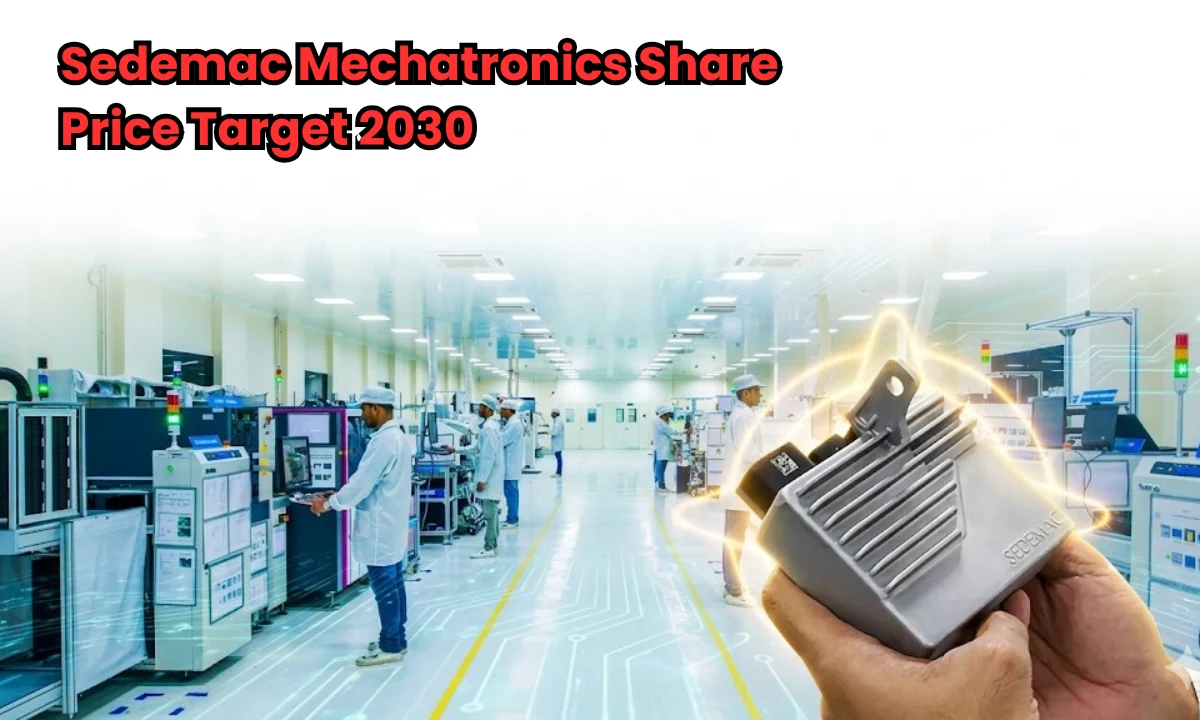
Sedemac Mechatronics Share Price Target 2030- The Automotive Electronics Revolution
Sedemac Mechatronics is becoming a strong player in India’s deep-tech and automotive electronics space. The company focuses on advanced systems like ECUs and motor control units, which are important for modern vehicles, especially electric vehicles. As EV adoption increases, demand for such smart electronic systems is also rising fast.
By 2030, Sedemac’s growth will mainly depend on how well it expands in EVs, exports, and new technology development. The company’s unique sensorless motor control technology gives it an edge over competitors, as it reduces cost and improves performance.
The automotive electronics market in India is growing quickly, which creates a big opportunity for Sedemac. In this blog post we are going to see the share price target of the sedemac Mechatronics from 2026-2050 with the help of numeric and fundamental data and try to guess how much returns can you expect from this share in upcoming years.
This post is full of numeric data, Growth Drivers and different risks factors so if you want to know more about Sedemac and want some more information that will make your investment decision easier this post is for you..
Table of Contents
Sedemac Mechatronics Share Price Target 2026
The year 2026 marks Sedemac’s first year as a publicly traded company. The company has demonstrated exceptional financial performance with Q4 FY26 sales of 1,043,025 ECUs, a 65.1% year-over-year increase, and full FY26 sales of 3,901,075 units, up 60% from the previous year . The stock has gained over 26% from the IPO issue price since listing .
2026 Yearly Price Target
| Metric | Value |
|---|---|
| Minimum Price Target | ₹980 |
| Maximum Price Target | ₹1,954 |
| Expected Midpoint | ₹1,467 |
The wide range reflects the high valuation multiple (P/E ~159x TTM) and differing views on the company’s ability to sustain growth while managing customer concentration risks. The minimum target accounts for potential correction from the high valuation, anchor investor lock-in expiry on April 7, 2026 , and profit-booking pressure. The maximum target assumes continued ECU sales momentum, successful capacity expansion, and expanding valuation multiples as the company proves execution capabilities.
2026 Monthly Share Price Target Table
| Month | Minimum Price (₹) | Maximum Price (₹) | Key Drivers |
|---|---|---|---|
| January | 1,278 | 1,700 | Strong listing momentum, post-IPO stabilization |
| February | 1,400 | 1,750 | Q4 FY26 results anticipation, ECU sales growth |
| March | 1,500 | 1,800 | FY26 annual results, 60% sales growth confirmation |
| April | 1,200 | 1,850 | Anchor lock-in expiry impact, potential volatility |
| May | 1,244 | 1,900 | New capacity utilization, manufacturing facility updates |
| June | 1,457 | 1,950 | H1 FY27 guidance, export market expansion |
| July | 1,557 | 2,000 | Q1 FY27 results, commercial vehicle segment growth |
| August | 1,587 | 2,050 | Power tools diversification, new product launches |
| September | 1,662 | 2,100 | Quarterly results, technology leadership demonstration |
| October | 1,690 | 2,150 | Festival season, OEM inventory building |
| November | 1,757 | 2,200 | Client diversification progress, new customer wins |
| December | 1,790 | 2,300 | Year-end portfolio rebalancing, 2027 outlook |
The monthly progression shows strong early momentum followed by potential volatility around the anchor lock-in expiry. The company maintains approximately 35% market share in ISG ECUs for two-wheelers and three-wheelers in India and dominates the genset controller market with 75-77% market share by volume . The recovery trajectory from mid-year assumes successful commissioning of new manufacturing facilities (MF3 in Chakan for controllers, MF4 for motors) and land acquisition in Hosur, Tamil Nadu .
Sedemac Mechatronics Share Price Target 2027
By 2027, Sedemac’s capacity expansion and diversification efforts should begin showing measurable results. The company has shipped over 10 million smart control units and holds 7.5 million installations of its sensorless ISG systems . The global three-wheeler market, both ICE and EV, is expected to grow at 8-9% CAGR to 2030 , supporting continued demand growth.
2027 Yearly Price Target
| Metric | Value |
|---|---|
| Minimum Price Target | ₹1,890 |
| Maximum Price Target | ₹2,778 |
| Expected Midpoint | ₹2,334 |
The 2027 targets represent 50-65% growth from 2026 levels. The company is expanding into electric vehicle motor controllers, power tools, commercial vehicles (after-treatment modules for BS-VI), and exports . The global power tools market is projected to grow at 5-6% CAGR, reaching 460-470 million units by 2030, with cordless tools accounting for significant share .
2027 Monthly Share Price Target Table
| Month | Minimum Price (₹) | Maximum Price (₹) | Key Drivers |
|---|---|---|---|
| January | 1,890 | 2,200 | FY27 results, annual guidance |
| February | 1,922 | 2,250 | New facility commissioning, capacity ramp-up |
| March | 1,974 | 2,300 | Q4 FY27 results, full-year profitability |
| April | 1,990 | 2,350 | EV motor controller sales, new segment growth |
| May | 2,025 | 2,400 | Commercial vehicle after-treatment modules |
| June | 2,078 | 2,450 | H1 FY28 guidance, export market penetration |
| July | 2,155 | 2,500 | Q1 FY28 results, international OEM wins |
| August | 2,256 | 2,550 | Power tools segment contribution |
| September | 2,287 | 2,600 | Quarterly results, technology patent filings |
| October | 2,365 | 2,650 | Festival season, automotive production peak |
| November | 2,414 | 2,700 | Client base expansion, TVS dependence reduction |
| December | 2,489 | 2,850 | Year-end closing, 2028 strategic outlook |
The 2027 trajectory assumes the company successfully diversifies beyond its core two-wheeler and three-wheeler segment while maintaining leadership in genset controllers. The company’s R&D spending of approximately ₹44.4 crore (6.74% of revenue in FY25) with 244 engineers, many from IITs, NITs, and BITS , should yield new product launches and technology advancements.
Sedemac Mechatronics Share Price Target 2028
By 2028, Sedemac should benefit from significant operating leverage as its diversified portfolio matures. The company originated from an IIT Bombay lab and maintains strong R&D focus with 7-9% of revenue spent on R&D . The integrated design-to-manufacturing chain is done in-house at two factories and two technical centers in Pune, providing tight control over quality and innovation .
2028 Yearly Price Target
| Metric | Value |
|---|---|
| Minimum Price Target | ₹2,725 |
| Maximum Price Target | ₹3,658 |
| Expected Midpoint | ₹3,192 |
The 2028 targets represent 44-45% growth from 2027 levels. The company’s SmartIgn technology has been deployed in more than 43 million vehicles cumulatively , demonstrating proven product deployment at scale. The expansion into commercial vehicles and power tools should contribute meaningfully to revenue by this time.
2028 Monthly Share Price Target Table
| Month | Minimum Price (₹) | Maximum Price (₹) | Key Drivers |
|---|---|---|---|
| January | 2,725 | 3,100 | FY28 annual results, five-year strategic review |
| February | 2,800 | 3,150 | Rare-earth-free motor commercialization |
| March | 2,900 | 3,200 | Q4 FY28 results, margin expansion confirmation |
| April | 2,950 | 3,250 | Summer production, BS-VI compliance modules |
| May | 3,000 | 3,300 | Export growth, international market share |
| June | 3,050 | 3,350 | H1 FY29 guidance, technology licensing revenue |
| July | 3,100 | 3,400 | Q1 FY29 results, EV adoption acceleration |
| August | 3,150 | 3,450 | Festival season, automotive electronics demand |
| September | 3,200 | 3,500 | Quarterly results, R&D pipeline monetization |
| October | 3,250 | 3,550 | Diwali production peak, inventory optimization |
| November | 3,300 | 3,600 | Diversified revenue streams, reduced concentration |
| December | 3,400 | 3,700 | Year-end closing, 2029 growth outlook |
The 2028 projections assume the company maintains its technology leadership through continuous innovation and successfully expands its client base beyond TVS Motor, which currently contributes approximately 75-81% of revenue . The company’s sensorless control technology provides competitive moats that are difficult for competitors to replicate.
Sedemac Mechatronics Share Price Target 2029
By 2029, Sedemac should be well-established as a diversified automotive electronics platform with presence across two-wheelers, three-wheelers, commercial vehicles, electric vehicles, power tools, and industrial gensets. The company’s strong operating cash flows and debt reduction should support continued growth investments .
2029 Yearly Price Target
| Metric | Value |
|---|---|
| Minimum Price Target | ₹3,587 |
| Maximum Price Target | ₹4,558 |
| Expected Midpoint | ₹4,073 |
The 2029 targets represent 32-35% growth from 2028 levels. The Indian automotive electronics market approaching USD 18.6 billion by 2033 provides a supportive backdrop for continued growth. The company’s expansion into EV motor controllers and commercial vehicle electronics should reduce dependence on the traditional two-wheeler segment.
2029 Monthly Share Price Target Table
| Month | Minimum Price (₹) | Maximum Price (₹) | Key Drivers |
|---|---|---|---|
| January | 3,587 | 4,000 | FY29 annual results, decade performance review |
| February | 3,650 | 4,050 | New OEM partnerships, customer diversification |
| March | 3,750 | 4,100 | Q4 FY29 results, sustained profitability track record |
| April | 3,800 | 4,150 | EV ecosystem leadership, motor controller growth |
| May | 3,850 | 4,200 | Export market maturity, global OEM relationships |
| June | 3,900 | 4,250 | H1 FY30 guidance, technology platform expansion |
| July | 4,000 | 4,300 | Q1 FY30 results, ADAS technology integration |
| August | 4,050 | 4,350 | Festival season, peak electronics content per vehicle |
| September | 4,100 | 4,400 | Quarterly results, innovation pipeline delivery |
| October | 4,150 | 4,450 | Diwali peak, automotive production records |
| November | 4,200 | 4,500 | Institutional investor confidence, research coverage |
| December | 4,300 | 4,600 | Year-end closing, 2030 strategic positioning |
The 2029 projections reflect a mature automotive electronics company with diversified revenue streams across multiple vehicle categories and industrial applications. The company’s proven track record of innovation and OEM relationships should support premium valuation multiples.
Sedemac Mechatronics Share Price Target 2030
The year 2030 represents a significant milestone for Sedemac as the Indian automotive electronics market matures and the company completes nearly 25 years of operations. By this time, the company should have evolved into a comprehensive automotive electronics platform with leadership across multiple segments.
2030 Yearly Price Target
| Metric | Value |
|---|---|
| Minimum Price Target | ₹4,490 |
| Maximum Price Target | ₹5,741 |
| Expected Midpoint | ₹5,116 |
The 2030 targets represent 25-30% growth from 2029 levels and imply a total return of approximately 230-320% from the IPO price of ₹1,352. This projection assumes the company maintains 20-25% revenue CAGR, expands margins through operational leverage, and successfully navigates the transition from ICE to electric vehicles while maintaining leadership in control-intensive electronics.
2030 Monthly Share Price Target Table
| Month | Minimum Price (₹) | Maximum Price (₹) | Key Drivers |
|---|---|---|---|
| January | 4,490 | 4,800 | FY30 annual guidance, 25-year anniversary |
| February | 4,511 | 4,900 | Next-generation sensorless technology launch |
| March | 4,557 | 5,000 | Q4 FY30 results, full decade public market track record |
| April | 4,621 | 5,100 | Summer production, EV-ICE hybrid solutions |
| May | 4,687 | 5,200 | Export leadership, global market share gains |
| June | 4,712 | 5,300 | H1 FY31 guidance, platform maturity |
| July | 4,788 | 5,400 | Q1 FY31 results, autonomous vehicle electronics |
| August | 4,825 | 5,500 | Festival season, technology leadership |
| September | 4,956 | 5,600 | Quarterly results, patent portfolio monetization |
| October | 5,145 | 5,700 | Diwali peak, market dominance confirmation |
| November | 5,257 | 5,800 | Long-term OEM relationships, strategic partnerships |
| December | 5,454 | 5,900 | Year-end closing, next decade outlook |
The 2030 projections reflect a dominant automotive electronics company with technology leadership, diversified revenue streams, and established competitive moats. The company’s journey from an IIT Bombay lab to a comprehensive automotive electronics provider should be complete, with sustainable profitability and market leadership.
Financial Performance Analysis
Revenue Growth Trajectory
Sedemac has demonstrated exceptional revenue growth, establishing itself as one of India’s fastest-growing automotive electronics companies. The following table presents the revenue progression:
| Financial Year | Revenue (₹ Crore) | Year-over-Year Growth | Key Developments |
|---|---|---|---|
| FY2022 | 3,276 | Base year | Pre-expansion phase |
| FY2023 | 4,231 | 29% | Market share gains |
| FY2024 | 5,307 | 25% | ISG technology adoption |
| FY2025 | 6,563 | 24% | Diversification, genset leadership |
| FY2026 | ~10,500 | 60% | IPO year, ECU sales surge |
The revenue CAGR of 34% between FY23 and FY26 demonstrates rapid scaling capability. The FY26 growth of 60% with 3.9 million ECU sales indicates accelerating momentum. For 2026-2030, analysts project a normalized growth rate of 20-25% annually as the company matures and diversifies beyond core segments.
Profitability Evolution
Sedemac’s path to profitability shows dramatic improvement:
| Financial Year | Profit After Tax (₹ Crore) | Year-over-Year Growth | Net Profit Margin |
|---|---|---|---|
| FY2023 | 10 | Base year | 2.4% |
| FY2024 | 6 | -40% | 1.1% |
| FY2025 | 47 | 683% | 7.2% |
| FY2026 | ~95 | 102% | 9.0% |
The profit CAGR of 123% between FY23 and FY26 significantly outpaces revenue growth, indicating strong operating leverage. The company achieved net profit margin expansion from 1.1% in FY24 to approximately 9% in FY26, demonstrating scalability of the business model.
Key Financial Metrics
| Metric | FY2024 | FY2025 | FY2026E | Assessment |
|---|---|---|---|---|
| EBITDA Margin | 15% | 18.88% | 21% | Strong improvement |
| Return on Equity | 16% | 22% | 23% | Exceptional capital efficiency |
| Return on Capital Employed | 35% | 37% | 40% | Very strong |
| Debt-to-Equity | 0.3 | 0.2 | 0.17 | Virtually debt-free |
| R&D as % of Revenue | 7% | 6.74% | 7% | Sustained innovation |
| Current Ratio | 1.4 | 1.5 | 1.6 | Healthy liquidity |
The company maintains exceptional ROE of 22% and ROCE above 35% , indicating world-class capital efficiency. The debt-to-equity ratio of 0.17 provides financial flexibility for expansion. R&D spending of ₹44.4 crore with 244 engineers ensures continuous innovation.
Growth Drivers Supporting 2030 Valuation
Sensorless Control Technology Leadership
Sedemac’s proprietary sensorless motor control technology is a critical differentiator. The company is the first globally to develop sensorless ISG systems for small two-wheeler and three-wheeler ICE vehicles . This patented innovation eliminates external sensors, reducing parts count, improving reliability, and lowering costs. The technology creates significant entry barriers for competitors.
Dominant Market Positions
The company commands approximately 35% market share in ISG ECUs for two-wheelers and three-wheelers in India and 75-77% market share in genset controllers by volume . It also claims roughly 14% of the global genset controller market . These dominant positions provide pricing power and customer stickiness.
Integrated Design-to-Manufacturing Capabilities
Unlike many competitors who rely on outsourced design or manufacturing, Sedemac maintains complete ownership of design, engineering, and manufacturing . This vertical integration enables faster innovation, better quality control, and faster response to regulatory and supply disruptions.
Diversification into New Segments
The company is actively expanding into:
- Electric vehicle motor controllers (MCUs) for two-wheelers and three-wheelers
- Commercial vehicle after-treatment modules for BS-VI compliance
- Power tools electronics for the global market
- Industrial genset controllers for export markets
These diversification efforts reduce dependence on any single segment and create multiple growth vectors.
Strong OEM Relationships
Sedemac supplies directly to major OEMs including TVS Motor, Bajaj Auto, Hero MotoCorp, Mahindra & Mahindra, and Kirloskar Oil Engines as a Tier-1 supplier. These relationships are built on years of collaboration and are difficult for competitors to replicate.
Emission Norms and Regulatory Tailwinds
Stricter BS-VI emission norms and future regulations drive demand for advanced ECUs, EFI systems, and after-treatment controls. Sedemac benefits from solutions enabling compliance, including ISG+EFI for better efficiency and silent start-stop .
Risk Factors Investors Must Understand
Extreme Customer Concentration
Sedemac faces extreme customer concentration risk. TVS Motor alone contributes approximately 75-81% of revenue , and the top 3 customers contribute over 91% of revenue. This heavy dependence on a single client creates significant vulnerability to OEM-specific slowdowns or adverse relationship shifts.
High Valuation Multiple
The stock trades at a trailing P/E of approximately 159x , significantly exceeding peers like Bosch (41x) and UNO Minda (51x) . This rich valuation implies that future growth is largely priced in, leaving limited margin of safety for execution errors or market downturns.
Mobility Segment Dependence
Over 80% of revenue comes from the mobility segment (two-wheelers and three-wheelers) . Any slowdown in this industry, whether from economic conditions, fuel prices, or rapid EV transition, could materially impact financial performance.
Pure OFS Structure
Since the entire IPO was an Offer for Sale, no fresh capital was raised for operational expansion or debt reduction . The company must fund growth through internal accruals or future capital raises.
EV Transition Risks
While Sedemac is expanding into EV motor controllers, the rapid transition from ICE to electric vehicles could disrupt its core ISG and EFI business for two-wheelers and three-wheelers. The company must successfully pivot to maintain growth.
Technological Obsolescence Risk
The automotive electronics industry evolves rapidly. Failure to keep pace with technological advancements, including ADAS, autonomous driving, and new powertrain technologies, could render Sedemac’s products obsolete.
Raw Material Cost Pressure
Raw materials constitute nearly 60% of total expenses . Increases in semiconductor, PCB, or component prices could pressure margins if not passed through to customers.
Low Promoter Holding
Promoter holding is relatively low at approximately 26.2% post-IPO , potentially impacting long-term control and alignment with minority shareholders.
Investment Suitability Assessment
Appropriate Investor Profile
Sedemac Mechatronics is suitable for investors with specific characteristics:
- Long-term investment horizon of 5-7 years or more
- High risk tolerance for valuation volatility
- Belief in India’s automotive electronics growth story
- Comfort with high-growth, high-valuation technology stocks
- Understanding of customer concentration risks
- Portfolio allocation discipline (position size of 3-5% recommended)
When to Consider Investing
For long-term investors targeting 2030, current levels around ₹1,680-1,700 reflect a premium valuation. The stock trades near all-time highs with significant momentum. Consider accumulating positions gradually through systematic investment approaches or waiting for potential corrections to improve entry points.
Monitor quarterly results for customer diversification progress, margin sustainability, and new product launch updates. The upcoming anchor lock-in expiry on April 7, 2026 could create near-term volatility and potential entry opportunities.
Who Should Avoid This Investment
This stock may not be suitable for investors who:
- Require dividend income or immediate returns
- Have low risk tolerance for significant price swings
- Are uncomfortable with extreme customer concentration
- Prefer value stocks with low P/E multiples
- Cannot withstand potential 30-40% drawdowns from peak prices
- Are concerned about high valuation risks
FAQ’s Sedemac Mechatronics Share Price Target 2030
What is the Sedemac Mechatronics share price target for 2030?
Based on comprehensive analysis of revenue projections, margin expansion potential, and comparable automotive electronics valuations, Sedemac Mechatronics share price target for 2030 ranges between ₹4,490 and ₹5,741. This target assumes the company maintains 20-25% revenue CAGR, expands net profit margins to 10-12%, and successfully diversifies its customer base.
What are the yearly price targets from 2026 to 2030?
| Year | Minimum Target (₹) | Maximum Target (₹) |
|---|---|---|
| 2026 | 980 | 1,954 |
| 2027 | 1,890 | 2,778 |
| 2028 | 2,725 | 3,658 |
| 2029 | 3,587 | 4,558 |
| 2030 | 4,490 | 5,741 |
Is Sedemac Mechatronics profitable?
Yes, Sedemac Mechatronics is highly profitable with profit after tax of ₹47 crore in FY2025 and approximately ₹95 crore in FY2026, representing net profit margins of 7-9%. The company has demonstrated exceptional profitability improvement with PAT CAGR of 123% between FY23 and FY26 .
What are the main risks of investing in Sedemac Mechatronics?
Primary risks include extreme customer concentration with TVS Motor contributing 75-81% of revenue, high valuation multiple of ~159x P/E, dependence on the two-wheeler and three-wheeler mobility segment, pure OFS IPO structure with no fresh capital, EV transition risks for core ICE products, technological obsolescence risk, raw material cost pressure, and relatively low promoter holding of 26.2%.
What drives Sedemac Mechatronics’ revenue growth?
Revenue growth is driven by proprietary sensorless motor control technology leadership, dominant 35% market share in ISG ECUs and 75-77% share in genset controllers, expansion into EV motor controllers and commercial vehicle electronics, integrated design-to-manufacturing capabilities, strong OEM relationships with TVS, Bajaj, Hero, and Mahindra, and regulatory tailwinds from stricter emission norms requiring advanced electronics.
How does Sedemac Mechatronics compare to competitors?
Sedemac competes with global giants like Bosch and Continental AG, and domestic players like UNO Minda and Samvardhana Motherson. Its differentiators include proprietary sensorless control technology, deep-tech R&D focus with 244 engineers, complete vertical integration from design to manufacturing, and dominant market positions in niche segments. However, its smaller scale and extreme customer concentration represent disadvantages compared to larger, more diversified peers.
Should I buy Sedemac Mechatronics stock for long-term investment?
Sedemac Mechatronics is suitable for long-term investors who believe in India’s automotive electronics growth, can tolerate high valuation volatility, and understand the risks of customer concentration. The company offers exposure to a high-growth technology segment but carries significant execution and valuation risks. Investors should limit position sizes and monitor quarterly performance closely.