Most investors search for monthly dividend stocks in India and get disappointed fast. The truth is that true monthly dividend payers simply do not exist in the Indian stock market. Most companies on NSE and BSE pay dividends once or twice a year. Some pay quarterly. None pay every single month.
But here is what smart investors figured out a long time ago. You do not need one stock to pay every month. You need a group of stocks whose dividend dates are spread across the calendar year. This is called a dividend calendar strategy. It is one of the most practical approaches to building passive income from Indian equities in 2026.
By early 2026, retail investor participation in NSE had crossed 8 crore unique investors. Demand for income-generating stocks has never been higher. In March 2026 alone, companies like Vedanta, HUDCO, Angel One, Coal India, REC, and PFC all declared interim dividends. This shows how active India’s dividend culture really is.
This article gives you a complete month-wise dividend stocks list, explains each stock in detail, and shows you how to build a dividend calendar portfolio that creates near-monthly income.
Table of Contents
Month Wise Dividend Calendar: Popular Stocks By Month
The table below shows the months when popular dividend stocks typically make payouts. These patterns are based on historical data from 2024 and 2025 and may shift based on board decisions each year. Always verify current ex-dates and record dates on NSE or BSE before investing.
| Month | Popular Dividend Stocks |
|---|---|
| January | TCS, HCL Technologies, Wipro, Angel One |
| February | ITC, ONGC, Coal India, IDFC First Bank |
| March | REC, PFC, GAIL, SAIL, CRISIL |
| April | Vedanta, HCL Technologies, Britannia, Nestlé India, ABB India |
| May | ITC, HDFC Bank, SBI, Vedanta |
| June | Infosys, Bajaj Finserv, Tata Power, REC |
| July | PFC, TCS, Hindustan Zinc, Castrol India |
| August | Coal India, BPCL, Oil India, ONGC |
| September | BPCL, HUDCO, NALCO, GAIL |
| October | TCS, Infosys, HCL Technologies, Indian Oil |
| November | Coal India, ONGC, SJVN, GAIL, Oil India |
| December | Vedanta, NALCO, PTC India |
This table is a starting point. It is not a fixed calendar. Companies can change dividend timings based on their financial year results and board decisions. The key is to verify the current ex-dividend date before buying any stock specifically for its dividend.
There is one important rule about ex-dividend dates. In India, the settlement system is T+1. This means if you buy a stock on Monday, it settles in your demat account on Tuesday. To receive a dividend, you must hold shares before the ex-dividend date. If you buy on the ex-date itself, you will not be eligible for that payment.
Top Stocks For A Month Wise Dividend Portfolio
1. Vedanta Ltd
Vedanta is India’s largest diversified natural resources company. It operates in zinc, aluminium, iron ore, oil and gas, and copper. The company is consistently one of the highest dividend payers in India by yield.
In FY25, Vedanta paid a total dividend per share that crossed Rs 30, which represented an extraordinary yield for income investors. The company’s promoter Anil Agarwal has a stated philosophy of returning maximum cash to shareholders. Vedanta often pays 3 to 4 interim dividends in a single financial year, which makes it especially useful in a dividend calendar strategy. In March 2026, Vedanta paid its third interim dividend of 1100 percent, meaning Rs 11 per share.
The dividend yield has ranged between 6 and 9.9 percent depending on the time of year and the stock price. This is one of the highest yields available from any large-cap Indian company.
The risk to monitor is that Vedanta’s business is cyclical. When global metal and commodity prices fall, profits fall and dividends can shrink. The parent company, Vedanta Resources, also carries high debt. But domestic cash flows from Hindustan Zinc remain strong and support payouts at the Indian listed entity.
2. Coal India Ltd
Coal India is the world’s largest government-owned coal producer. It has a market cap of over Rs 2.80 lakh crore and a dividend yield that has consistently stayed between 5.8 and 6.9 percent.
The company typically pays multiple dividends through the year. In FY25, Coal India paid an interim dividend of Rs 5.60 per share in January, another interim of Rs 5.50 per share in August, a final dividend of Rs 5.15 per share in August, and a second interim of Rs 10.25 per share in November. This payout pattern across multiple months makes Coal India extremely valuable for a dividend calendar.
The business is stable because India’s coal demand from power plants, steel, and cement industries is not going away anytime soon. The government mandates PSU companies to distribute a significant portion of profits as dividends. Coal India follows this policy consistently.
Net profit margin for Coal India stands at approximately 24.82 percent and the return on equity is around 55.32 percent. These are very strong numbers for a company of this size. The stock trades at a low PE ratio of around 7 to 9, which further supports its attractiveness as an income stock.
3. Hindustan Zinc Ltd
Hindustan Zinc is a subsidiary of Vedanta and one of India’s leading producers of zinc and silver. The company has a strong balance sheet with low debt and high return ratios. Its ROCE consistently stays above 25 percent.
The dividend yield ranges between 4.6 and 6.6 percent. The company benefits from two income streams. Zinc is an essential industrial metal used in galvanizing steel. Silver is both an industrial and precious metal. Recent interest in silver as an investment has generated additional positive attention around Hindustan Zinc.
Hindustan Zinc is known for maintaining high payout ratios. Because the balance sheet has very little debt, most of the company’s cash generation can be distributed to shareholders. The stock is available at an approximate price of Rs 515 as of early April 2026.
4. ITC Ltd
ITC is the most prominent FMCG dividend stock in India. It operates across cigarettes, packaged foods, hotels, paperboards, and agri-business. Brands like Aashirvaad, Sunfeast, Bingo, Savlon, and Yippee are part of its growing FMCG portfolio.
The dividend yield on ITC stands at approximately 4.9 percent. The company has a 3-year average ROE of 28 percent and maintains a dividend payout ratio of around 78.6 percent. In FY25, ITC paid a final dividend of Rs 7.85 per share. Total payouts for the year crossed Rs 13 per share when interim dividends are included.
ITC is almost completely debt-free. Its cigarettes business generates enormous free cash flow, which funds both FMCG expansion and shareholder dividends. The company has announced plans to invest Rs 20,000 crore in its FMCG segment in the coming years.
ITC typically pays dividends in February and May. It fits well into the FMCG portion of a dividend calendar and adds stability because FMCG revenues are not cyclical.
5. Power Finance Corporation (PFC)
PFC is a PSU financial institution that provides loans to power generation, transmission, and distribution projects across India. It is government-backed and benefits from India’s massive infrastructure spending push.
The Union Budget for FY26 allocated Rs 11.11 lakh crore in capital expenditure. A large portion of this flows into the power sector, which directly benefits PFC’s loan book. The dividend yield ranges between 4 and 5.5 percent. The company typically pays 4 interim dividends through the year, making it one of the most frequent dividend payers. In March 2026, PFC paid its fourth interim dividend of Rs 32.5 per share.
The payout ratio is above 40 percent, which is healthy. The PE ratio is very low at around 5 to 5.3, which reflects the market’s perception of financing businesses but also means the dividend yield is well-supported by earnings.
6. REC Ltd
REC, formerly known as Rural Electrification Corporation, is another power sector financing PSU. It is similar in structure to PFC and benefits from the same infrastructure spending trends.
The dividend yield sits around 5.69 percent. In March 2026, REC paid its fourth interim dividend of Rs 32 per share. The company typically announces dividends in March, June, September, and sometimes December, which fills in important calendar gaps.
REC’s loan book has been growing steadily as India ramps up renewable energy capacity. This growth in the book supports earnings and in turn supports the dividend trajectory. The stock is currently trading around Rs 324, which gives an attractive yield for income-focused investors.
7. Power Grid Corporation of India
Power Grid is India’s central electricity transmission company. It operates over 1.75 lakh circuit kilometres of transmission lines across the country. As a regulated monopoly, its cash flows are among the most predictable of any PSU.
The dividend yield ranges between 4 and 5 percent. Because the business operates under a regulated returns model, earnings are stable and visibility is high. Power Grid is widely regarded as one of the safest dividend payers in India for this exact reason. The risk of dividend cuts is lower here than in cyclical sectors.
The current stock price is around Rs 289. The company usually pays dividends in the second half of the year, which helps balance a portfolio that has several first-half payers.
8. Castrol India
Castrol India is a leading lubricant manufacturer and a subsidiary of BP. It produces engine oils, gear oils, and industrial lubricants under the well-known Castrol brand. The business is asset-light and generates strong operating margins.
The dividend yield is approximately 5 to 7 percent. Castrol paid a final dividend of 1050 percent in early 2026, with an ex-date in March 2026. The company’s payout ratios are consistently high because there is limited need for major capital expenditure in the lubricants business.
Castrol is available at approximately Rs 177 per share. The dividend yield at this price is one of the most attractive in the consumer-linked space.
9. ONGC
ONGC is India’s largest oil and gas exploration company. It is a central PSU and pays dividends backed by its earnings from oil exploration and production. The dividend yield ranges between 4.6 and 5.5 percent. ONGC paid Rs 12.3 per share in dividends in FY25.
The company typically pays dividends in February, August, and November. The risk here is that oil prices globally can impact ONGC’s profitability. When crude prices fall sharply, profits and dividends can shrink. However, the government’s direction for PSU companies to maintain dividend payments provides a floor to payouts.
10. TCS (Tata Consultancy Services)
TCS is India’s largest IT services company and one of the most consistent dividend payers in the private sector. The annualized dividend payout is approximately Rs 154 per share, which translates to a yield of around 3.4 to 3.9 percent at current prices.
Unlike PSU stocks, TCS does not offer a high yield. But what it offers is quality. The company has 5-year revenue CAGR in the mid-single digits and consistently high net margins above 25 percent. TCS also pays special dividends occasionally, which can boost yield in strong years.
TCS typically pays dividends in January, April, July, and October, making it one of the few large Indian companies with quarterly payouts. This makes TCS especially useful in a dividend calendar because it fills every quarter.
11. GAIL India
GAIL is India’s largest natural gas transmission and distribution company. The dividend yield is approximately 5.5 percent. The company pays dividends in March and September, which are useful months in a dividend calendar.
GAIL benefits from India’s growing natural gas infrastructure. Government policy strongly supports natural gas as a transition fuel, which keeps GAIL’s business stable and cash flows predictable.
What Is A Month Wise Dividend Calendar Strategy
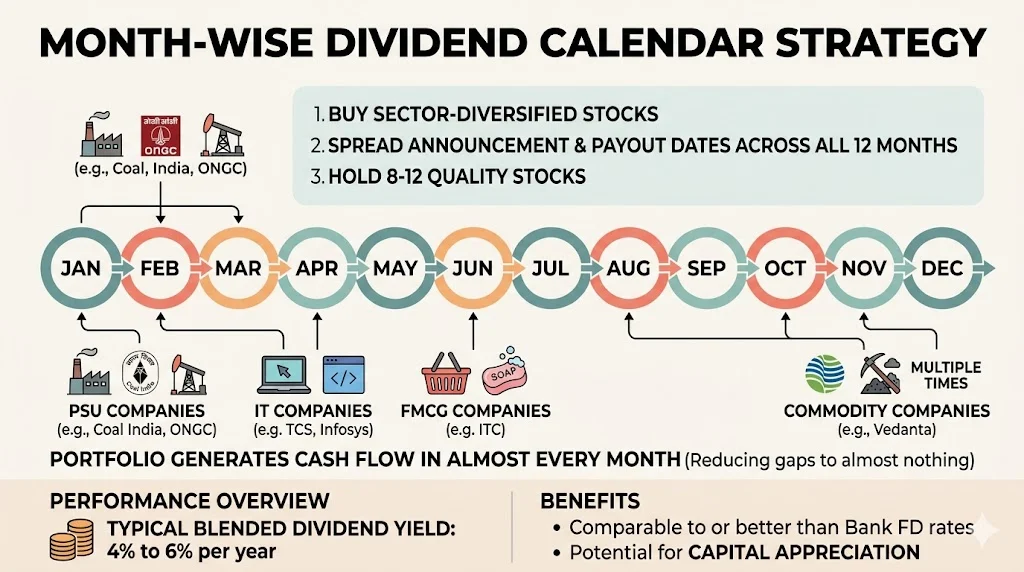
A dividend calendar strategy means you buy a mix of stocks from different sectors so that their dividend announcement and payout dates are spread across all 12 months of the year. Instead of holding one stock and waiting once or twice a year for income, you hold 8 to 12 quality stocks. Each pays at a different time. The result is a portfolio that generates cash flow in almost every month.
Here is why this works well in India. PSU companies like Coal India and ONGC typically pay dividends in February, August, and November. IT companies like TCS and Infosys pay around January and October. Commodity companies like Vedanta pay multiple times through the year. FMCG companies like ITC pay around February and May.
When you combine these across sectors, you end up with income arriving at different points in the year. With the right selection, you can reduce gaps to almost nothing.
The blended dividend yield of such a portfolio typically ranges from 4 to 6 percent per year. That is comparable to or better than bank fixed deposit rates, with the added benefit of potential capital appreciation over time.
How To Actually Build This Portfolio
Building a month-wise dividend portfolio requires you to think about three things at the same time. The first is yield. You want a blended portfolio yield of at least 4 to 5 percent. This means you do not just fill up on 1 percent yielders. Balance high-yield PSU and commodity stocks with moderate-yield FMCG and IT stocks.
The second is sector diversification. Do not put all your money into PSUs or all of it into commodity stocks. A reasonable allocation looks something like this. Put 25 to 30 percent in PSU commodity stocks like Coal India, Vedanta, and Hindustan Zinc for high yield.
Put 20 to 25 percent in PSU financing companies like PFC and REC. Put 15 to 20 percent in FMCG like ITC for defensive stability. Put 15 percent in IT like TCS for quarterly income and quality. Put 10 to 15 percent in regulated utilities like Power Grid for low-risk cash flow.
The third is dividend timing. Before buying any stock for dividend income, map out when it typically pays. You want coverage in as many months as possible without large gaps.
Realistic Income Expectations
Many social media posts claim you can earn Rs 20,000 per month from a Rs 25 to 30 lakh portfolio. The math rarely works out that cleanly.
A Rs 25 lakh portfolio with a blended yield of 5 percent generates approximately Rs 1,25,000 per year before tax. That is about Rs 10,400 per month on average. But dividends do not arrive in equal monthly amounts. Some months you get more, some months you get nothing.
After tax, assuming a 20 percent slab rate, your actual take-home is approximately Rs 1,00,000 per year or Rs 8,333 per month on average. This is meaningful supplemental income. It is not a salary replacement unless your corpus is Rs 1 crore or more.
Being realistic about this is important. Dividend income is a supplement to your other investments or income sources. It is not a standalone retirement plan unless you have built a very large corpus over many years.
Key Risks To Know Before You Start
Dividends Are Not Guaranteed
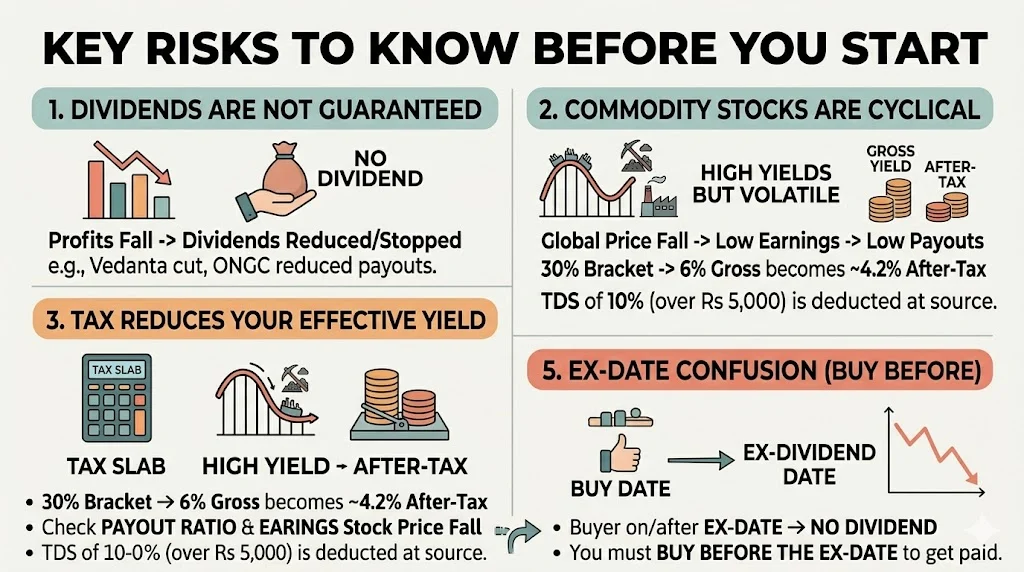
Companies can reduce or stop dividends at any time. This happens when profits fall. Vedanta cut dividends during a commodity downturn. ONGC reduced payouts during low oil price periods. Always check the company’s recent earnings trend before relying on its dividend.
Commodity Stocks Are Cyclical
Vedanta, Hindustan Zinc, and Coal India offer the highest yields but are also the most cyclical. When global metal or coal prices fall, these companies earn less and pay less. Do not build a portfolio that is 70 to 80 percent commodity stocks just because the yields look attractive.
Tax Reduces Your Effective Yield
Since 2020, dividends are taxed in your hands at your applicable income tax slab. If you are in the 30 percent bracket, a 6 percent gross yield becomes about 4.2 percent after tax. Always calculate the after-tax yield when comparing dividend stocks to fixed deposits or other income instruments. TDS of 10 percent is deducted at source if dividends from a single company exceed Rs 5,000 in a financial year.
High Yield Can Signal Risk
A stock that shows a 12 or 15 percent dividend yield is usually showing that number because the stock price has fallen sharply. This is called a dividend trap. The company may have paid high dividends in the past, but future dividends may not be sustainable at that level. Always cross-check the payout ratio and the company’s recent earnings growth before chasing unusually high yields.
Ex-Date Confusion
Some investors buy a stock on the ex-dividend date expecting to receive the dividend. This is wrong. On the ex-dividend date, the stock opens lower by roughly the dividend amount and the buyer does not receive that payment. You must buy before the ex-date.
How To Track Dividend Calendars In India
You do not need to manually track all announcements. Several reliable tools make this easy. The NSE and BSE corporate action sections publish every dividend announcement, including ex-date, record date, and payment date. These are updated in real time.
Screener.in and Trendlyne allow you to filter stocks by dividend yield, payout ratio, and dividend history. You can also view historical dividend payment timelines for each company.
Many broker apps like Zerodha, Groww, and Upstox now show upcoming corporate actions including dividend dates directly in the stock profile. Setting up alerts for your portfolio holdings ensures you never miss an ex-date.