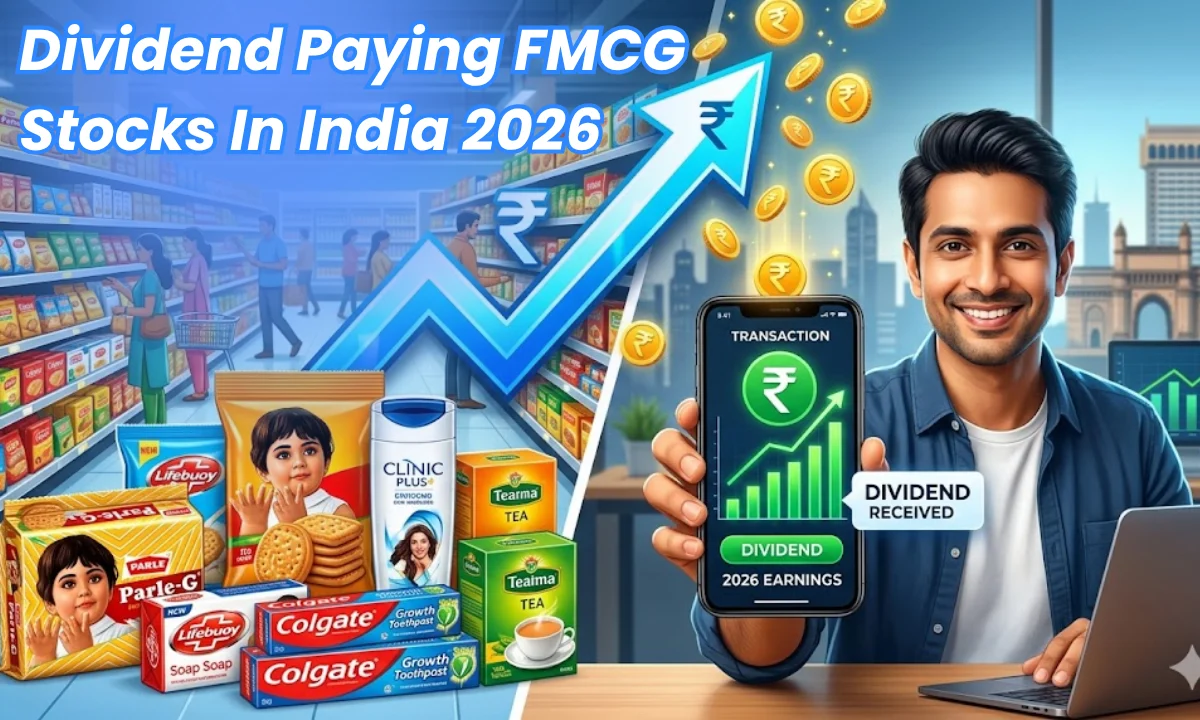
If you want to earn regular income from the stock market without taking big risks, dividend paying FMCG stocks in India are one of the most practical options available right now. These companies sell products that people buy every single day. Soap, biscuits, noodles, toothpaste, shampoo. None of these things go out of demand no matter what happens in the economy.
That is exactly why FMCG stocks are called defensive stocks. When the broader market falls, these companies continue generating revenue and profits. And because of their strong cash flows, they can share profits with investors through dividends regularly.
In 2026, the Nifty FMCG Index is trading around the 52,000 to 53,000 level. The sector has seen some correction over the past year. But for long-term dividend investors, this correction is actually a good thing. It means valuations are coming down and dividend yields are becoming more attractive compared to previous highs.
The Indian FMCG market itself is expected to reach around Rs 10.2 lakh crore by 2026, growing at a 9 to 11 percent CAGR. Rural India now contributes nearly 45 percent of total FMCG sales and is expected to drive the next wave of sector growth.
In this article, we will see 8 most reliable dividend paying FMCG stocks in India, understand what makes each one worth owning, and help you figure out whether these stocks fit your investment goals.
Table of Contents
8 Best Dividend Paying FMCG Stocks In India For 2026
1. ITC Ltd
Dividend Yield: Approximately 4.9%
ITC is the most talked about dividend stock in the Indian FMCG space right now. Founded in 1910, ITC started as a cigarettes company but has steadily built one of the most diversified consumer goods businesses in India. Today its FMCG brands include Aashirvaad atta, Sunfeast biscuits, Bingo chips, Savlon hand wash, Yippee noodles, and Classmate notebooks.
What makes ITC stand out as a dividend stock is its combination of high yield and strong financial health. The company is virtually debt-free. Its 3-year return on equity stands at around 28 percent. Its dividend payout ratio is approximately 78.6 percent, which is high but sustainable because ITC generates enormous cash from its cigarettes business. In FY25, ITC paid a total dividend of around Rs 13 to 14 per share.
ITC has a 5-year sales CAGR of around 8.9 percent and a profit CAGR of around 10.4 percent. These numbers are not explosive, but they are consistent. The company has also announced plans to invest Rs 20,000 crore in expanding its non-cigarette FMCG segment over the coming years.
A key development in 2025 was the demerger of ITC Hotels into a separately listed company. This makes ITC a more focused consumer goods and agri-business company. Many analysts believe this leaner structure will improve capital allocation and make the core FMCG business more efficient.
At a current market cap of around Rs 3.66 lakh crore and a PE of roughly 10 to 11 times, ITC also trades at a significant discount compared to most pure FMCG peers. HUL trades at a PE above 32 and Nestle trades above 69. This discount combined with a nearly 5 percent dividend yield makes ITC one of the most compelling passive income picks in this sector.
ITC holds around 80 percent market share in the organized domestic cigarette market. While regulatory pressure on tobacco is a risk to monitor, the company’s FMCG segment is scaling fast enough that dependence on cigarettes is slowly reducing year by year. For investors who want the highest dividend yield in the FMCG sector, ITC is the clear leader.
2. Hindustan Unilever Ltd (HUL)
Dividend Yield: Approximately 1.5% to 2.5%
HUL is India’s largest FMCG company by both market cap and revenue. Founded in 1933, it is a subsidiary of the global giant Unilever. The company has more than 50 trusted brands across 16 categories. Products like Dove, Lux, Lifebuoy, Surf Excel, Rin, Horlicks, Brooke Bond, and Knorr are found in nearly every Indian household.
HUL has a 5-year PAT CAGR of around 10.9 percent and a sales CAGR of 9.7 percent. The company is completely debt-free and maintains very high operating margins. In FY25, HUL paid a total dividend of around Rs 53 per share, which has grown steadily from Rs 42 per share in FY24. The company regularly pays both interim and final dividends each year.
One thing investors appreciate about HUL is its ability to pass on raw material cost increases to consumers without losing significant market share. This pricing power protects profit margins even when input costs rise. HUL has also been investing in premiumization, which means launching higher-priced, higher-margin products to capture the growing segment of urban consumers who are willing to spend more.
The yield on HUL appears moderate compared to ITC. But what HUL offers is reliability and quality. The stock has delivered consistent wealth creation over multiple decades. Investors who bought HUL 10 years ago and reinvested dividends have seen their wealth grow significantly.
In 2026, the stock has corrected from its 52-week high near Rs 2705, and at current levels around Rs 2065, the dividend yield has become more attractive than it was a year ago. HUL’s current market cap stands at approximately Rs 4.85 lakh crore, making it the largest company in the FMCG space by this measure. For investors who prioritize safety and consistency over high yield, HUL is the most trusted name.
3. Nestlé India
Dividend Yield: Approximately 1% to 1.5%
Nestlé India is the premium player in packaged food and beverages. Its products include Maggi noodles, Nescafé coffee, KitKat chocolate, Munch, Milkmaid, and KitKat. These are iconic brands that have been part of Indian homes for decades. In FY25, Nestlé India reported revenue of approximately Rs 20,202 crore and net profit of around Rs 3,314 crore. The company focuses on nutrition, health, and wellness, which positions it well to capture the growing consumer shift toward healthier and premium food choices.
Nestlé’s dividend yield is lower compared to ITC or Colgate. But the company compensates with very high earnings quality. Its margins are strong, its brand loyalty is exceptional, and it has maintained pricing power across all economic cycles. The stock has risen approximately 366 percent over the last decade.
Nestlé trades at a premium PE of above 69. This is expensive by most standards. But investors pay this premium because Nestlé has rarely disappointed on earnings. If you are looking for dividend income from a company that you want to hold for 15 to 20 years without worrying about, Nestlé fits that profile.
4. Britannia Industries
Dividend Yield: Approximately 1.3% to 1.8%
Britannia is the market leader in India’s biscuits segment. Brands like Good Day, Marie Gold, NutriChoice, and 50-50 are eaten by millions of Indians every single day. The company has also expanded into bread, cakes, dairy products, and croissants.
Britannia is known for paying very high absolute dividends per share. In FY24 it paid Rs 72 per share as a final dividend. The payout looks very large, but you need to evaluate it relative to the share price, which is currently above Rs 5,400.
The company’s current market cap is around Rs 1.31 lakh crore. Britannia has shown consistent revenue growth and strong brand recognition. It operates with relatively low debt and generates healthy cash flows from its biscuits business.
Rural distribution is one of Britannia’s key strengths. As rural incomes grow and spending on packaged food increases, Britannia is well-positioned to benefit. The management has also been investing in capacity expansion and new product categories to sustain long-term growth.
5. Colgate-Palmolive India
Dividend Yield: Approximately 2.5% to 2.8%
Colgate-Palmolive India is the dominant brand in the oral care segment. The company holds an estimated market share of over 50 percent in the toothpaste category. Products include Colgate Strong Teeth, Colgate Vedshakti, Colgate Sensitive, and Palmolive personal care items.
Colgate is known for exceptionally high payout ratios. The company has paid dividends consistently across all market conditions. In FY24, total dividends paid were around Rs 58 per share. The company is expanding into newer categories like mouthwash and teeth whitening products to sustain growth beyond its core toothpaste business.
What is attractive about Colgate from a dividend perspective is that the company generates strong cash flows with very low capital expenditure requirements. The business does not need massive investments in factories or equipment. This leaves a large chunk of profits available for shareholder distributions.
Its current market cap stands at around Rs 49,759 crore. The dividend yield at current prices is one of the better ones among FMCG companies, making Colgate a solid income-generating holding.
6. Dabur India
Dividend Yield: Approximately 1% to 2%
Dabur is one of India’s oldest FMCG companies. It focuses on natural, Ayurvedic, and healthcare-oriented products. Key brands include Dabur Chyawanprash, Dabur Honey, Real fruit juice, Hajmola, Vatika hair oil, and Dabur Red toothpaste.
Dabur has a strong rural presence. Around 50 percent of its domestic sales come from rural markets. As rural incomes improve and health awareness grows, Dabur’s product portfolio is well-aligned with these trends.
The company’s CEO has identified four major growth drivers: growing affluence in India, rural demand expansion, India’s demographic dividend, and technological advancements in distribution. Dabur’s natural and Ayurvedic positioning has also benefited from the post-pandemic shift toward health-focused products.
Dabur’s dividend yield is modest, but the company has maintained a consistent payout history for several years. At a current market cap of around Rs 74,007 crore and share price of around Rs 417, the stock has corrected significantly from its highs, which makes the yield more attractive now than it was in 2024.
7. Emami Ltd
Dividend Yield: Approximately 2% to 3%
Emami is a focused personal care company. Its product portfolio includes Boroplus antiseptic cream, Navratna hair oil, Fair and Handsome cream, Zandu Balm, and Kesh King hair care products. These are market-leading brands in their specific categories.
Emami has been showing an increasing dividend trend in recent years. The company’s market cap currently stands at around Rs 17,385 crore. The stock has corrected over 30 percent from its 52-week high, which has pushed the dividend yield higher to around 2 to 3 percent.
Emami’s business is seasonal in nature. Some of its products like Navratna Cool oil sell more in summer. But overall, the brand strength is solid and the company continues to generate consistent cash flows.
8. Godrej Consumer Products Ltd (GCPL)
Dividend Yield: Approximately 2% to 2.5%
Godrej Consumer Products is a personal care and home care company. Its main products include Godrej Expert hair colour, Cinthol soap, HIT mosquito repellent, Good Knight mosquito liquidator, and Ezee fabric conditioner. The company also has a significant international presence across Africa and Indonesia.
GCPL has a market cap of around Rs 1.01 lakh crore. The company pays steady dividends and has maintained a consistent payout policy over the years. Its personal care and home care focus makes it resilient because demand for these products does not fluctuate significantly.
Comparison Table: Dividend FMCG Stocks At A Glance
| Company | Approx. Dividend Yield | Market Cap (Approx.) | Payout Style | Stability |
|---|---|---|---|---|
| ITC Ltd | 4.9% | Rs 3.66 lakh cr | Annual + Interim | Very High |
| Hindustan Unilever | 1.5% to 2.5% | Rs 4.85 lakh cr | Interim + Final | Very High |
| Nestlé India | 1% to 1.5% | Rs 2.29 lakh cr | Annual | Extremely High |
| Britannia Industries | 1.3% to 1.8% | Rs 1.31 lakh cr | Annual | High |
| Colgate-Palmolive India | 2.5% to 2.8% | Rs 49,759 cr | Interim + Final | High |
| Dabur India | 1% to 2% | Rs 74,007 cr | Interim + Final | High |
| Emami Ltd | 2% to 3% | Rs 17,385 cr | Interim | Moderate-High |
| Godrej Consumer Products | 2% to 2.5% | Rs 1.01 lakh cr | Annual | High |
All figures above are approximate and based on data available as of early 2026. Dividend yields change as stock prices move up and down. Always check the latest figures before investing.
The table shows an important pattern. Companies with higher dividend yields like ITC tend to be more mature businesses with limited reinvestment needs. Companies with lower yields like Nestlé and HUL are reinvesting more into growth, which shows up in their stronger earnings compounding over time.
There is no single correct answer here. Your ideal pick depends on whether you want maximum income right now or a growing income stream over the next decade.
What Makes FMCG Stocks Good For Dividend Investing?
Before we look at specific companies, it helps to understand why FMCG stocks work well for dividend investing.
FMCG companies sell products in massive volumes every single day. This creates very predictable and stable revenue streams. Unlike cyclical sectors like metals, real estate, or infrastructure, FMCG businesses do not depend on economic booms to do well. People buy toothpaste and biscuits regardless of whether GDP growth is 5 percent or 8 percent.
This predictability means these companies can plan their cash flows well in advance. They know roughly how much money is coming in each quarter. And when a company knows its cash flow is stable, it becomes much easier to commit to regular dividend payouts. There are three numbers you should always check before investing in any dividend stock.
The first is Dividend Yield. This is the annual dividend divided by the current share price, shown as a percentage. A yield between 1.5 percent and 5 percent is generally considered healthy and sustainable in the FMCG sector. Anything much above 5 percent should make you pause and check whether the stock price has fallen sharply for some negative reason.
The second is Payout Ratio. This is the percentage of net profit that a company pays out as dividends. A payout ratio between 30 percent and 80 percent is usually a comfortable range. It shows the company is generous with shareholders but still reinvesting enough money to keep growing the business. If the payout ratio goes above 100 percent, the company is paying more than it earns, which is not sustainable for long.
The third is Dividend History. A company that has paid dividends consistently for 10 or more years is far more reliable than one that paid dividends only twice. Track record matters a lot here. Now let us look at the 8 companies that meet these criteria in the FMCG space.
Key Trends Shaping FMCG Dividends In 2026
Rural Recovery Is Picking Up
Rural India contributes close to 45 percent of all FMCG sales. After a period of demand slowdown in 2024 and early 2025, rural spending is showing signs of recovery. Biscuits, noodles, and packaged food categories are seeing improved volume growth. This is good news for companies like Britannia, Dabur, and ITC.
Premiumization Is Boosting Margins
Urban consumers are shifting toward higher-priced, better-quality versions of everyday products. HUL, Nestlé, and Colgate are benefiting significantly from this trend. Higher-margin premium products improve profitability, which in turn supports stronger dividend payouts.
GST Reductions Are Helping Consumers
The government has reduced GST rates on several household products from 12 to 18 percent to 5 percent. This makes everyday products more affordable, which encourages higher consumption volumes. Higher volumes benefit FMCG companies even if per-unit margins stay the same.
Sector Correction Has Created Entry Opportunities
The FMCG sector saw significant price correction in 2024 and 2025. Many stocks are now trading 15 to 30 percent below their 52-week highs. For dividend investors, this is actually a positive development. Lower stock prices mean higher dividend yields on the same rupee amount of dividend payment.
Quick Commerce Is Opening New Sales Channels
Apps like Swiggy Instamart, Zepto, and Blinkit are now significant distribution channels for FMCG products. Companies that adapt to quick commerce are reaching urban consumers faster and more efficiently. This adds a new revenue layer on top of traditional retail distribution.
How Dividends Are Taxed In India: What You Must Know
Since 2020, the Dividend Distribution Tax at the company level has been abolished. This means dividends are now taxed directly in the hands of investors, based on their income tax slab.
If you are in the 30 percent tax bracket, your dividend income will be taxed at 30 percent. This significantly reduces the effective yield you receive. For example, if ITC pays a 4.9 percent gross yield and you are in the 30 percent bracket, your actual after-tax yield comes to approximately 3.4 percent.
For NRI investors, Tax Deducted at Source applies. The rate can sometimes be reduced based on Double Taxation Avoidance Agreements between India and the investor’s country of residence.
This is why high-yield FMCG stocks like ITC are especially popular among investors in lower tax brackets, such as retirees who have little other income.
Always calculate your after-tax yield before comparing dividend stocks. The gross yield number printed on screener websites does not reflect what actually lands in your bank account.
What To Check Before Buying Any FMCG Dividend Stock
Check At Least 5 to 10 Years Of Dividend History
A company that paid dividends once or twice in the last decade is not reliable. Look for companies that have paid dividends consistently across bull markets and downturns. ITC, HUL, and Nestlé all qualify on this front.
Check Whether Dividends Are Funded From Operating Cash Flow
Some companies pay dividends by selling assets or by taking on new debt. This is not sustainable. The best dividend stocks fund their payouts entirely from their day-to-day business operations. For FMCG companies, this is generally not a concern, but it is still worth verifying.
Avoid Dividend Traps
A dividend trap occurs when a stock’s yield appears very high only because its price has fallen sharply due to fundamental problems in the business. Before chasing a high yield, check whether profits are stable, whether the payout ratio is reasonable, and whether management has given any guidance about future dividend continuity.
Look At Payout Ratio Trends
If a company’s payout ratio has been rising sharply each year while profit growth has been slow, that is a warning sign. It may mean the company is struggling to grow earnings and is distributing more of what it already earns just to keep investors happy.
Balance Dividend Yield With Growth Potential
A stock that pays a 1.5 percent yield but grows earnings at 12 percent per year will likely give you a better total return over 10 years than a stock that pays a 5 percent yield but grows earnings at only 3 percent. Think about total return, not just current income.
Risks You Should Know Before Investing
Raw Material Cost Volatility
FMCG companies use commodities like palm oil, wheat, sugar, crude oil derivatives, and packaging materials. When these input costs rise sharply, margins come under pressure. Companies with strong brand power can pass on cost increases through price hikes, but those with weaker brands may be unable to do so and will see profits shrink.
Slow Volume Growth
In recent quarters, some FMCG companies have been growing revenue mainly through price increases rather than actual volume growth. Volume growth is a healthier sign for long-term business health. Investors should watch volume growth numbers in quarterly results carefully.
High Valuations
Most FMCG companies trade at premium valuations. Nestle trades above 69 times earnings. Britannia trades above 53 times earnings. Even with sector corrections, these are expensive stocks. High PE ratios limit near-term price appreciation potential.
Competition From Regional And D2C Brands
New-age direct-to-consumer brands and regional FMCG companies are eating into market share in several categories. Dabur faces competition from Patanjali in the Ayurvedic space. HUL faces competition from local personal care brands in smaller towns. This is an ongoing risk to monitor.
Regulatory Changes On Tobacco
For ITC specifically, any significant increase in cigarette taxes or regulatory restrictions on tobacco products could impact its primary cash-generating segment. This would directly affect its ability to maintain high dividend payouts.