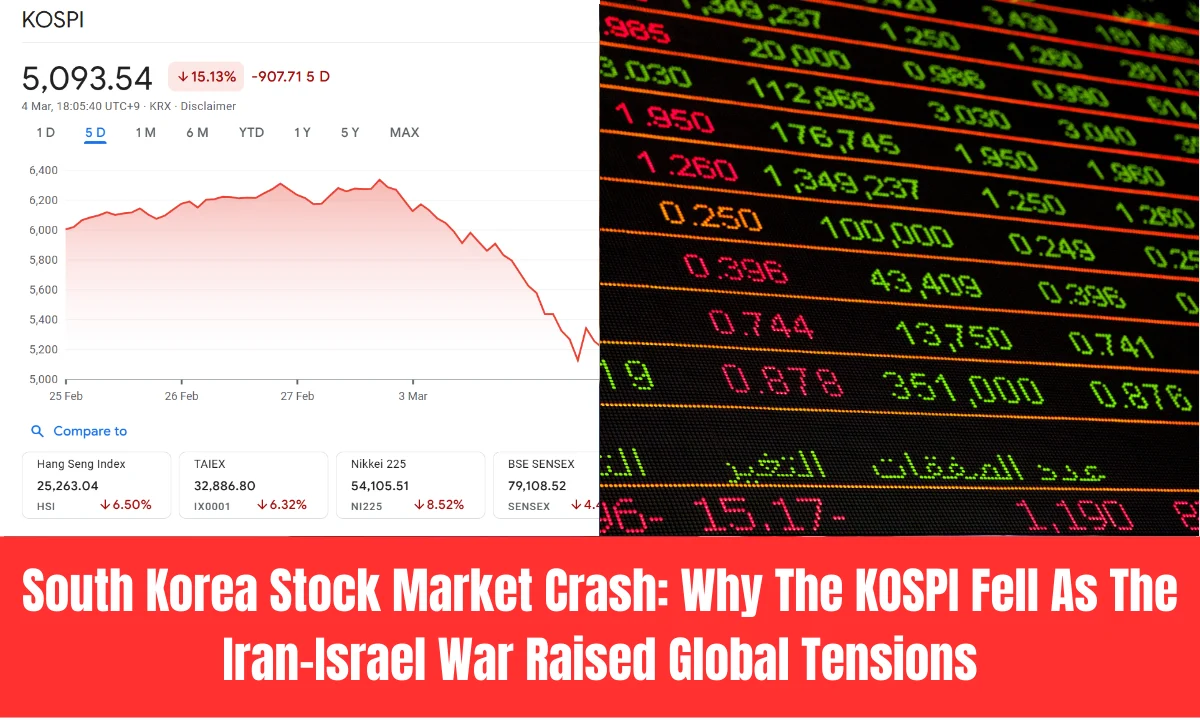
The South Korea stock market shocked global investors in early March 2026. Just weeks ago the KOSPI index was one of the best performing markets in the world. It crossed the historic 6,000 level and many analysts were calling it the strongest AI-driven rally in Asia. But suddenly the situation changed. The South Korea stock market crash wiped out a huge portion of gains in just a few trading sessions.
The main reasons include geopolitical tensions, rising oil prices and heavy selling by foreign investors. The KOSPI index dropped more than 12 percent in a single day. This became one of the worst declines in decades and triggered circuit breakers across the market. Retail investors who were celebrating the rally just weeks ago are now facing sharp losses.
Key Takeaways:
- The KOSPI index crashed over 12 percent in a single day marking its worst fall in decades.
- South Korea stock market had previously gained more than 75% in 2025.
- The rally was mainly driven by AI related semiconductor demand.
- Rising geopolitical tensions in the Middle East triggered panic selling.
- Circuit breakers were activated to pause trading temporarily.
- Retail investors and foreign institutions both contributed to the heavy volatility.
- Despite the crash some analysts see it as a correction after a massive rally.
What Is The South Korea Stock Market And The KOSPI Index
The South Korea stock market is mainly tracked through the KOSPI index. KOSPI stands for Korea Composite Stock Price Index. It represents the performance of the largest companies listed on the Korea Exchange.
Many global investors follow this index closely because South Korea plays a major role in the semiconductor industry and global manufacturing supply chains. Some of the biggest companies inside the index include:
- Samsung Electronics
- SK Hynix
- Hyundai Motor
- LG Energy Solution
These companies are important for sectors like memory chips, electric vehicles, batteries and consumer electronics. Because of this, the South Korea stock market often reacts strongly to global technology demand.
The KOSPI index is also heavily concentrated in semiconductor stocks. Samsung and SK Hynix alone represent a large portion of the index weight. When chip stocks rise the entire index moves higher. When they fall the market can drop quickly.
The Massive Bull Run Before The Crash
Before the sudden crash the South Korea stock market was on an incredible rally. In fact many analysts called it the hottest major market in the world during 2025. The growth numbers were huge.
| Year | Market Performance |
|---|---|
| 2025 | KOSPI gained around 76 percent |
| Early 2026 | Index rose around 44 to 50 percent |
| 12 Month Return | Nearly 130 percent growth |
The index also crossed the historic 6,000 level which was once considered almost impossible. Several factors pushed the market higher.
First was the global AI boom. Data centers and artificial intelligence systems require huge amounts of memory chips. South Korea is the global leader in this industry.
Second was corporate governance reforms introduced by the government. These reforms aimed to improve transparency and reduce what investors often call the Korea discount.
Third was strong participation from retail investors. Many individuals in Korea started trading stocks actively. Online trading accounts increased rapidly and stock education content became viral on social platforms. Because of these factors the market entered a phase of strong optimism.
Why The South Korea Stock Market Suddenly Crashed
The sudden crash of the South Korea stock market did not happen without warning. Several global factors combined together and triggered the sharp fall.
1) Geopolitical Conflict And Oil Supply Fears
One of the biggest reasons behind the crash was rising geopolitical tension involving Iran. The conflict created fears that global oil supplies could be disrupted.
South Korea depends heavily on imported energy. If oil prices rise sharply it increases costs for manufacturers and technology companies. Investors quickly start pricing in those risks.
As oil prices jumped traders began selling export heavy stocks. Semiconductor and manufacturing companies were hit the hardest.
2) Foreign Investor Profit Taking
Another major reason was profit booking by foreign investors. The market had already doubled in a year.
Large institutional investors started locking in profits after the massive rally. When foreign funds begin selling large positions the effect on the market becomes very strong. This wave of selling pushed the KOSPI index sharply lower.
3) High Retail Leverage
Retail traders also played a role in the decline. During the rally many investors used margin trading to increase their positions.
When prices started falling margin calls forced traders to sell their holdings quickly. This created a chain reaction and increased the downward pressure. The combination of these three factors created one of the most dramatic market corrections in recent years.
Circuit Breakers And Emergency Market Measures
When markets fall too quickly exchanges sometimes activate circuit breakers. These are safety mechanisms that temporarily stop trading.
The Korea Exchange triggered circuit breakers after the KOSPI dropped around 8 percent in early trading. Trading was paused for about 20 minutes. The goal was to slow down panic selling and give investors time to reassess the situation.
However even after trading resumed the selling pressure continued. By the end of the day the index had dropped more than 12 percent. This made it one of the worst trading days for the South Korea stock market in nearly five decades.
Impact On Major Korean Companies
The crash also affected several large companies listed on the KOSPI index. Here is a quick overview of the impact.
| Company | Approximate Stock Drop |
|---|---|
| Samsung Electronics | around 10 to 12 percent |
| SK Hynix | around 10 percent |
| Hyundai Motor | significant decline |
| Semiconductor sector | heavy selling |
Since semiconductor companies dominate the index their decline accelerated the broader market fall. Even strong companies were sold off as investors rushed to reduce risk exposure.
Public Opinion On The South Korea Stock Market Crash
Public discussions on X show how quickly sentiment has changed. Just weeks ago investors were celebrating the massive gains in the KOSPI. Now many traders are expressing shock and concern.
Some posts described the situation as a Black Wednesday for Asian markets. Many users pointed out that the KOSPI fell more than 12 percent in a single day which reminded them of past financial crises.
Others warned that heavy leverage among retail traders made the market more fragile. However not everyone sees the drop as a disaster. Some investors believe this correction was expected after such a strong rally.
Many users also highlighted an important point. Even after the crash the market is still up significantly compared to last year. This shows that long term trends may still remain intact despite short term volatility.
Is This A Temporary Correction Or A Bigger Problem?
Market experts are currently divided on what will happen next. Some analysts believe the crash is simply a correction after an unsustainable rally. Markets often move in cycles and strong gains are usually followed by pullbacks.
Others warn that geopolitical risks and energy prices could keep volatility high for some time. However the long term story of the South Korea stock market is still closely linked with technology demand.
Artificial intelligence infrastructure requires massive semiconductor production. South Korean companies remain key suppliers in this global supply chain.
If AI demand continues growing the semiconductor sector could eventually support another recovery phase. For now investors are watching global developments closely. Oil prices, geopolitical tensions and foreign investment flows will likely determine the next direction of the market.