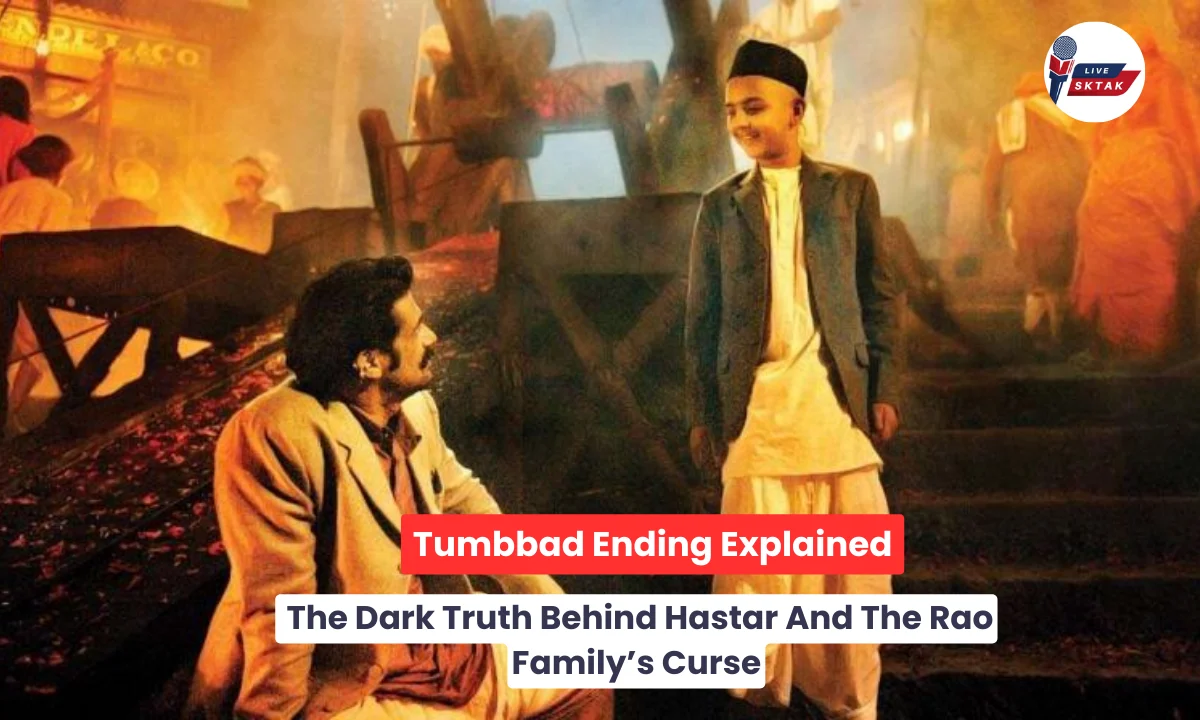
If you just finished watching Tumbbad and sat there in silence thinking “yeh maine kya dekh liya,” you are not alone. The ending of Tumbbad is haunting, emotional, and layered with symbolism that stays in your head long after the credits roll. This is not your typical horror film. It is a slow burn story about greed, generational trauma, and the price of obsession.
In this blog we will break down the full story of the Tumbbad as well as explain the ending, the mythology of Hastar, the final sacrifice, and what the ending really means. We will also look at public reactions from X and why this film has achieved cult status years after its release.
Key Takeaways
- Tumbbad is set across three timelines 1918, 1933 and 1947
- Hastar is a cursed god who represents endless greed
- Vinayak becomes wealthy by stealing gold coins from Hastar’s womb
- Multiple Hastar clones in the climax symbolize multiplying greed
- Vinayak sacrifices himself to save his son Pandurang
- Pandurang breaks the cycle by rejecting the gold and burning his father
- The ending represents freedom from generational greed
- The film gained cult status after re releases and strong word of mouth
The Mythology Of Hastar Explained
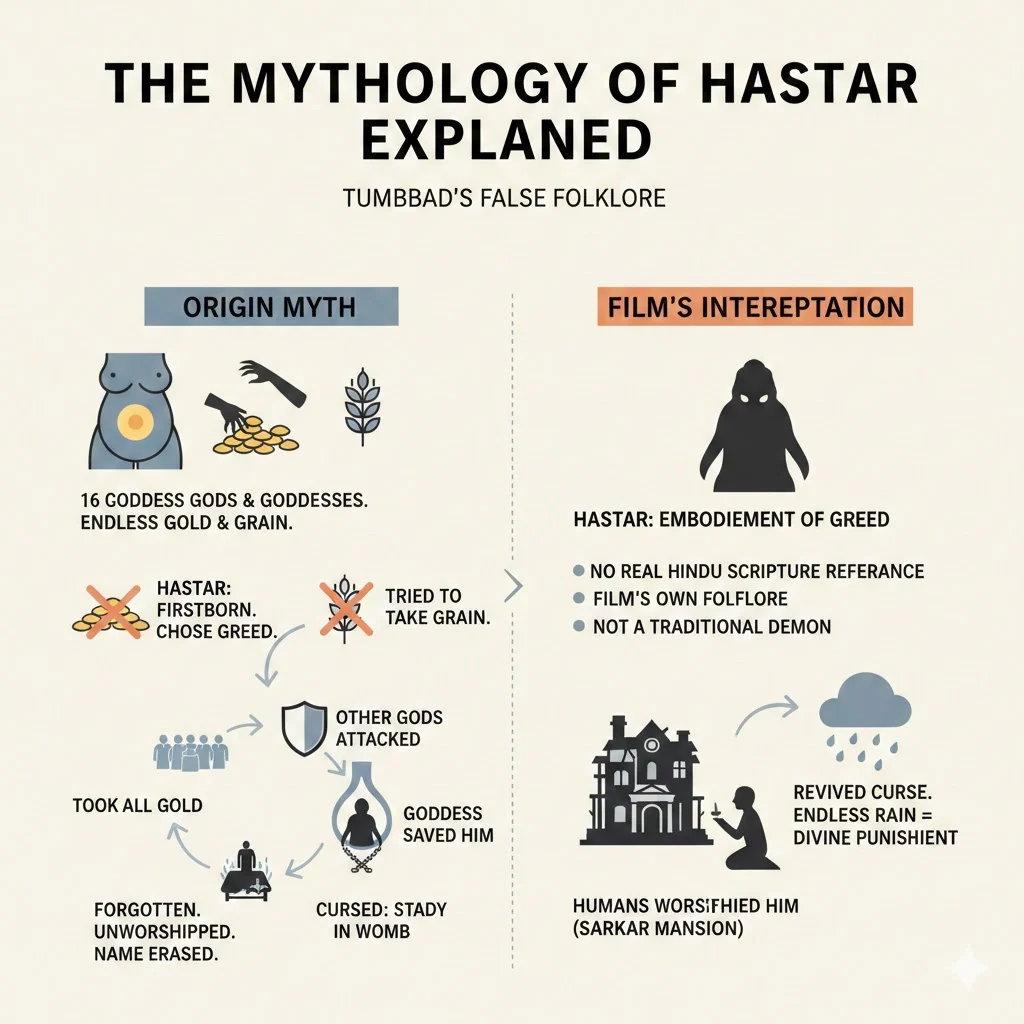
At the heart of Tumbbad is the terrifying figure of Hastar. According to the film’s myth, Hastar was the firstborn of the Goddess of Prosperity. She created 16 crore gods and goddesses. Her womb symbolized the Earth and contained endless gold and grain.
Hastar chose greed. He took all the gold. He then tried to take the grain which represents food and survival. The other gods attacked him. The Goddess saved him but cursed him to remain in her womb forever. He could never be worshipped. His name was erased.
Interestingly, there is no real reference to Hastar in Hindu scriptures. The film creates its own folklore which makes it even more unsettling. He is not a traditional demon. He is the embodiment of greed.
The moment humans in Tumbbad started worshipping him inside the Sarkar mansion, they revived his curse. The endless rain in the village becomes a symbol of divine punishment.
Full Story Breakdown Across Three Timelines
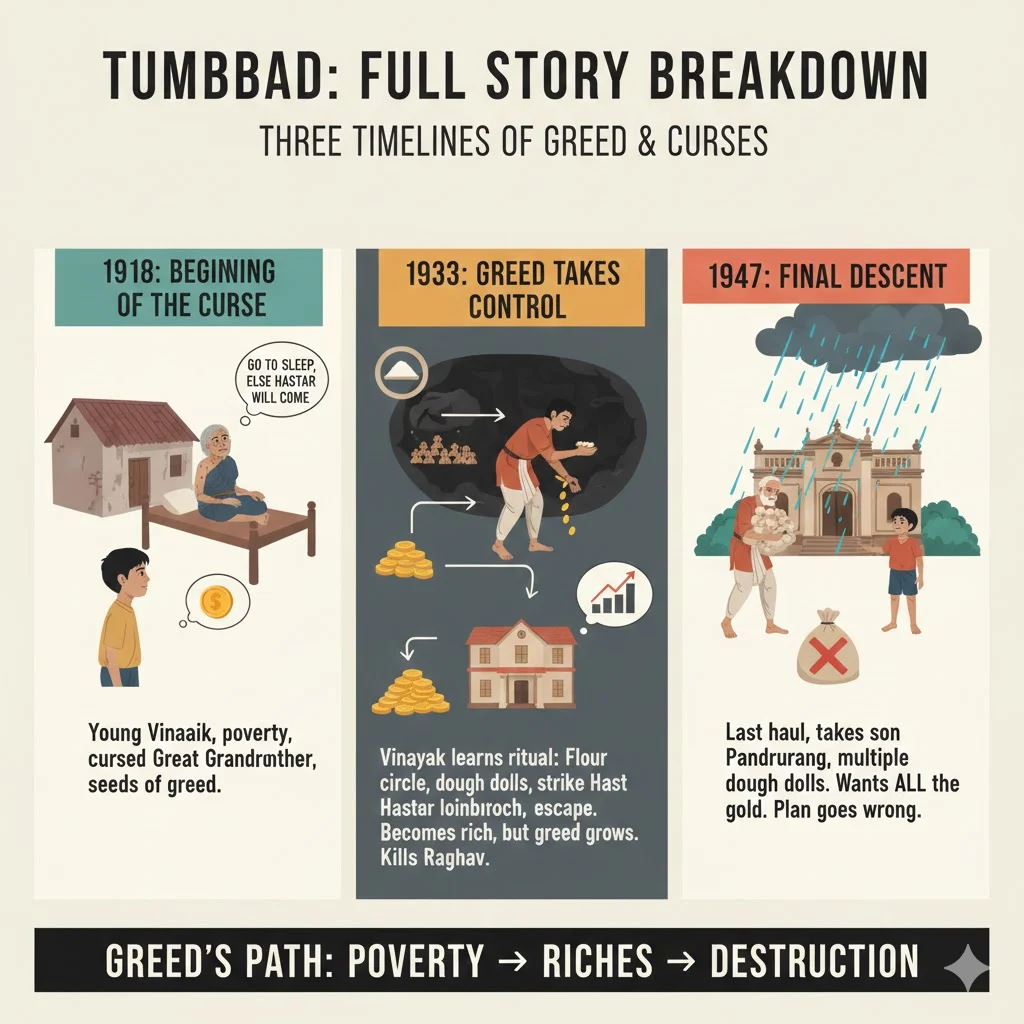
1918: The Beginning Of The Curse
Young Vinayak lives in poverty in the village of Tumbbad in Maharashtra. His mother works in the mansion of Sarkar. She also feeds a cursed great grandmother who once tried to steal Hastar’s treasure. The old woman is immortal but decaying. She must be fed daily.
The famous line “Go to sleep, else Hastar will come” is used to control cursed beings.
After tragedy strikes and Vinayak’s mother dies, he leaves the village. But greed has already entered his mind.
1933: Greed Takes Control
Adult Vinayak returns to Tumbbad. He learns the ritual to extract gold from Hastar.
Here is the procedure he follows:
- Create a protective circle using flour
- Enter the womb like underground chamber
- Offer flour dough dolls to distract Hastar
- Hit Hastar’s loincloth to release gold coins
- Escape before Hastar finishes eating
He does this repeatedly. He becomes rich. He moves to Pune. But his hunger grows. Money is never enough.
He even kills Raghav who tries to steal the treasure without knowing the rules. This shows how greed turns Vinayak into something almost monstrous.
1947: The Final Descent
India becomes independent. The mansion is about to be taken over by the government. Vinayak wants one final haul. Not just coins. He wants the entire loincloth full of gold.
He takes his son Pandurang with him. They carry multiple dough dolls to distract Hastar for longer.
But this is where things go wrong.
Why Multiple Hastar Clones Appear
Inside the womb chamber, something shocking happens. For every dough doll, a new Hastar appears. Instead of one demon, there are many.
This is not random horror. It is symbolism.
Greed multiplies.
The more you try to outsmart greed, the more it consumes you. Each doll represents desire. Each Hastar represents consequence.
They get trapped inside a small flour circle. Death feels certain.
The Ending Explained In Detail
In the climax, Vinayak ties all the dough dolls to his own body. He becomes the ultimate distraction. All the Hastars chase him. Pandurang manages to escape with the loincloth full of gold.
But one Hastar touches Vinayak. He becomes cursed. His body starts transforming. He is eternally hungry like the great grandmother before him.
Outside the well, Vinayak offers the gold to his son. This is the most powerful moment.
Pandurang refuses. He understands the curse. He sees what greed has done to his father. He chants “Go to sleep, else Hastar will come” and sets his father on fire to end his suffering.
This act breaks the generational curse. Pandurang walks away from Tumbbad. For the first time, someone chooses life over gold.
Symbolism And Deeper Meaning
Tumbbad is not just about horror. It is about:
- Generational greed
- Post independence transition
- Moral decay
- Obsession with wealth
The year 1947 is important. India gains freedom from colonial rule. At the same time, Pandurang gains freedom from inherited greed. It is subtle but powerful.
The womb chamber represents the Earth. Humans keep digging into it for resources. Gold becomes a metaphor for exploitation. The rain never stops in Tumbbad. It feels like nature itself is grieving.
Public Opinion And Re Release Buzz On X
When Tumbbad was re released in 2024, discussions exploded on X. Many users called it one of India’s best horror films ever made.
Some popular sentiments included:
- People praising its re watch value
- Comparisons of Vinayak’s repeated returns to the film’s box office comeback
- Fans calling the ending emotional and heartbreaking
- Appreciation for no cheap jump scares
Many users described it as a masterpiece that avoids typical Bollywood tropes. The atmosphere, cinematography and slow pacing received massive appreciation.
The term “Tumbbadception” even trended among some fans. They compared the film’s comeback to Vinayak’s inability to stay away from Tumbbad.
Key Characters And Their Arc
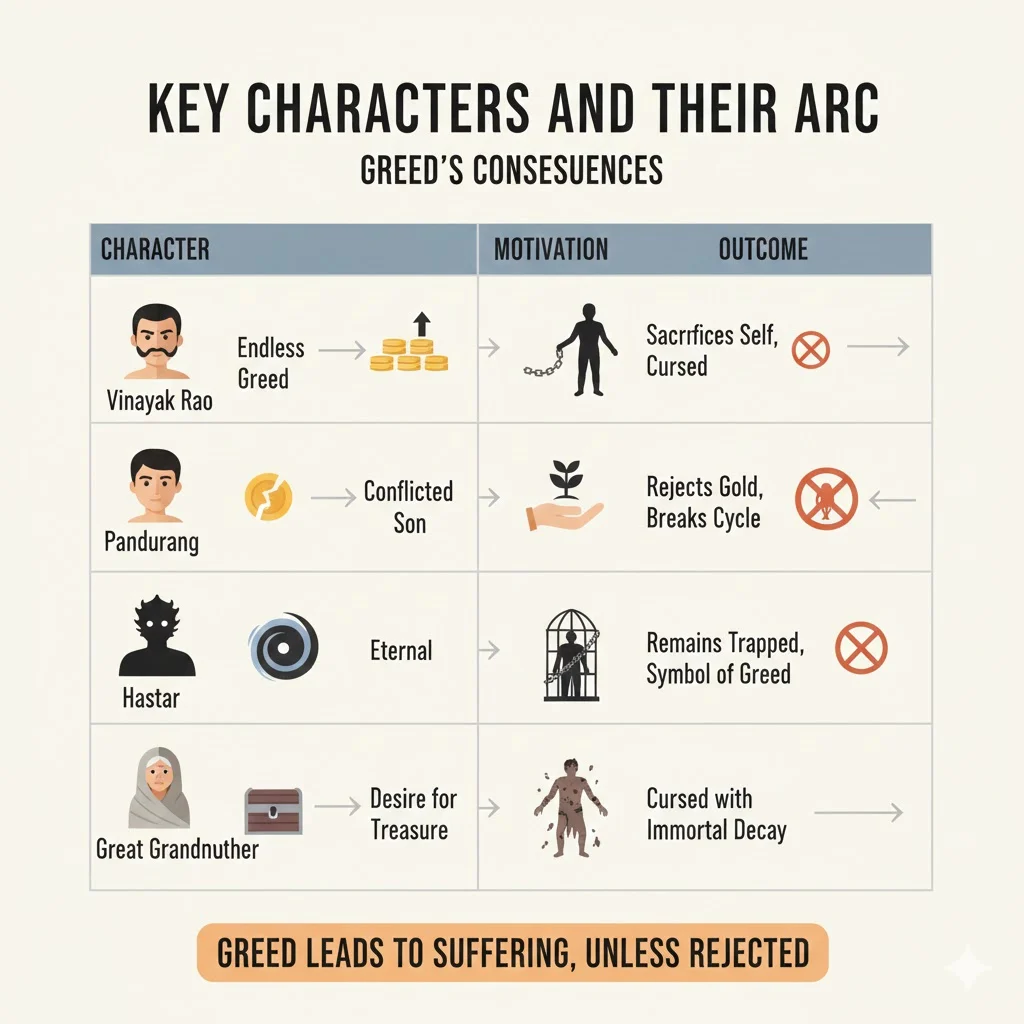
| Character | Motivation | Outcome |
|---|---|---|
| Vinayak Rao | Endless greed | Sacrifices himself, becomes cursed |
| Pandurang | Conflicted son | Rejects gold, breaks the cycle |
| Hastar | Eternal hunger | Remains trapped, symbol of greed |
| Great Grandmother | Desire for treasure | Cursed with immortal decay |
This table clearly shows that greed always ends in suffering except when someone consciously rejects it.
Did Hastar Die In The End
No. Hastar does not die. He remains inside the womb. As long as greed exists in human hearts, Hastar exists. That is the real horror.
The film does not end with victory over a monster. It ends with victory over temptation.
Why Tumbbad Is Considered A Cult Classic
Directed by Rahi Anil Barve along with Anand Gandhi and Adesh Prasad, Tumbbad stands apart because:
- It builds original Indian folklore
- It uses horror as metaphor
- It focuses on atmosphere over jump scares
- It delivers a morally complex ending
The film premiered at international festivals and slowly gained recognition. Over time, word of mouth made it iconic.
Even years later, new viewers keep discovering it on streaming platforms and sharing ending explanations online.
Final Thoughts
Tumbbad is a story where the real monster is not Hastar. It is greed.
Vinayak spends his entire life chasing gold. In the end, he realizes too late that wealth without morality destroys families. His final sacrifice redeems him slightly. But the true hero is Pandurang.
He chooses to walk away. That single decision changes everything.
And that is why the ending of Tumbbad feels so powerful. It is not about defeating a demon. It is about defeating the darkness within.