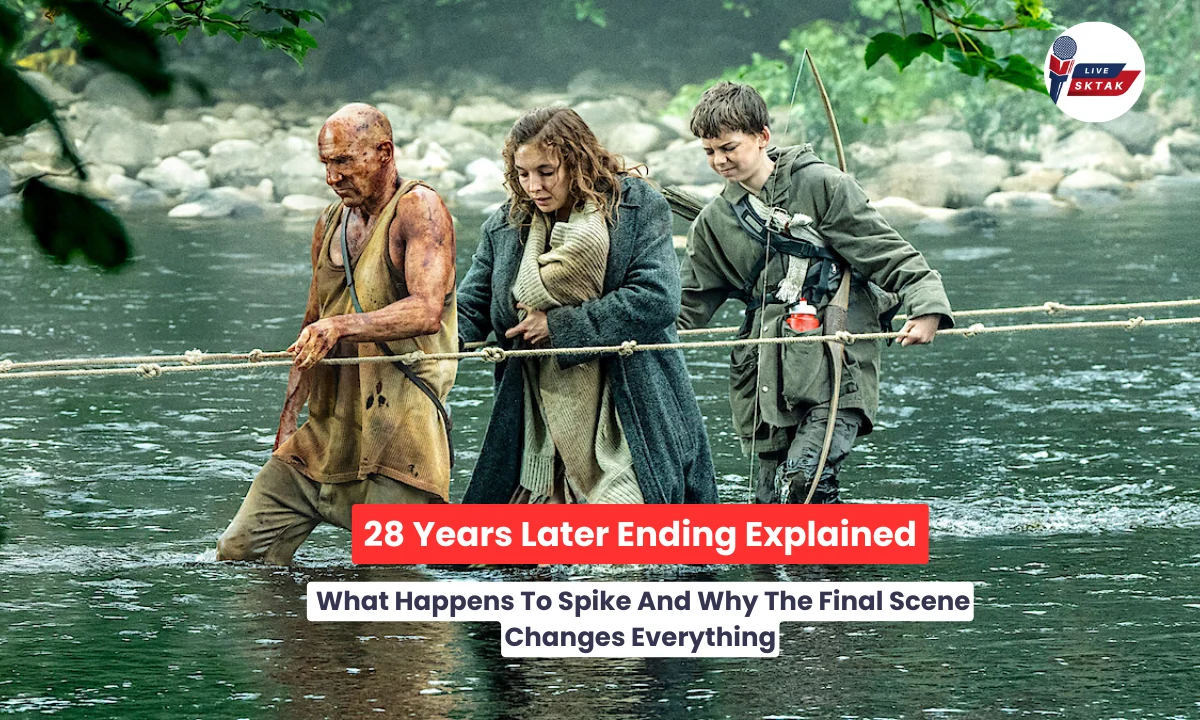
28 Years Later ending explained searches have surged since the film’s release, mainly because the final ten minutes completely reframe the story viewers thought they were watching. What begins as a grounded survival and coming-of-age narrative ends with a sharp tonal shift that introduces new threats, new factions, and a much darker future for Spike. The film does not just close one chapter of the franchise, it deliberately opens several uncomfortable questions.
At its core, 28 Years Later is not about infected monsters or jump scares. It is about grief, growing up too early, and what survival does to morality after decades of isolation. Spike’s journey forces him to confront death, betrayal, and responsibility long before adulthood should begin. The ending tests whether hope can survive in a world that keeps reinventing its own forms of violence.
Key Takeaways
- Spike completes his emotional journey but chooses isolation over safety
- Isla’s death is the emotional center of the film, not the final twist
- Sir Jimmy Crystal is revealed as a long-foreshadowed cult leader
- The ending intentionally shifts tone to set up future sequels
- Public reaction is sharply divided between admiration and discomfort
The Full Meaning Behind The Ending Of 28 Years Later
Spike’s Journey From Childhood To Choice
Spike’s story is structured as a slow loss of innocence. Early in the film, he is still tethered to childhood habits and expectations. His father Jamie believes survival is about toughness and ritual. His mother Isla represents vulnerability and emotional truth. Spike is pulled between these two ideas of adulthood.
The moment he leaves Holy Island is not an act of rebellion alone. It is a decision driven by love and fear. He wants answers. He wants his mother to live. By the time he reaches the mainland, Spike is no longer being protected by stories or traditions. Every choice has a consequence, and the film does not soften that reality.
By the end, Spike has learned how to kill, how to survive, and how to accept death. What he has not learned is how to trust the future.
Isla’s Death And The Bone Temple Explained
Isla’s illness is intentionally vague for much of the film. The ambiguity allows viewers to hope alongside Spike. When Dr. Ian Kelson finally names it as terminal cancer, the story shifts from survival to acceptance.
Kelson’s Bone Temple is not presented as madness alone. It is his way of imposing meaning on endless death. He believes remembrance is the last form of dignity left in the world. Isla’s decision to accept euthanasia is portrayed as calm, consensual, and deeply personal. There is no miracle cure. There is no last-minute escape.
This moment grounds the film emotionally. Isla’s death is not meant to shock. It is meant to close a chapter of Spike’s dependence. When Spike places her skull on the monument, he is acknowledging that love does not require denial.
Why Spike Leaves The Island Again
After returning the uninfected baby to Holy Island, Spike could have stayed. The island represents structure, familiarity, and protection. His father is flawed, but the community survives.
Spike chooses to leave anyway.
This decision matters more than the later action sequence. Spike has outgrown the island’s moral simplicity. He has seen mercy, cruelty, and ambiguity coexist. Staying would mean pretending those lessons never happened. Leaving is not bravery. It is honesty.
Spike’s note to his father is not an accusation. It is a boundary. He is choosing his own path without fully rejecting his past.
The Sir Jimmy Crystal Reveal Explained
The most debated moment in the film arrives abruptly. Spike is overwhelmed by infected, only to be saved by a group of identical, tracksuit-clad fighters led by Sir Jimmy Crystal.
Jimmy is not a random addition. His presence is foreshadowed throughout the film through graffiti, rumors, and the prologue. He is the child who survived the original outbreak after witnessing religious delusion and mass death. His adulthood is shaped by spectacle, control, and performance.
Sir Jimmy Crystal represents a new kind of survivor faction. Not isolated. Not defensive. Aggressively ideological.
What Sir Jimmy Crystal Symbolizes
| Element | Meaning |
|---|---|
| Matching outfits | Loss of individual identity |
| Inverted crosses | Rejection of traditional morality |
| Performative violence | Survival as spectacle |
| Cult structure | Power through belonging |
Jimmy’s group does not simply kill infected. They enjoy it. This is where the tonal shift unsettles many viewers. The film moves from quiet grief to chaotic energy within minutes.
Why The Tonal Shift Is Intentional
Many reactions focus on how sudden the ending feels. This is not accidental. The film spends most of its runtime teaching the audience how to sit with loss and silence. The final scene breaks that rhythm to show what comes next.
The world is no longer divided into safe and unsafe places. It is divided into belief systems.
Spike standing among the Jimmys is not a triumph. It is a warning. Survival alone does not prevent extremism. It can nurture it.
What Happens To Spike After The Ending?
The film deliberately avoids answering this fully. Spike is alive. He is accepted by the group. That is all we are meant to know.
What makes this unsettling is Spike’s emotional state. He is grieving, isolated, and searching for purpose. These are conditions where charismatic leaders thrive. The ending asks whether Spike will resist becoming part of something darker, or whether survival will demand compromise.
This question is left open for future films.
Public Opinion On The Ending From X
Public reaction to the 28 Years Later ending explained debate is sharply split. Many viewers praise the boldness of the final scene, calling it exciting and fearless. The punk-inspired energy resonates with audiences who see it as a return to British counter-culture storytelling.
Others find the shift disruptive. Some felt the emotional weight of Isla’s death deserved a quieter resolution. A portion of viewers dislike cliffhanger endings and question whether the sequel setup undermines the film’s intimacy.
What most opinions agree on is this: the ending is memorable. Whether loved or criticized, it sparked discussion across social platforms, Reddit threads, and video essays. That level of engagement suggests the film succeeded in refusing to be forgettable.
How The Ending Sets Up The Future Of The Franchise
The final scene positions the trilogy to explore moral extremes. The first story focused on family. The next explores ideology and power. Spike’s arc becomes a bridge between compassion and cruelty.
Rather than promising answers, the ending promises conflict. Human factions. Competing philosophies. Survival without innocence.
This direction aligns with the franchise’s long-standing idea that the greatest danger is not the virus, but what people build in its aftermath.
Tags: 28 Years Later ending explained, What happens to Spike, Sir Jimmy Crystal explained, 28 Years Later plot analysis, Bone Temple meaning, Rage Virus sequel, post apocalyptic films